The probe took seven years to reach Saturn. Since then, the robot spacecraft has been delivering stunning photographs of the ringed planet and its fantastic family of moons. “The launch was the start of one of space exploration’s great adventures and we didn’t really know what we would find,” said Professor Andrew Coates, of University College London, who heads one of the UK teams involved in Cassini. “Now we are reaping the rewards of nearly 20 years’ work on the mission and the science continues to be amazing.”
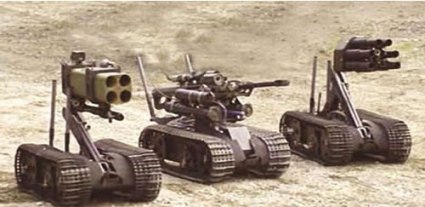
MAARS features new software controls, which allow the robot’s driver to select fire and no-fire zones. The idea is keep the robots from accidentally shooting a flesh-and-blood American. A mechanical range fan also keeps MAARS’ gun pointed away from friendly positions.
The robot is also equipped with a GPS transmitter, so it can be seen on — and tap into — the American battlefield mapping programs, just like tanks and Humvees. These “Blue Force Trackers” have been credited with dramatically reducing friendly-fire incidents during the Iraq war. MAARS comes with an extra fail-safe, which won’t allow it to fire directly at its own control unit.
Last Summer, the U.S. Army sent three armed Talon IIIB robots, also know as SWORDS (Special Weapons Observation Reconnaissance Detecting System) to Iraq, where they were handed over to the 3rd Brigade of the 3rd Infantry Division for “more realistic” testing. Apparently the tests went well – the commander of the 3rd Brigade has asked for twenty more. The army already has 80 more on order.
The [robots] will be used as a 125 pound armed sentry, not a combat droid. Or so the official announcement went. So far, the tests appear to have been successful. Swords can also be armed with a 7.62mm machine-gun (and 300 rounds of ammo), a .50 caliber sniper rifle or a 40mm automatic grenade launcher.
Craig Venter, the controversial DNA researcher involved in the race to decipher the human genetic code, has built a synthetic chromosome out of laboratory chemicals and is poised to announce the creation of the first new artificial life form on Earth.
The announcement, which is expected within weeks and could come as early as Monday at the annual meeting of his scientific institute in San Diego, California, will herald a giant leap forward in the development of designer genomes. It is certain to provoke heated debate about the ethics of creating new species and could unlock the door to new energy sources and techniques to combat global warming.
Presenting the fact and fiction of tomorrow since 2001
 The Cassini-Huygens probe was launched on October 15,