
All posts by Tomas Martin

Writer and particle physics student from Bristol, England. My story 'A Shogun's Welcome' featured in Aberrant Dreams #7 and 'The Shogun and The Scientist' will be published in the anthology 'The Awakening' in January 2008. I review at SFCrowsnest and wrote the fictional blog miawithoutoil for the world without oil project.

Travel hypersonically from the EU to Australia in 5 hours

Fancy a quick day trip halfway across the world?The guardian has a technology article about a UK study on hypersonic aviation that concluded that producing a plane fueled by liquid hydrogen could feasibly transport commercial passengers on long distances in much shorter times than current planes. Provided the hydrogen is created without using hydrocarbons (not easy currently but potentially doable in the future), the flight will be pollution-low, as hydrogen burns to form plain old water, although as the correction to the article mentions, Nitrogen oxide byproducts would still need to be contained.

There are issues though, before we can hop on a sub-orbital or hypersonic flight. Like the Virgin Galactic project, there are concerns about how well us puny humans can cope up there in high-atmosphere at very fast speeds. And, like Paul said earlier today, the future is expensive, including that of flight – will people be willing to pay many times more for such a ticket? Incidentally, isn’t it neat that the design looks and behaves just like the ‘Fireflash’ hypersonic airliner out of Thunderbirds? Supermarionation is the future!

[link and picture via the guardian]

Depleted Cranium gives good advice on where Environmentalists could spend their time

Flaring is an unneccessary waste of resources that could quickly lower CO2 emissionsI think action is needed to prevent climate change and to mitigate against peak resources. However I don’t think we should go back to the stone age to do so. By pairing good governmental regulation with the invention and investment of smart business, important steps can be made without destroying either our livelihoods or the world.

Bad Science blog Depleted Cranium has some good posts on ten things Environmentalists rail against that is probably a waste of time and on what would be a more productive use of their protests. Things like Flaring, underground coal fires, Landfill gases and ship pollution are all things that could cut a huge chunk out of greenhouse gas emissions without denting our lives too much. Overall, we need to be encouraged to make everything we do more efficient, to give economic and social penalties to unneccessary waste. In many cases, this can often increase profits rather than losing them. There are some excellent posts on the Oil Drum related to this, especially those about Relocalization of Agriculture, The Limits of growth and an analysis of smaller cars and Jevons paradox – as cars get cheaper and more efficient, will the world just buy more and end up using just as much energy?

[via Charles Stross, image via Depleted Cranium]

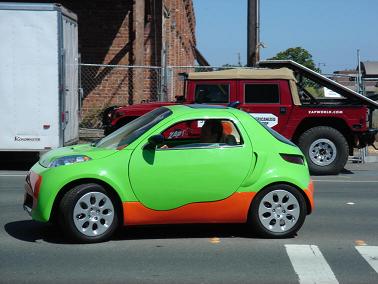
Brazilian ultra-compact cars running on ethanol, petrol, natural gas or electricity

The dinky Obvio in front of a less efficient example of automobile construction…

Lotus and Brazilian car manufacturer Obvio have a number of versions of cute VW Beetle-esque cars that run on any combination of ethanol, petrol or natural gas. They also have optional upgrades to become plug-in electric vehicles. They have a very consistent design style and the car even features an inbuilt ‘carputer’ with GPS, details on nearby locations such as restaurants and virtual instrumentation. You can also use the console as a normal PC. The engine uses continuously variable transmission (CVT) rather than distinct gears which aims to cut down on fuel use.

The Obvio 828 is projected for sale at around $14,000 and the more sporty Obvio 012 is projected at $28,000 although the electric versions are currently a lot more.

[thanks to Alex Thorne for the link, picture via the Obvio website]

The LHC may find extra dimensions

xkcd is an absorbing mix of stick figures, physics, programming, math, love and dark humour

One of the main functions of the Large Hadron Collider – the huge supercollider in Geneva, Switzerland – is to find the underlying reasons for why the particles in the universe have mass and how gravity works. My masters project is a simulation of the most simplistic solution, the Standard Model Higgs Boson. If the collider doesn’t find this particle in its simple form, there are number of more complicated theories proposed for how the world works at this tiny level.

One of these theories supposes that for every particle in the universe, there’s a supersymmetric particle balancing it out. Another set of exotic theories that could be proved right at the LHC is Extra Dimensions – is the reason Gravity is so weak compared to the other forces because its power is trapped inside other dimensions we can’t see? This would link into the infamous string theory, which describes all the tiny particles we’re made of as vibrating strings of energy, suggesting six or seven dimension we can’t see that affect everything we do see! The 27km diameter collider will start smashing protons together later this year if all goes to plan and a new era of particle physics will begin.

[link via ScienceDaily, image from the awesome webcomic xkcd]

Nanotube anti-radiation pill

Fallout was one of the games that inspired John Joseph Adams to edit the recent anthology ‘Wastelands’After work by Stanford University found that carbon nanotubes don’t seem to have any detrimental effect inside the bodies of mice, researchers are looking for more ways of utilising the growing technology in medicine. DARPA has awarded a grant to Rice university to study whether a carbon nanotube based pill would be a good way of treating radiation sickness. Radiation in the body deforms cells and molecules, releasing terribly damaging free radicals which then cause more damage to the body.

“More than half of those who suffer acute radiation injury die within 30 days, not from the initial radioactive particles themselves but from the devastation they cause in the immune system, the gastrointestinal tract and other parts of the body. Ideally, we’d like to develop a drug that can be administered within 12 hours of exposure and prevent deaths from what are currently fatal exposure doses of ionizing radiation,” said James Tour, Rice University’s Chao Professor of Chemistry and director of Rice’s Carbon Nanotechnology Laboratory.

The Carbon pills would absorb large quanties of the radiation within the body, as well as the free radicals, which could dramatically cut down on the post-exposure spread of damaged cells. As DailyTech mention in their article about the discovery, video game Fallout had carbon-based anti-radiation pills way back in 1997. The third Fallout game is being released this year by the makers of Oblivion, Bethesda, for your post-apocalyptic gaming pleasure.

[story and Fallout 3 teaser poster via DailyTech]