All posts by Tomas Martin

Writer and particle physics student from Bristol, England. My story 'A Shogun's Welcome' featured in Aberrant Dreams #7 and 'The Shogun and The Scientist' will be published in the anthology 'The Awakening' in January 2008. I review at SFCrowsnest and wrote the fictional blog miawithoutoil for the world without oil project.

Nasa finds doorway structure on Mars

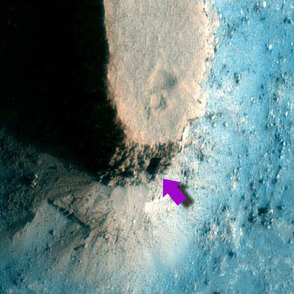
is this a remnant of an alien civilisation or a trick of the light?It’s amazing the things you can find in the universe. Images of our neighbouring red planet by the Mars Reconnaissance Orbiter picked up this little space oddity: a teardrop shaped mountain with a rectangular dark patch that, to the human observer, looks like a door.

The oddly shaped mountain, in the frozen ocean region of the planet, was discovered by a Russian reader, rather than a member of the NASA project. The blog article also has some interesting quotes about Mars terraforming plans.

“They’ve done some experiments and have noticed that some types of plants can grow under the low pressure CO2 atmosphere on Mars,” Australian physicist Charles Lineweaver noted when asked about the prospect of altering the atmosphere of our red neighbour.

Of course, this doorway is probably not the path to some alien civilisation gifting us with its future tech but one can dream…

[via Daily Galaxy, image by NASA]

The LHC on track for summer launch

Part of the huge LHC colliderAs a Physics student doing a masters project on a computer simulation of CERN’s new particle supercollider, I’ve got a vested interest in the progress of the real thing. CERN is reporting good progress on the Large Hadron Collider (LHC) and thinks it is on track to start producing results this summer.

The LHC accelerates two beams of protons in opposite directions around its 27-kilometre diameter ring, until the two beams meet and collide with huge amounts of energy. From this energy, particle physicists hope new particles will form that we haven’t seen before. Chief among those prospective discoveries is the Higgs Boson, which would explain why the other particles have mass.

The Guardian’s weekly science podcast talks about the prospects of finding new science at the LHC, whilst Fermilab has a good summary of the other potential new things the LHC might find when it begins colliding later this year.

[via Science Daily, image by poluz]

Oil hits $100

Crude oil prices have rocketed up since 1999Today oil prices touched $100 a barrel for the first time in history, marking a growing important trend for the near future. Even when historic prices are adjusted for inflation the price has been very slightly higher (at $104.70 during the Iran revolution in 1980). Crude prices reached a high of $97 in November and then fell, only to rise again after the new year.

Peak oil, and the other associated peaks (peak food production, peak metals and peak coal, among others) are a real concern over the next fifty years. When I participated in the collaborative fiction project World Without Oil in May, I thought peak oil was an interesting problem for the future but I wasn’t expecting prices to jump from $50 in January to $100 today. Although oil is always a volitile market, it looks like we may be hitting the point where supply can’t keep up with the increased demand. In the end $100 is just a number but the trend of oil, gold and other commodities mean many of the conservations needed to combat climate change may be forced on us by price alone.

[via the oil drum, where two people had a $1000 bet on whether oil would hit $100 a barrel in 2007. It didn’t, by one trading day, graph by futures.tradingcharts]

A New Year’s look at 2007’s science fiction

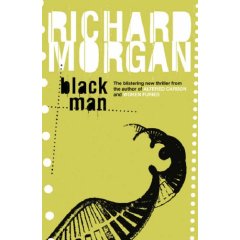
I preferred the US title but the UK cover to Richard Morgan’s excellent bookAs the year draws to a close I thought I’d highlight some of the delights I’ve read in the SF genre this year.

Two of the best books I’ve read this year are Spook Country by William Gibson and The Yiddish Policeman’s Union by Michael Chabon but as they are generally considered mainstream rather than SF, I’ve left them out of my top five. Gibson in particular brings the boundaries between the present and the future closer together than ever before.

Top Five for 2007:

5. Joel Shepherd – Breakaway/Killswitch (books 2 + 3 of the Casssandra Kresnov trilogy) – Pyr have brought over this extremely good trilogy from Australia and the combination of insightful interstellar politics, kickass action and Battlestar Galactica-esque discussion of what it means to be human make these books following android Cassandra Kresnov a real hit.

4. Alastair Reynolds – The Prefect A real step up for Reynolds comapred to his previous work, with a much more sympathetic protagonist and a racy police-thriller plot. The worldbuilding in each of the space stations along the Glitter Band and the crisis that develops are intriguing and engaging.
3. Ian McDonald – Brasyl Three plotlines across three times in Brazil’s past, present and future interconnect with dizzying vision and skill. In addition to some incredibly cool future tech and scientific ideas, McDonald continues his trend of highlighting a country less explored in SF, really giving the reader a feel for the wonderfully different world of South America.

2. Charles Stross – Halting State Stross has many pans in the fire but this is easily my favourite of his novels so far. The extrapolation of today’s MMOs and online games into a complex near future of virtual realities and spy networks is breathtaking and the humour helps the thriller aspects tick along nicely. This year’s Rudy Rucker in the ‘most likely to happen’ category.
1. Richard Morgan – Thirteen (or Black Man in Europe) Morgan really stepped it up a notch with his fifth novel. The near-future Earth is brilliantly done and the moral ambiguities of the genetically altered hero and the world’s politics resonate strongly with current events. The action is frenetic and the plotline zips along but the worldbuilding of 90 years from now is what made me love this novel.

A special mention to the anthology edited by Lou Anders – Fast Forward #1. It’s really encouraging to see a broad remit anthology featuring superb new stories from big authors, rather than reprints and best of the year collections. John Joseph Adams’ Wastelands is also excellent. I’m sure I’ve missed a few books – what were your highlights of 2007?
A glimpse into a Wireless Future

Since 2002, the Wireless World Initiative (WWI) has been working on a number of user-centric wireless systems that integrate what is currently an extremely disjointed mess of networks and protocols.  The five systems – SPICE, MobiLife, WINNER, E2R and Ambient Networks aim to provide a seamless wireless system that connects up all of a user’s gadgets and software in an integrated configuration that doesn’t impact on the usability for the user.

Science Daily has a good article on what ‘Bob the builder’ and ‘Bob the businessman’ might use this new technology for.

“Outside their front doors, the two Bobs wish each other a good morning and head their separate ways. On the train, the businessman watches the financial news on his palm pilot, while the builder tunes in his phone to his favourite digital radio channel and relaxes in the morning traffic to some classical music.”

[via ScienceDaily]