Writer and particle physics student from Bristol, England. My story 'A Shogun's Welcome' featured in Aberrant Dreams #7 and 'The Shogun and The Scientist' will be published in the anthology 'The Awakening' in January 2008. I review at SFCrowsnest and wrote the fictional blog miawithoutoil for the world without oil project.
Here in the UK the FON network is gradually reaching a point where people are aware of it. The company asks users to siphon off part of the wireless internet on their router and offer it up as a wireless node for other users. This can be done in the ‘Linus Torvald’ way of linux and be free or in the ‘Bill Gates’ way, giving the router owners a small cutback.
Back when the idea first came around there was little traction – the software wasn’t compatible with most routers and ISP. Meanwhile, most wireless nodes were incompatible with each other and you had to shell out a load of money to use each one. Now with ISPs like BT coming on board with the idea and many other wireless networks springing up all the time, it looks like much of the UK will have wireless access before too long. With content from the BBC becoming freely available over wireless nodes, it looks like complete connectivity throughout the country will be a reality sooner rather than later. Use this handy Londonist map to find free wireless points in London. By making the internet more freely available and decentralised we can use web 2.0 products that are less dependent on infrastructure, encouraging non-profit web solutions that benefit everyone.
The wormholes they describe aren’t quite the instantaneous transportation portals described by Star Trek or Valve’s new computer game. The light still travels through the metamaterial tube but isn’t detectable outside it, by sight or other methods. Uses for this idea include endoscopic surgery and 3D televisions where all but the end tips of many beams of light are hidden by the wormhole, giving the appearance of a floating image.
[image and link via ScienceDaily, image courtesy of Rochester University]
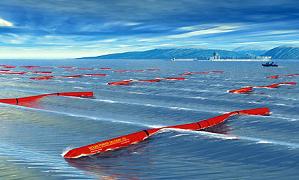
Even without the dual spectres of climate change and dwindling resources our future is likely to be wedded to many of these nascent technologies. When the Earth provides so much energy currently left untapped, it would be a shame not to use it. Economic centres in the future will be invariably tied to the amount of natural energy the environment nearby provides. It’s exciting to think that many of these technologies are reaching the point where they may soon be economically viable on large scale.
A big team of astronomers studying Venus’ atmosphere have found a new type of heavier carbon dioxide molecule that absorbs more heat than the one more commonly found on Mars or Earth. The molecule, which is believed to have two additional neutrons in one of its oxygen atoms, allows it to absorb an additional infrared wavelength of 3.3 microns, which is what tipped the teams off to the discovery. They believe this is part of the reason Venus has such a hot atmosphere – the bigger percentage of these molecules creates an even bigger Greenhouse Gas effect than normal CO2.
As soon as I read this article comparing Mars’ cold atmosphere to Venus’ hot one in relation to the quantities of this new molecule, I immediately thought of Kim Stanley Robinson’s ‘Red Mars’. If this gas contributes more global warming than normal CO2, in the future it may be a very valuable tool if we ever came to terraform our red neighbour.
In a bizarre case of Orwellian doublespeak, the CIA director today announced that he was going to investigate… the man in charge of investigating the CIA director. Inspector General John L. Helgerson and his office are responsible for oversight and internal investigation of the intelligence agency. Over the last few years a series of intelligence blunders has led the office to take a higher profile than usual, including work on extraordinary rendition, unauthorised wiretapping, torture methods at Abu Graib and Guantanamo Bay as well as the calamity of the Plame Affair and criticism of the agency in the lead up to 9/11.
This story is so bizarre it leads my head in circles, making me feel like I’m in a Phillip K. Dick novel. So the director is investigating the inspector general who is investigating the director… Now we just need the news tomorrow that the inspector is mounting a counter investigation into the investigation of his investigating and besides, what is Ubik?
Presenting the fact and fiction of tomorrow since 2001
 Here in the UK the FON network is gradually reaching a point where people are aware of it. The company asks users to siphon off part of the wireless internet on their router and offer it up as a wireless node for other users. This can be done in the ‘Linus Torvald’ way of linux and be free or in the ‘Bill Gates’ way, giving the router owners a small cutback.