All posts by Tom James

Vinyl archaeology

vinylAs formats wither and die and the digital dark age trundles ever on enterprising hackers are already developing techniques for extracting data from older formats. Here a gentleman has extracted discernible sound recording from a photograph of a vinyl disk:

Remember those flat round things you may have found lying around the house. Those that never really worked well as flying saucers? Well, the other day I happenned to have a good look at one through a magnifying glass. I was able to discern something waveform’esqe in the shape of the groove. I thought, “groovy, there must be a way to extract something sensible off of that” (actual thought quoted).

Once the image was ready, writing the decoder was very simple. All it did was rotate a “needle” around a given center at some predefined angular velocity, attempting to keep track of the groove the needle was initially positioned on. The offsets (dr) between this track and the basic radial were bunched into a sequence of samples. these were later converted into wav files.

It’s a beautiful project – and it actually sorta works. You can listen to the results and compare it to a recording direct from the disk (or were they called discs?).

[via Short Sharp Science][image from Hryck on flickr]

Neurocosmetics: wireheads for congress

neurospasmNeurocosmetics has yet to take off in the backstreets of Birmingham, but is likely to change everything, at least according to Marcel Kinsbourne in his Edge question answer:
…the novel method of deep brain stimulation (DBS), by which electrodes are inserted into the brain to stimulate precisely specified locations electrically, is already used to correct certain brain disorders (Parkinsonism, Obsessive Compulsive Disorder).

Not only are the targeted symptoms often relieved; there have been profound changes in personality, although the prior personality was not abnormal.

A patient of lifelong somber disposition may not only be relieved of obsessions, but also shift to a cheerful mood, the instant the current is switched on (and revert to his prior subdued self, the instant it is switched off). The half empty glass temporarily becomes the glass that is half full. The brain seems not entirely to respect our conventional sharp distinction between what is normal and what is not.

Paging Larry Niven, Arthur C. Clarke, Iain Banks, Greg Egan et al – but how will society change when people are free to choose their personalities at a whim?

In fact, could that be the solution to the Fermi Paradox? Could it be that all technological civilizations advance to the point where they develop a technique for inducing whatever their alien equivalent of permanent happiness is and then stop developing?

If you can track down a copy Arthur C. Clarke’s The Lion of Comarre deals with a similarly themed subject rather well.

[from the Edge question][image from TheAlieness GiselaGiardino²³]

GOCE lowly, lest ye fall

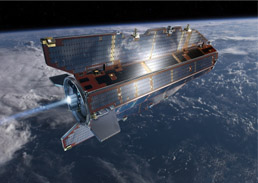
goce-copyEric Drexler writes about the beautiful Gravity and Steady State Ocean Explorer on his blog:

I’m glad to see that someone finally found an excuse to launch a streamlined spacecraft that will cruise above Earth, steadily firing its engines to keep it moving. (Aristotelian physicists take note.) The European Space Agency will soon launch this sleek piece of hardware on a mission of gravity measurement with unprecedented accuracy: The Gravity Field and Steady-State Ocean Circulation Explorer (GOCE) will carry accelerometers able to sense accelerations as little as 10–13 of what we tolerate on Earth.

Apparently because GOCE will orbit much lower than usual it needs to be streamlined to cope with the thin upper atmosphere and generate thrust to keep itself aloft.

Anyway it’s a very pretty piece of kit: surely the MacBook Air of spacecraft1.

[via Eric Drexler][image from ESA]

1: In that it’s solid-state and sleek.

The small world in our hands

wirelessmicrScientists at John Hopkins University, Maryland have developed minute hands that can grasp tiny pieces of tissue when exposed to particular chemicals:

The researchers describe development of tiny metallic microgrippers shaped like a hand that work without electricity. The grippers are about 0.03 inches wide when open — smaller than the diameter of a grain of sand and made from a gold-coated nickel “palm” joined by six pointy metallic “fingers.”

The addition of certain chemicals triggers the hands to open or close. In laboratory studies, the scientists demonstrated that the grippers could grasp and release tiny pipes and glass beads and transport these objects to distant locations with the aid of a magnet, showcasing their potential for pick-and-place operations that are ubiquitous in manufacturing, they say.

The field is apparently called Micro-Chemo-Mechanical-Systems (MCMS) and along with Micro-Electro-Mechanical-Systems (MEMS) is set to have a major impact over the next several decades, particularly in the realm of health and medicine:

…the untethered grippers devised by Gracias’ team contain gold-plated nickel, allowing them to be steered by magnets outside the body. “With this method, we were able to remotely move the microgrippers a relatively long distance over tissue without getting stuck, he said. “Additionally, the microgrippers are triggered to close and extricate cells from tissue when exposed to certain biochemicals or biologically relevant temperatures.”

[from Physorg][image from the Physorg article][also check out the paper for more technical details]

The descent of phone

lilypadsGlancing back in time at the evolution of electronic gadgets like mobile phones you realise what futurist Ray Kurzweil means by the intuitive linear perspective (described by Kurzweil here) – the difficulty we humans have with intuitively grasping the impact of exponential growth (as exemplified by the water lily story) and improvement, from 10 Great Geek Gadgets:

Cellphones have evolved so fast even last year’s models are already uncool. Go back a few more years – or watch most any 90s sitcom like Seinfeld – and you’ll be reminded of how things used to be. Rewind back to the beginning and behold the behemoths: how did we ever walk around with those things?

Kevin Kelly has some thoughts on the nature of the exponential growth of knowledge, most notably that as we learn more our ignorance increases (SRSLY check it out).

[via Bruce Sterling][image from BinaryApe on flickr]