 Some nice pictures of SF-inspired concept spacecraft over at Wired. And if you’re into that sort of thing why not check out Memories of the Space Age.
Those were the days, when we had real fake spaceships and it was all-about-the-science.
Some nice pictures of SF-inspired concept spacecraft over at Wired. And if you’re into that sort of thing why not check out Memories of the Space Age.
Those were the days, when we had real fake spaceships and it was all-about-the-science.
 More developments in the field of ultracapacitors, this time using graphene (like a single layer of the graphite molecule, apparently), from researchers at the University of Texas:
“Through such a device, electrical charge can be rapidly stored on the graphene sheets, and released from them as well for the delivery of electrical current and, thus, electrical power,” says Rod Ruoff, a mechanical engineering professor and a physical chemist. “There are reasons to think that the ability to store electrical charge can be about double that of current commercially used materials. We are working to see if that prediction will be borne out in the laboratory.”
My understanding is that a key part of solving the two problems of anthropogenic climate change and the depletion of primary energy resources involves finding new and more efficient ways of storing energy.
Ultracapacitors are on option, synthetic petrol is another, or hydrogen fuel cells.
It will be interesting to see which technology (if any of these) becomes dominant as a means of storing energy.
[story from Physorg][image by procsilas on flickr]
 Hubble-using astro-boffins have seen something they don’t recognise in the boundless worlds of space:
The object also appeared out of nowhere. It just wasn’t there before. In fact, they don’t even know where it is exactly located because it didn’t behave like anything they know. Apparently, it can’t be closer than 130 light-years but it can be as far as 11 billion light-years away. It’s not in any known galaxy either. And they have ruled out a supernova too. It’s something that they have never encountered before. In other words: they don’t have a single clue about where or what the heck this thing is.
That’s a pretty big margin of error! Also check out the paper itself (via Sky and Telescope).
I was surprised to discover, whilst reading Bill Bryson‘s brilliant A Short History of Nearly Everything how difficult it is to ascertain astronomical distances precisely, and how much brain work and observation goes into it.
Anyway I’d love to find out what this is (an OCP perhaps?). Such excitement!
[from Gizmodo][image is credited to Kayle Barbary and others]
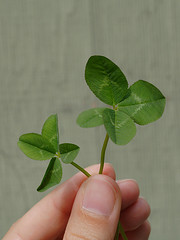 I’ve always been curious as to why human beings are superstitious, now evolutionary biologists believe it is the result of natural selection. Prof Kevin Foster of Harvard University defines superstition as the tendency to falsely link cause and effect:
…a prehistoric human might associate rustling grass with the approach of a predator and hide. Most of the time, the wind will have caused the sound, but “if a group of lions is coming there’s a huge benefit to not being around,”
So far so plausible:
Foster and Kokko worked with mathematical language and a simple definition for superstition that includes animals and even bacteria.
The pair modelled the situations in which superstition is adaptive. As long as the cost of believing a superstition is less than the cost of missing a real association, superstitious beliefs will be favoured.
I’ve always felt that, even though I agree with a lot of what A C Grayling, Christopher Hitchens and Richard Dawkins say vis a vis belief and superstition they need to give more thought to the possibility that superstitious beliefs are part of the human condition.
[story via Slashdot][image from Greencolander on flickr]