All posts by Tom James

New ESA/Russian manned spacecraft pictures!

Check out the Soyuz capsule replacement and conceptual artwork here.

One of the most unusual features about the capsule appear to be the thrusters and landing gear on its underside. Mr Zak said it would use these engines to soften its landing on Earth after the fiery re-entry through our atmosphere.

It’s interesting how the national space agencies seem to see the future in rockets, rather than space planes, for space exploration.

What with the Space Shuttle being retired in 2010, and with a possible alternative European plan for a manned version of the ATV called Jules Verne, as well as the American Ares V rockets planned for use in Project Constellation, it seems it’s no longer de rigueur to build spaceplanes unless you’re a private space tourism company.

[story from BBC News]

Floating cities on Venus?

Combining two of the most compelling tropes from science fiction: floating cities and colonising other planets, Geoffrey Landis, a scientist at the NASA Glenn Research Center (who also writes science fiction, apparently) suggest the idea that humans could live in aerostatic cities in the upper atmosphere of Venus:

50 km above the surface, Venus has air pressure of approximately 1 bar and temperatures in the 0

The next revolution in social policy

The reliably interesting Daniel Finkelstein has a good article on what he sees as a social psychology revolution developing via the collision of the two disciplines of evolutionary psychology and behavioural economics. From the article:

Yet the integration of the academic work on human behaviour into politics is still very much in its infancy. It is roughly now where economic understanding was in about 1978, before the Thatcher revolution. It is possible, indeed usual, to have entire policy debates in which the science of human behaviour doesn’t figure at all.

For instance, in the past two weeks we have had discussion of obesity and of knife crime. Social norms have hardly figured. If everybody thinks that everybody else is getting fat, then more people will put on weight. The campaigns designed to reduce obesity may be spreading it. Similarly the very idea that every young person is carrying a knife increases knife crime. The obvious route of making such behaviour seem odd and isolated appears not to have occurred to any major politician.

This does tie in with studies that crop up every few weeks concerning how humans co-operate and compete, and how our perceptions of risk and reward work.

One recent study concerns how mathematical models that include diversity of connectedness in social networks can show why altruism appears in societies. It’s an interesting article, even if a little hard to understand.

redpill_bluepillApropos the free-market intellectual revolutions of the eighties and the use (or overuse) of mathematical models in the study of human behaviour, check out Adam Curtis’ brilliant The Trap series of documentaries – they can be found on YouTube here.

The idea that we are entering a new era in which policy is created by politicians who have an empirical understanding of human nature is a compelling one. Doubtless it is full of potential for science fictional speculation.

[story from Physorg, article from The Times Online][image from Night Star Romanus on flickr]

White elephants… IN SPACE!

Suggestions for what exactly to do with the International Space Station are always welcome. Michael Benson, writing in The Washington Post suggests sending it to the Moon:

The ISS, you see, is already an interplanetary spacecraft — at least potentially. It’s missing a drive system and a steerage module, but those are technicalities. Although it’s ungainly in appearance, it’s designed to be boosted periodically to a higher altitude by a shuttle, a Russian Soyuz or one of the upcoming new Constellation program Orion spacecraft.

This seems a little crazy, but then so does spending $156 billion on the ISS in the first place (check out the discussion on Slashdot about the technical side of it). As it is, we don’t seem to be getting much in the way of tangible benefits from the ISS. As Michael Benson points out:

But if the station’s goal is to conduct yet more research into the effects of zero gravity on human beings, well, there’s more than enough of that already salted away in Russian archives, based on the many years of weightlessness that cosmonauts heroically logged in a series of space stations throughout the 1970s, ’80s and ’90s. By now, ISS crews have also spent serious time in zero gravity. We know exactly what weightlessness does and how to counter some of its atrophying effects. (Cue shot of exercycle.)

In any case I’m fairly cynical about the medium-term benefits of human space travel. We have enough trillion dollar problems here on Earth without wasting money on white elephants like the ISS.

elephantI agree that people need frontiers and visible symbols of human progress. To inspire a sense of wonder about the universe is very laudable, but surely we are not so unimaginative as to be unable to find other, less literal, frontiers than space?

Advances in biology, neuroscience, and computer science can provide enough sense-of-wonder to keep everyone happy. Also these areas are much cheaper to pursue (in comparison to space travel) and have the potential to yield much more practically useful results.

Purely scientific study can be pursued by unmanned probes without going to the expense of transporting tin-cans full of hominids billions of kilometres to plant a flag.

[story in The Washington Post via Slashdot][image from chidorian on flickr]

Where to put the carbon…

Aside from nuclear power, one of the most enticing possibilities for solving problems of energy security, peak gas, and global warming is carbon sequestration.

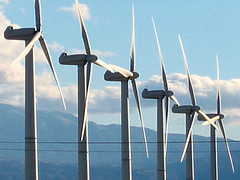
windfarmBy burning cheap and widely available coal but storing the resultant carbon dioxide rather than venting it into the atmosphere means you (theoretically) have a cheap and low-carbon energy source.

The main issue is finding a place to stick all that carbon dioxide. Dave Goldberg of the Lamont-Doherty Earth Observatory claims there is a vast area off the east west coast of Oregon under the Juan de Fuga Fuca tectonic plate which addresses many of the safety issues of carbon sequestration:

“We have insurance upon insurance upon insurance,” he said.

First, the center of the proposed location is about 100 miles off the coast, obviously far away from human settlement. Second, the impermeable sediment cap on the permeable basalt reservoir is hundreds of feet thick, creating an effective seal for the compressed CO2. Third, when CO2 mixes with water inside the basalt, over time it turns into a variety of carbonates, which are, essentially, chalk. Fourth, if there were an unforeseen leak, in deep water, CO2 forms into icy hydrates in the water, preventing it from floating up to the surface.

As to the UK: what about using the recently emptied North Sea oil wells as a carbon sink?

It is becoming clear that if we are to create a genuinely zero-carbon (or even low-carbon) economy we are going to have to embrace nuclear power and carbon sequestration, as suggested in Plan D of David David J. C. Mackay’s excellent (but unfinished) free ebook Substainable Energy – Without the Hot Air. The evidence is mounting that wind power, solar thermal, and photovoltaics don’t work well enough.

[story from Wired][image from Scott Ableman on flickr]