All posts by Tom James

Where in the World?

Finding photos in old books and not having any clue as to the locations they depict could become yet Earthanother mild annoyance thrown into the furnace of perpetual progress.

Comp-sci boffins at Carnegie-Mellon University have developed a system called IM2GPS that can identify the probable geographic location of a given image. From the abstract of the paper:

In this paper, we propose a simple algorithm for estimating a distribution over geographic locations from a single image using a purely data-driven scene matching approach. For this task, we will leverage a dataset of over 6 million GPS-tagged images from the Internet. We represent the estimated image location as a probability distribution over the Earth’s surface. We quantitatively evaluate our approach in several geolocation tasks and demonstrate encouraging performance (up to 30 times better than chance). We show that geolocation estimates can provide the basis for numerous other image understanding tasks such as population density estimation, land cover estimation or urban/rural classification.

The trend is towards every piece of data being tagged with a location: here we see a way of legacyqrcode information (old photos) being given a “probable geographic location” without having originally being created with a time/GPS location stamp. It would still only be a general guess as to a geographic area, but it is better than nothing.

This is part of a more general trend towards what Bruce Sterling calls Spimes. From the Man himself:

The most important thing to know about Spimes is that they are precisely located in space and time. They have histories. They are recorded, tracked, inventoried, and always associated with a story.

In the case of IM2GPS it is the data itself that is being recorded and tracked, and potentially the objects the data describes (the objects in the photos) which connects with another loosely related concept: the panopticon. Imagine if you combined IM2GPS technology with facial recognition software and put CCTV archives through this kind of process. You could essentially Spimify the population retrospectively!

Hysterically delusional paranoia aside this is a fascinating development. Read the paper in full (pdf), it’s well worth it.

[story via PhysOrg][images by Reto Stockli and QR-Code Generator]
Oil You Can Eat: Bacteria Eat Rubbish, Egest Petrol

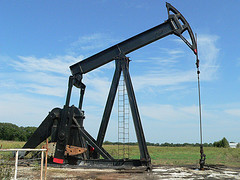
Splendid news from Silicon Valley: a flotilla of companies, including one called LS9, are now starting toblack_gold genetically engineer bacteria that poop petrol and eat any old rubbish:

Because crude oil (which can be refined into other products, such as petroleum or jet fuel) is only a few molecular stages removed from the fatty acids normally excreted by yeast or E. coli during fermentation, it does not take much fiddling to get the desired result.

For fermentation to take place you need raw material, or feedstock, as it is known in the biofuels industry. Anything will do as long as it can be broken down into sugars, with the byproduct ideally burnt to produce electricity to run the plant.

The key facts are that this is a carbon-neutral method of producing conventional crude oil (and all the good stuff you can get out of crude oil), that doesn’t cause food inflation, consumes waste biomass, and doesn’t require us to spend $billions upgrading our current transport infrastructure to compatibility with hydrogen fuel cells.

The company is not interested in using corn as feedstock, given the much-publicised problems created by using food crops for fuel, such as the tortilla inflation that recently caused food riots in Mexico City. Instead, different types of agricultural waste will be used according to whatever makes sense for the local climate and economy: wheat straw in California, for example, or woodchips in the South.

The main onion in the ointment seems to be the scale required to produce the amount of oil needed:green_oil

However, to substitute America’s weekly oil consumption of 143 million barrels, you would need a facility that covered about 205 square miles, an area roughly the size of Chicago.

This is it: with oil prices continuing to break records and global warming coming around the corner this is the direction we need to go in (unless there’s some other huge problem with it, aside from the Chicago-sized thing?).

[story at Times Online, via Charlie’s Diary][images by nalilo and XcBiker]

Exoskeletal Awesomeness

Human augmentation and science fictional brilliance collide with real life in the HULC – the Human Universal Loads Carrier. According to sales-jabber from the Berkeley Bionics website:

The Human Universal Load Carrier (HULC™) is the third generation exoskeleton system from Berkeley Bionics. It incorporates the features of ExoHiker™ and ExoClimber™, exhibiting two independent characteristics:

1) It takes up to 200 pounds without impeding the wearer (Strength Augmentation)

2) It decreases its wearer’s metabolic cost (Endurance Augmentation).

Like most people I’m ambivalent about the idea of a runaway military industrial complex, but aside from the military applications this sort of technology has a lot of applications for paraplegics and the disabled. Check out the video for more corporate propaganda and quasi-transhumanist possibilities:

Fans of Iain M Banks’ wonderful Player of Games will be fully aware of the dark side of exoskeletal systems. My bet is it’ll be about 10 years before these are available to consumers: and will probably be expensive, heavily regulated and licensed when they are.

[via Gizmodo]

Robotic Dragonflies

Fans of one of Terry Pratchett’s early comic science-fiction novels The Dark Side of the Sun, will be familiar with the idea of robotic versions of insects being used as “bugs” to spy on people.

This is an idea that is being enthusiastically embraced by the US military, with many small UAVs in development for surveillance purposes.

And there is even more insect-themed biomimicry on it’s way from the labs: the dragonfly is of particular interest, according to researchers:

Dragonflies are one of few creatures that utilize four independently controlled wings to fly,dragonfly allowing them to hover, dart, glide, move backward, and change directions rapidly. Looking to understand such abilities, scientists at the Royal Veterinary College, in England, and the University of Ulm, in Germany, have developed a robotic dragonfly to measure the current flows over and under the wings at different flap cycles. While most of the dragonfly hovering scenarios were not efficient, the team found that if the lower wings are beating slightly ahead of the top wings, the double set of wings proves more efficient at generating lift, employing 22 percent less power to lift the same weight as a single pair.

Well good luck to them. Fortunately for privacy-lovers/paranoids it seems that practical fabrication of these insect spies is still some way in the future.

[story from Technology Review][image by Lori Greig]

ZOMFG! MORE CARBON NANOTUBES!

I have already made my feelings clear on the impending scourge of carbon nanotubes. However it seems that my dire warnings are being ignored and hubristic scientists are continuing to portray these evil molecules as the world-saver I will continue to claim they are not:

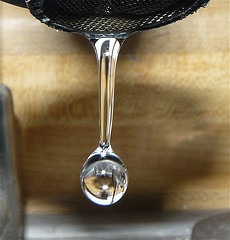
One of the most promising applications for carbon nanotube membranes is sea water dripdesalination. These membranes will some day be able to replace conventional membranes and greatly reduce energy use for desalination.

Oh the humanity! How can we stop the perfidious spread? I for one will refuse to drink any nanotube desalinated water for fear of impurification of my precious bodily fluids! &c [flickr image by cursedthing]