Psychologist Jonathan Haidt explores the question on The Edge, with eight responses from the Reality Club. This self-described liberal suggests:
Democrats would do well to read Durkheim and think about the quasi-religious importance of the criminal justice system. The miracle of turning individuals into groups can only be performed by groups that impose costs on cheaters and slackers. You can do this the authoritarian way (with strict rules and harsh penalties) or you can do it using the fairness/reciprocity foundation by stressing personal responsibility and the beneficence of the nation towards those who “work hard and play by the rules.” But if you don’t do it at all—if you seem to tolerate or enable cheaters and slackers — then you are committing a kind of sacrilege.
Afterwards, Howard Gardner wonders why left-wing societies have lower crime rates and more stable marriages; Michael Shermer decries what he calls liberal bias in academia; James Fowler wonders why people vote at all; Alison Gopnik asks what about the children; Roger Schank gets the last word:
Republicans do not try to change voter’s beliefs. They go with them. Democrats appeal to reason. Big mistake.
Update: In light of stuff like this, at least one of the U.S. Presidential candidates has a website to register to vote or to confirm registration. I haven’t found it on the other guy’s site, but I’m probably just overlooking it. [Thanks again, Todd]
Things aren’t always what they seem. More than 200 years ago, General (and future U.S. President) William Henry Harrison decided that a structure at the confluence of the Ohio and Miami Rivers was a fort. Now University of Cincinnati archaeologists and anthropologists say it’s really an irrigation system built by the Shawnee to deal with long-term drought.
Two points stand out: one is that the engineering expertise required to conceive of such a massive irrigation system must have been far greater than what history has traditionally assigned to Native American groups from that time in history, and the second is that the cultural priority of engaging in such a massive undertaking as building these earthworks by hand was done by this culture not because of military motivations but for a more civil cause.
Based upon conversations with the WTC survivors, researchers from the Universities of Greenwich, Ulster and Liverpool concluded that more than half of them delayed evacuating because they wanted to gather information about what was happening; those intent on getting more info about the attacks before exiting took between 1.5 and 2.6 times longer to begin evacuating than others; and congestion in stairways was the main cause of delay in getting out, even though the towers were less than one-third occupied that day.
Taken in context, Zawahiri’s latest memos seem to indicate that al-Qaeda’s oft-cited “central front” is a persistent if increasingly difficult management challenge for the movement’s front office.
Privatizing the elections was a great idea, as Black Box Voting reminds us:
Diebold/Premier says [it’s] too late to fix a new voting machine 2-minute warning and “time-out” feature which can kick voters off the machine, forcing them to accept a provisional ballot. “At least 15” voters were booted off the machine in Johnson County, Kansas recently, and Diebold/Premier says this is due to a software “upgrade” which sets a timer on voter inactivity. According to the company, the machines receiving the upgrade are used in 34 states and 1,700 jurisdictions.
The average voter takes 4-9 minutes to cast a ballot, according to studies. [Thanks, Todd]
It sounds like something Bruce Sterling foresaw as long ago as Islands in the Net: Larry Dignan on ZDNet looks at a patent for a structure that would sit offshore like an oil rig:
Google is pondering a floating data center that could be powered and cooled by the ocean. These offshore data centers could sit 3 to 7 miles offshore and reside in about 50 to 70 meters of water.
….Now wild-cards abound. Jurisdiction issues will occur. Are states really going to allow Google or anyone else place these pontoons offshore without some tax hit?
And will Google take advantage of such a setup to bank your data like the Swiss bank money?
[Rusting sea forts in the Thames estuary photographed by phault; story tip: Gregory Frost]
Presenting the fact and fiction of tomorrow since 2001
 Psychologist Jonathan Haidt explores the question on The Edge, with eight responses from the Reality Club. This self-described liberal suggests:
 Things aren’t always what they seem. More than 200 years ago, General (and future U.S. President) William Henry Harrison decided that a structure at the confluence of the Ohio and Miami Rivers was a fort. Now
  Imagine trying to exit a burning building.
 Privatizing the elections was a great idea, as
 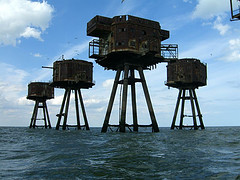 It sounds like something Bruce Sterling foresaw as long ago as Islands in the Net: Larry Dignan on ZDNet looks at