All posts by Tom Marcinko

Immersive 3D: ‘Please touch’ coming soon?

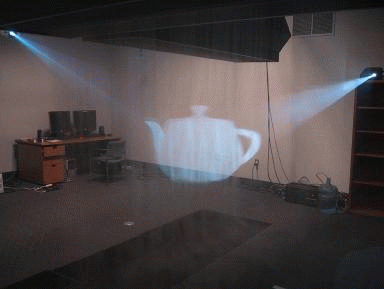
immaterialteapotThe ability to touch and manipulate 3D images is key to the future of interactive entertainment, not to mention every other episode of Star Trek: The Next Generation. Now two UC-Santa Barbara researchers say they’ve built a prototype room-sized 3D display using projectors, a user-tracking system, and two FogScreens, which produce 2D images using microscopic water droplets and ultrasound.

To achieve the 3D effect, the same image is rendered on two overlapping screens at different depths. Users’ head positions are tracked since the 2D images on each screen depend on the user’s viewing direction. The system computes the image alignment in real time, and users see a single, fused 3D image where the screens overlap.

But a room-sized DFD [depth-fused 3D] still presents technical challenges for researchers. For instance, the fog from two FogScreens can bleed through and disrupt each other, air conditioners and open doors can cause turbulence that interferes with the image quality, and alignment and tracking errors can occur because people view the 3D images with two separate eyes.

Possible future applications include virtual museums, surgery, and offices, not to mention virtual catch or Frisbee.

[Image: 3D teapot by Cha Lee, UCSD, IEEE]

Scented laptops

floralApparently for real, from PC maker Asus:

Floral Blossom is pink with a flowery smell; Musky Black sports graffiti art and emits an earthy musk; Morning Dew comes in pastel green and offers that refreshing early a.m. je ne sais quoi; and Aqua Ocean gives off an aquatic aroma and comes with sky and wave imagery on the cover.

MediaBistro, unimpressed:

I can’t wait to get on a plane in a middle seat in coach surrounded by this stuff.

[Floral by Asus]

Fun science fact: We are all somewhat insane

wingnutA bold claim (or maybe not), but evolutionary biologist Randolph Nesse thinks he can back it up.

[He] compares the human brain with race horses: Just as horse breeding has selected for long thin legs that increase speed but are prone to fracture, cognitive advances also increase fitness — to a point….

People with aggressive and narcissistic personalities are the easiest to understand evolutionarily; they look out for number one. But even if 16 million men today can trace their genes to Genghis Khan…very few potential despots achieve such heights. Perhaps to check selfish urges, in favor of more probable means to biological success, social lubricants such as empathy, guilt and mild anxiety arose….

But too much emotional acuity — when individuals overanalyze every grimace — can cause a motivational nervousness about one’s social value to morph into a relentless handicapping anxiety.

[Wingnut by Gibna Kebira]

Singularity watch: Vinge on the future

raptureThe New York Times has a brief, appreciative item about Vernor Vinge and his novel Rainbows End. Here’s a nice if-this-goes-on snip:

“These people in ‘Rainbows End’ have the attention span of a butterfly,” [Vinge] said. “They’ll alight on a topic, use it in a particular way and then they’re on to something else. Right now people worry that we don’t have lifetime employment anymore. How extreme could that get? I could imagine a world where everything is piecework and the piece duration is less than a minute.”

[Image: cloudsoup]

A new book about Steve Ditko

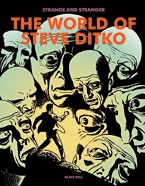
steveditkoThe New York Times has a review of Strange and Stranger: The World of Steve Ditko, a biography and critical study by Blake Bell (Fantagraphics). Stan Lee always knew how to promote himself, and the late Jack Kirby is getting the props he deserves. Ditko is less well known to the public, but of course every comics fan knows he was the original Spider-Man artist. (Tobey Maguire was such a great casting choice, capturing the antiheroic geekiness of the early Peter Parker.)

Ditko now seems now to be leading a strange, sad life, recounts Times reviewer Douglas Wolk:

He split with Lee and Marvel in 1966. By then, he’d fallen under the spell of Ayn Rand and Objectivism, and started producing an endless string of ham-fisted comics about how A is A and there is no gray area between good and evil and so on. “The Hawk and the Dove,” for instance, concerns two superhero brothers who … oh, you’ve already figured it out. Ditko could still devise brilliantly disturbing visuals — the Question, one of his many Objectivist mouthpieces, is a man in a jacket, tie and hat, with a blank expanse of flesh for a face — and his drawing style kept evolving, even as his stories tediously parroted “Atlas Shrugged” and “The Fountainhead” at the expense of character, plot and ultimately bearability.

He drew Transformer coloring books and Big Boy comic books, almost as if he followed John Galt on strike.

(Self-indulgent note: Rand is always good for starting an argument, in my experience…)

[Image: book cover from Fantagraphics]