Category Archives: Blog

Rudy Rucker’s biosynthetic future

digital rendering of DNARudy Rucker has been ruminating on synthetic biology in the wake of a September essay in The New Yorker entitled “A Life Of Its Own”, which is well worth the half hour or so it’ll take to read. [image by ynse]

In response, Rucker has reposted a piece he wrote for Newsweek on the same subject back in 2007… and if you love Rucker’s ability to flip-flop from hard science to way-out West-Coast weirdness within the space of a few paragraphs (as I do), it’s a must-read. For example, here are Rucker’s thoughts about the biotech “grey goo”scenario:

What’s to stop a particularly virulent synthetic organism from eating everything on earth? My guess is that this could never happen. Every existing plant, animal, fungus and protozoan already aspires to world domination. There’s nothing more ruthless than viruses and bacteria—and they’ve been practicing for a very long time.

The fact that the synthetic organisms are likely to have simplified Tinkertoy DNA doesn’t necessarily mean they’re going to be faster and better. It’s more likely that they’ll be dumber and less adaptable. I have a mental image of germ-size MIT nerds putting on gangsta clothes and venturing into alleys to try some rough stuff. And then they meet up with the homies who’ve been keeping it real for a billion years or so.

And if that’s a bit too serious for you, hands up who’d love to live in this future:

Of course, people will want to start tweaking their own bodies. Initially we’ll go for enhanced health, strength and mental stability, perhaps accelerating the pace of evolution in a benign way.

But, feckless creatures that we are, we may cast caution to the winds. Why would starlets settle for breast implants when they can grow supplementary mammaries? Hipsters will install living tattoo colonies of algae under their skin. Punk rockers can get a shocking dog-collar effect by grafting on a spiky necklace of extra fingers with colored nails. Or what about giving one of your fingers a treelike architecture? Work ten two-way branchings into each tapering fingerlet of this special finger, and you’ll have a thousand or so fingertips, with the fine touch of a sea anemone.

Ah… just me, then? 🙂

Rumours of the internet’s death have been greatly exaggerated

Internet - serious business.Hey, have you heard? The internet’s goose is pretty much cooked, as far as Nemertes Research are concerned, thanks to exponential traffic increases running up against linear infrastructure investment – and net neutrality legislation will be the nails in the coffin lid.

The thing is, there isn’t a whole lot of factual data to back up the assertion, which has been made (and debunked) numerous times since the rise of video streaming services like YouTube. Ars Technica has a good takedown:

What’s most odd about Johnson’s argument about network neutrality is that she admits that this is default network behavior right now. And while she frets about the huge growth of Internet traffic, the reality is that the growth rates have been much faster in the past (doubling every year or faster)—and the Internet abides! As for ISPs not having the money to invest in enough infrastructure to keep up with demand, well… just take a look at ISP balance sheets. Tremendous profits are being made now, even as cable operators roll out DOCSIS 3.0 tech and boost download speeds to 50Mbps or 100Mbps.

In the end, the song remains the same: of course the Internet has issues, but some kind of network-killing “exaflood” hasn’t materialized in two years and doesn’t look about to wreak devastation on the Internet in the near future. What we have instead is declining traffic growth rates in mature markets, and big boosts to access line capacity (for Verizon and the cable operators, at least), plenty of bandwidth in the core—all on a network that has generally been neutral for decades.

So there’s probably very little to worry about… except perhaps where Nemertes’ research funding originates from.

More positive sf: DayBreak Magazine launches for Diwali

Wondering what’s happening with the Shine anthology of postive science fiction that was announced last year?

Well, editor Jetse de Vries has more good news; not only is Shine still on the roster of forthcoming releases from the recently-rescued Solaris Books imprint (April 2010), but there will be a whole bunch of teaser stories posted on DayBreak Magazine, a free-to-read webzine. Tell it to ’em, Jetse:

With the Shine anthology now slated for an April 2010 release, and with exuberant SF as thin on the ground as bankers without bonuses, DayBreak Magazine will alleviate the waiting and fill the gap. Simultaneously quenching your thirst for upbeat stories while also whetting your appetite for the main uplifitng dish, DayBreak Magazine will feature a positive, forward-looking story every second Friday until the print Shine anthology is released, or possibly even a bit beyond that date.

The launch is on Friday October 16, on the eve of Diwali, with “The Very Difficult Diwali of Sub-Inspector Gurushankar Rajaram” by Jeff Soesbe. The second story will be released on Friday October 30, the eve of Halloween: “Horrorhouse” by David D. Levine. More to be announced. A new story every two weeks: stories set all over the world, all depicting a future in which you would actually love to live. All for free, and all for your delectation.

Please note that these online stories are different from the ones in the print Shine anthology: It’s just that I liked them so much I’ve decided—after negotiations with the authors—to put them online as a free showcase for upbeat science fiction.

Free fiction is always good news! That first story is up right now:

“The Very Difficult Diwali of Sub-Inspector Gurushankar Rajaram” by Jeff Soesbe

It is Diwali in Bangalore, but not everyone is partying as Sub-Inspector Gurushankar Rajaram and his colleagues are working overtime to keep certain things from escalating:

  • There will be helicopters, wobbling!
  • There will be children, rebelling!
  • There will be elephants, marauding!
  • There will be monkeys, harassing!
  • There will be the third eye of Shiva, watching from the sky!
  • There will be song!
  • There will be dance!
  • There will be party!
  • There will be the ghost of Dev Kapoor Khan, the Indian Elvis!

Will Sub-Inspector Gurushankar Rajaram overcome the increasing madness around him, or will he become mad, himself? Confused? You won’t be, after reading “The Very Difficult Diwali of Sub-Inspector Gurushankar Rajaram”, an exuberant tale of a near-future India that puts most Bollywood pictures to shame!

Well, that’s your weekend reading sorted, anyway!

Leave a comment at DayBreak if you take a look, but feel free to pop back here and discuss, too. Has Jetse delivered on his promise of solid stories with a positive outlook?

Tobias Buckell takes down vertical farming

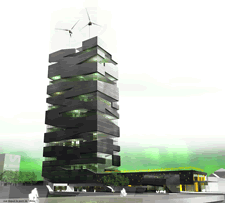
Vertical farm conceptWe’ve mentioned vertical farming a number of times before, and the mighty BoingBoing brought it up earlier in the week; general consensus seems to be that it’s a lovely idea. [Vertical farm image borrowed from VerticalFarm.com]

But lots of things are lovely ideas until you run the numbers on them, and that’s exactly what Futurismic alumnus Tobias Buckell has been doing with vertical farming:

One of the more famous advocates of the Vertical Farm concept, Dickson Despommier, estimates a 30 story farm would feed about 10,000-50,000 people (depending on which article he’s speaking in). Let’s be charitable and assume 30,000 per 30 story skyscraper.

A 30 story skyscraper can cost as much as half a billion dollars. So we’re looking at a unit cost of at least that to build these, and that’s not considering the hydroponic and recycling technology costs!

New York has 10 million people. To feed New York, you’d need roughly 334 of these buildings, with the building cost being at least $150 billion.

That’s affordable on a country scale (10 years of NASA-like budget).

But the fact is, the existing land sprawling out around New York and the US and gasoline to transport the goods from the heartland to NYC is still far cheaper when an accountant crunches the figures.

That’s a whole lot of money, as Toby rightly points out. Which is no reason to abandon the idea entirely, of course, but as with all futurist visions it needs to be tempered with some reality. No plan ever survives contact with the enemy, after all, and economics is the enemy of us all at the moment (with the possible exception of the Wall Street weasels, natch).

One possible solution to Toby’s objections might be retrofitting old skyscrapers with the new kit. Perhaps that would be cheaper than raising a structure from scratch?

Google’s Building Maker: crowdsourcing the world’s architecture

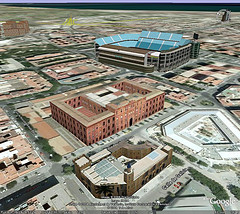
Valencia, Spain as seen in Google EarthIs there anything that can’t be crowdsourced? Google sure don’t think so, as they’ve just announced another new project for Joe Public to muck in on. Google Building Maker will be used to populate Google Earth with 3D models of major buildings:

We like to think of Building Maker as a cross between Google Maps and a gigantic bin of building blocks. Basically, you pick a building and construct a model of it using aerial photos and simple 3D shapes – both of which we provide. When you’re done, we take a look at your model. If it looks right, and if a better model doesn’t already exist, we add it to the 3D Buildings layer in Google Earth. You can make a whole building in a few minutes.

It’s entirely browser-based, too, so no compatibility problems. Of course, you don’t get the freedom of Second Life, where you can build any damned building you feel like… but then learning how to build well in SL can take weeks of practice, whereas Google have aimed to make it as easy as possible. Which is a sensible move if you want people to do work for free, I guess… [image by Visentico/Sento]