Category Archives: Blog

Cyborg bugs and locust flight simulators

We seem to be on an insect tip here at the moment, so entomophobes may want to click away until tomorrow. This stuff’s even creepier than software ants, too – via grinding.be (and many other places) comes video footage of the Pentagon’s latest experiments toward remote-controlling the flight of beetles with embedded hardware:

That’s more than a little unsettling, and I’m not usually bothered by insects. More details over at Wired‘s Danger Room blog.

But why build hardware into fragile real bugs when you could just build fully robotic critters? Obviously you’ll need to suss out the mechanics of their ability to fly, first… so you’re going to need a locust flight simulator like the one developed by a fellow called Adrian Thomas.

The simulator could be a big step forward for the many teams around the world who are designing robotic insects, mainly for military purposes, though Thomas expects them to have a massive role as toys, too. “Imagine sitting in your living room doing aerial combat with radio-controlled dragonflies. Everybody would love that,” he says.

Hmm. I think most folk would far prefer to have all insect combat confined to entirely virtual spaces, at least within the home. And by the time these proposed toy insects make it to the marketplace, you probably won’t need to actually pilot them yourself – after all, you can already build your own self-piloting and fully autonomous GPS-enabled UAV without needing access to a Pentagon-sized budget.

Technology and population growth

fieldThere’s a great interview over at New Scientist with environmentalist and techno-realist Jesse Ausubel on the subject of how technology and improved agricultural practices may enable and support continued population growth and economic prosperity:
You’ve said that we could feed 10 billion people on half the area we currently use by improving agricultural efficiency. How would that work?

High yields are the best friend of nature. Even if humans remain carnivorous, if we continue lifting yields at roughly 2 per cent per year, as farmers have achieved over the past 100 years, then simple arithmetic shows lots of land now farmed will be abandoned and can return to nature. The world population is increasing by only around 1 per cent per year, so sustaining 2 per cent yield growth could free half of farmed land over 75 years or so. The highest yields that have been achieved in China, India, the US and many other countries are typically 300 per cent of average yields, so 2 per cent yearly gains are not miracles. They are business-as-usual, but with a lot of sweat.

It’s weird to hear someone talking about population growth as if it was something manageable, rather than something to be worried about. I was particularly intrigued by the notion of quorum sensing:

Surely our inability to limit ourselves is a major issue.

Some recent research suggests organisms do try to sense limits. Even bacteria turn out to have networks of social communication and to use something called quorum sensing to coordinate their gene expression according to the local density of their population, and so avoid disastrous growth.

Ever the optimist, I see no reason why problems like global warming, deforestation, or resource depletion should not eventually be resolved. It rarely seems to be a matter of practical or even economic barriers, but rather political will to take the kind of action needed.

Clean air laws and action taken on the ozone layer show that it is possible to make the necessary changes.

[image from Olof S on flickr]

Biomimicry in computer security: ants vs. worms

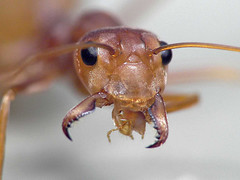
ant headWe have a tendency to name software entities after biological creatures whose behaviours they remind us of – think of viruses in general, or worms. Now a bunch of computer security geeks are coming from the other direction, taking inspiration from nature’s creatures for the next weapon in the never-ending war against malware and viruses… few species are more effective at responding to intrusions into their system than the ant, after all. [via SlashDot; image by CharlesLam]

Unlike traditional security devices, which are static, these “digital ants” wander through computer networks looking for threats, such as “computer worms” – self-replicating programs designed to steal information or facilitate unauthorized use of machines. When a digital ant detects a threat, it doesn’t take long for an army of ants to converge at that location, drawing the attention of human operators who step in to investigate.

The concept, called “swarm intelligence,” promises to transform cyber security because it adapts readily to changing threats.

“In nature, we know that ants defend against threats very successfully,” explains Wake Forest Professor of Computer Science Errin Fulp, an expert in security and computer networks. “They can ramp up their defense rapidly, and then resume routine behavior quickly after an intruder has been stopped. We were trying to achieve that same framework in a computer system.”

[…]

“Our idea is to deploy 3,000 different types of digital ants, each looking for evidence of a threat,” Fulp says. “As they move about the network, they leave digital trails modeled after the scent trails ants in nature use to guide other ants. Each time a digital ant identifies some evidence, it is programmed to leave behind a stronger scent. Stronger scent trails attract more ants, producing the swarm that marks a potential computer infection.”

Let’s just hope it takes the black-hat kids a long time to code up a software aardvark, eh?

Beginner’s guide to DNA sequencing

Model DNA moleculeGenetic engineering and DNA sequencing are regular features in our news posts here at Futurismic, and in many other venues much less explicitly future-focussed. The technology of life’s tiny building blocks is steadily becoming ubiquitous – hell, you can even buy a DNA synthesizer on eBay [via Paul McAuley] – but it’s still a pretty hardcore scientific discipline, one that takes years of study and research to fully understand.

Luckily for us curious laypersons, Ars Technica is running a series of articles aiming to explain the basics of genetic science in terms that we should be able to grasp – though a basic high-school level understanding of science is probably still a prerequisite to get the best out of it. The first instalment is all about the basic principles of DNA sequencing – the underlying ideas that the latest and greatest methods are built upon. Some of the diagrams and chemical names might be a bit intimidating, but it’s a well-written piece and worth persisting with if you’re genuinely curious about how it all works. [image by net_efekt]

Here comes everyone – why the internet won’t belong to the West forever

Wired UK has a passing mention of a keynote speech by BBC internet pundit Bill Thompson, who points out that the days of the internet’s predominantly white Western constituency are numbered:

Thompson has just returned from a BBC trip to Kenya, where he explored the internet take-up in Africa, specifically the effects of one of the six cables being laid to boost bandwidth to the continent. “The internet has been dominated by the West,” he says, but now “our little pond is going to be replaced with an ocean as millions of new internet users come along.”

This is nothing but a good thing, says Thompson, as with the surge of users will come new ideas. The internet, he says, is soon to enter a period of “punctuated equilibrium”, in which we will all be trying out new technologies and those that fail will sink.

The real successes, he said, could come off the back of the failures: “People will need to feed on the carcasses of other people’s failed ideas,” he says, immersing themselves in a process of innovation “play and flow”. To quote countless life coaches: “In this day and age there’s no such thing as failure – only feedback.”

I love the smell of change in the morning. Smells like… victory.

[ In case you’re wondering as to my choice of title, by the way, it’s not a homage to Clay Shirkey’s book (which I have yet to acquire and read). It’s actually a reference to the music of my youth… UK readers of a certain age may remember an early-90s indie band called The Wonderstuff. And as I’ve already posted two videos today, why not make it a hat-trick? I don’t think there was ever an official video for the original, but here’s Wonderstuff frontman Miles Hunt performing “Here Comes Everyone” (with one cuss-word, for them what’s worried about such things) at the Womad Festival a while back:

Off-topic? Yup, sure is – but hey, I’m the editor. Gotta take my perks where I find ’em. Enjoy. 🙂 ]