Category Archives: Blog

The consumer recovery is a fiction

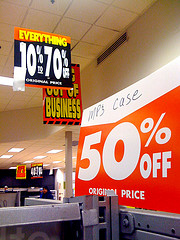
bankruptcy sale signs - tough times at Circuit CityAs Tom has set the tone already, how’s about some more economics?

This one’s even bleaker than the prospect of another bubble in the pipeline: John Robb explains why the consumer recovery being trumpeted desperately by newspapers everywhere is, at best, wishful thinking:

The driver of this fragility is that 75% of a typical American families budget (not counting education costs of kids) is dedicated to fixed expenses. This means that the loss a small as 10% in a family’s income would be sufficient to force failure. Combine this fragility with increasing income volatility and even the slightest shock will set off a wave of extreme frugality and mushrooming financial failure at the household level. In the past, we were able to hide this fragility through increased debt/bubbles. That’s over. We’ve already taken on as much debt (375% of GDP right now, and still climbing) as we can acquire and the banks are hoarding the bulk of federal cash infusions to paper over their insolvency (almost all of the toxic assets from last fall’s debacle are still in place, and more are en route from commercial real-estate).

Part of me would like to think Robb is wrong, but his ideas – and those of other outsider analysts like him – have the ring of truth about them, simply because they’re the only people who aren’t telling us what we desperately want to hear (which just so happens to be what governments and economists want us to believe).

Meanwhile, TomorrowMuseum points to an article at the Wall Street Journal that attempts to “remove the stigma of bankruptcy:

As long the economy stays grim, bankruptcy filings will become increasingly common – which may diminish the stigma that accompanies bankruptcy. It is, in a sense, surprising that so many Americans should still feel ashamed of bankruptcy when those in a far more comfortable situation feel no such chagrin. Corporate bankruptcies are an accepted part of doing business from Wall Street to Silicon Valley. Executives who collect $30 million from a bank in the years before it collapses are not expected to give it back.

Most striking to me as a European, though, is this bit at the beginning of the essay:

… too many people are talking about bankruptcy as if it’s a sign this country’s social safety net has failed. It isn’t. Bankruptcy is part of the safety net. Other countries have welfare states, America has bankruptcy.

Now, I’m no economist, I’ll freely admit… but from where I’m sat that sounds like something the Queen of Hearts might have said if Alice in Wonderland had been a satire on economics. Either that, or a contender for Panglossian statement of the decade. [image by quinn.anya]

The next economic bubble

foam_bubblesOne of the many fascinating aspects of the recent crisis of credit is discovering that many people predicted something like this would happen as far back as 2002, like the hilarious stockbroker/blogger Daniel Davies does here. Since reading his analysis of the post dot-com boom I have been on the look out for similar predictions of the next big bubble. And here we have one from Peter Boone and Simon Johnson at the New York Times:

The next global bubble is already under way. What happens when the most powerful nation in the world, with a reserve currency everyone trusts and holds, decides to push a big credit expansion — again, at the instigation of our financial sector? The creditworthy borrowers this time are not in the United States — they are in Asia, Latin America, and even Africa. They have little debt and great prospects; for a mere 1 percent per year they can borrow American dollars, spend the funds at home, and turn paper money into real assets. Every great bubble begins with a truly convincing shift in fundamentals.

In the 1990s this was called the “carry trade.” You borrowed from the Japanese at 1 percent and bought anything outside Japan that yielded a bit more (including United States subprime mortgages). The coming American carry trade is the same thing: it weakens the dollar, lifts the economy out of recession through exports, and creates inflation that reduces the real value of our debts.

It will be interesting to see whether this latest scheme works superbly forever or results in a collassal failure some years down the line. But if and when it does fail and results in another recession it will kind of suck.

Are recessions a normal and inevitable part of capitalism and free markets as they currently exist, and if so, is there something that can be done to improve the situation?

[from the New York Times][image from woodleywonderworks on flickr]

The future is biological

hummingbirdWired does an excellent job of focusing on a day-to-day aspect of an imminently transformative technology. Much is spoken of the coming biotech revolution, but industrial designers like Tuur Van Balen focus on the how biotechnology will present itself at the most basic level:

The 1s and 0s of software live in shiny metals shielded by colourful plastics; biological data lurks in dampness, in pipettes and test tubes. Hacking is about the culture of garages and workshops; DIY bio lives somewhere between the kitchen and the garden. You need mixing bowls and hygiene, beakers and taps. Every article about DIY bio seems to mention a salad-spinner. This isn’t the heavy macho culture of Survival Research Labs and steampunk. We’re moving from BarCamps to Tupperware parties.

Continuing with the theme of biomimetics: artificial technology is gradually merging with natural biology at both ends. Engineers borrow from nature to create new gadgets whilst biotechnologists seek to alter nature to meet human ends.

[from Wired UK][image from Lori Greig on flickr]

Smallest ever free-flying device

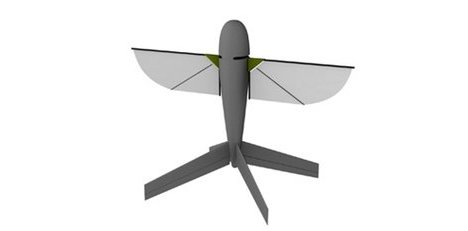
smallest-uavThe world’s smallest free-flying device has successfully flown. The DARPA-commissioned nano-air-vehicle flew TK without external support:

Aeronvironment has released a video that shows its “nano air vehicle” (NAV), which is the size of a small bird or large insect, hovering indoors without such crutches and under radio control. “It is capable of climbing and descending vertically, flying sideways left and right, as well as forward and backward, under remote control,” says the company….
Their ultimate ask is a ten-gram aircraft with a 7.5cm wingspan, which can carry a camera and explore caves and other potential hiding places. “It will need to fly at 10 metres per second and withstand 2.5-metre-per-second gusts of wind”

The micro-ornithopter/robot-insect concept has plenty of precedants in science fiction, and is another example of engineers borrowing from nature to solve engineering problems.

[from New Scientist, via Wired UK][image from ubergizmo]

Sparse posting apology

Hi folks;

Just a quick note to apologise for the paucity of posts here over the last few days, and to let you know it may continue for a few days more. Unfortunately I have a dead cable modem at home, and until the bureaucratic incompetents at the media company see their way to replacing it I’m in damage-control mode as far as my freelance work goes. Much as I’m loathe to let things slip here at Futurismic, I don’t currently have any other options. Please rest assured that I’ll be back up to speed just as soon as I can.

Thanks for your patience.

PGR