Category Archives: Blog

Eye in the sky – commercial satellites trace Sudanese arms purchases

Europe seen from space at nightWell, maybe ubiquitous global surveillance isn’t all bad. Remember that big load of tanks and armaments that Somalian pirates scored from a Ukranian cargo ship and subsequently ransomed back? Well, two magazine reporters used commercial imaging satellites to chase down their final destination, proving in the process that they were en route to the breakaway government of South Sudan:

Images captured by DigitalGlobe satellites in March 2009 showed 33 tanks parked at Kahawa Barracks northeast of Nairobi. In parallel, satellite imagery captured from southern Sudan showed tracked vehicles, parked under camouflage, at a Sudan People’s Liberation Army (SPLA) compound northeast of Juba, the capital of South Sudan. Jane’s observed that SPLA attempts to conceal the location “were deliberate and masterful, but dimensional analysis, tracked-vehicle scarring and the staging of three vehicles in a tactical perimeter established the concealed vehicles as tanks.”

It’s not particularly good news – governments tooling up for nasty regional conflicts never is – but it’s the sort of news we’re better off having than not. Maybe the UN should be funding more similar satellites so as to keep an eye on governments who are somewhat economical with the truth about their military build-ups? [image by woodleywonderworks]

Maybe we could use them to keep Obama and Medvedev honest with regards to their nuclear disarmament agreement… provided the whole thing isn’t a carefully orchestrated publicity play in the first place, natch.

Mono-molecular optical transistor brings quantum computing closer

Researchers at the Swiss Federal Institute of Technology have managed to make an optical transistor from a single molecule, offering another potential stay of execution for Moore’s Law.

ETH’s Martin Pototschnig told us more about the molecule used for the experiments. “It is a small hydrocarbon molecule called dibenzanthanthrene (DBATT). The molecules are doped in n-tetradecane, an organic solvent. So the sample is a pink liquid at room temperature. Then we cryogenically cool the small portion of the sample then the n-tetradecane freezes and forms a molecular crystal.”

The molecule itself is about 2 nanometers in size, over ten times smaller than standard transistors, which means that a lot more could be integrated in a single chip.

Great, you may be thinking, but what is it good for? Well, not much. Yet.

By using a laser beam to impose the quantum state of a molecular transistor, the research team demonstrated control of a second laser beam, which reflects the way in which a conventional transistor works.

“The next step is to ‘connect’ two or more [single-molecule optical transistors],” Pototschnig told us with regard to future areas the team will be focusing on. “In other words, we have to connect two molecules in a way that the quantum mechanical superposition state of each molecule is exchanged in a coherent manner. Only that way the strength of the quantum computing principles can be fully taken advantage of. We are in the middle of coming up with actual ways to implement the connection idea.”

Doesn’t really explain much, but then I don’t really fully understand how quantum computing is meant to work, despite numerous attempts to research it a bit further… if anyone can point me towards a good simplified explanation, please pipe up in the comments.

One thing I do know is that a lot of people are skeptical of quantum computing having any practical real-world applications, assuming it ever makes it out of the developmental stages. But then IBM’s chairman of 1943 never imagined the world would need more than five regular computers, and he’s been proved very wrong since then. Human ingenuity being what it is, we’ll find something to do with it once it’s here.

Is there any truly secure personal identifier?

identity theft warning signIf there were any criminal elements unaware of the potential for brute-force guessing of United States Social Security numbers, we can be sure they know about it now, as the news is everywhere. Thankfully, it’s still not particularly easy to do and has a low success rate:
An SSN consists of nine digits, the first five of which are assigned by established criteria based in part on the zip code in which someone was born. Now Alessandro Acquisti and Ralph Gross of Carnegie Mellon University in Pittsburgh have shown that it is possible to predict the remaining four digits from someone’s birth date.

For 8.5 per cent people born between 1989 and 2003, the researchers were able to identify the complete SSN within less than 1000 attempts.

Obviously a rethink is required, as an SSN can be used to apply for credit cards – but what to replace it with? In this specific instance, preventing automated online credit card applications would be a wise move, incorporating the added bonus of making high-interest credit less easy to obtain on a whim. [image by TheTruthAbout]

But the SSN issue is symptomatic of the growing problem of identity theft. Are there any ID systems that can’t be hacked, spoofed, brute-forced or cloned? If not – and I rather suspect not – what do we do in situations where it’s necessary to conclusively confirm a person’s identity, especially in situations where the person isn’t present?

Perhaps some sort of localised bureau network would be of use, with every town having an office that could act as an identity clearing house for a multitude of different high-risk transactions, requiring the applicant or transactee to attend in person to confirm that they are who they claim to be. Sure, it’d add an extra layer of hassle to things like applying for credit cards, but that’s a small price to pay for a lower likelihood of having someone else apply for one in your name.

But then any national bureaucratic system will have the sort of baroque operational architecture that invites colonisation by corruption and good old fashioned human error… perhaps it would end up as a step sideways, or even backwards. Sounds like a problem for Bruce Schneier!

Perhaps it’s time to accept that in any large system where user convenience is increased, the risk of identity theft increases in proportion. But what will it take for us to give up quick credit and one-click ordering?

Predicting future technologies with Eric Drexler

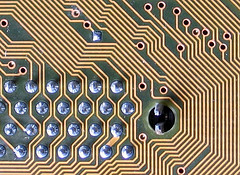
chipEric Drexler describes how you can apply scientific methods to assess the lower bounds of the capabilities of future technologies:

A subset of the potential capabilities of future levels of technology can be understood by means of a design process that can be described as exploratory engineering. This process resembles the first phase of standard design engineering (termed conceptual engineering, or conceptual design), but it serves a different purpose

In the early 20th century, a missing fabrication technology was the combination of engineering expertise and metalworking techniques (among others) that were required to build large aerospace vehicles. The physics of rocket propulsion, however, were well understood, and the strength and weight of large, well-made aluminum structures could be estimated with reasonable accuracy.

On the basis of exploratory engineering applied to this kind of knowledge, engineers who studied the matter were confident that orbital flight could be achieved by means of multistage chemically fueled rockets.

This was an element of Drexler’s Engines of Creation I found especially compelling: that we should base our ideas of future technologies not on what we already have, but what lies within the bounds of what is possible by physical laws as we understand them.

[image from quapan on flickr]

Is piracy irrelevent to authors?

Looks like book piracy will be one of this week’s genre blog hot topics after io9 had a chat with successful media tie-in novelist Michael Stackpole, who seems to have come round to Tom O’Reilly’s aphorism that obscurity is a bigger threat than piracy:

Writers still trying to break into the publishing world have an unprecedented chance to start their own websites, build an audience and create a market for their work without relying on major publishers at all, said Stackpole. Posting short fiction or even a serialized novel on a website won’t cause problems if a writer tries to sign a publishing deal at a later date because mainstream publishers don’t see digital publishing as a serious threat.

[As many other commenters have already pointed out, that’s not really the case… and certainly won’t remain the case for much longer. Still:]

Rather than simply changing the method of delivering stories to readers, Stackpole believes digital formats will change the nature of the stories themselves. At the very least, authors should tailor their work to these new mediums. He cited what he referred to as “the commuter market,” people who read two chapters per day on their half hour train ride to work. It’s an ideal market for fiction broken into 2,500 word chapters, and could presage a resurgence of serial fiction. “It’s kind of like a return to the Penny Dreadfuls,” he said. “But the readers today are more sophisticated, so we as writers need to put more work into it.”

Insert your own joke about skiffy media tie-ins and the word ‘dreadful’ here… 😉

Still, the web’s ability to change the publishing game is a given (as we’ve discussed here many times before). What remains to be seen is how things will look when (or if) the dust settles. A commenter at BoingBoing has a summary that seems pretty plausible:

… I’ve been saying that in the future books will be either cheap and print-on-demand, electronic, or expensive beautifully designed and crafted art objects, and that publishers will soon become irrelevant but you will see the rise of superstar editors and designers.

Nobody has disagreed yet.

Anecdotal, sure, but it matches up with similar theories from a whole raft of people both within the publishing machine and without.

In related news, fiction isn’t the only printed medium that is finding a new (and more affordable) home online. The American Chemical Society plans to move its dozen-or-so scientific journals to being published online only, according to a leaked memo:

In it, the publisher lays out the basic facts: printing a hard-copy version of a journal is expensive, and researchers simply aren’t demanding one anymore. Advertisers are undoubtedly aware of the reduction in print readership, which means that the former calculus that made print valuable—more ads per journal than could possibly fit on a webpage—was reaching a point of diminishing returns. According to the Nature article, the journals publisher flatly stated, “Printing and distribution costs now exceed revenues from print journals.”

The person who finally cracks the online publishing business model is going to be a very rich man indeed. So let’s hope it isn’t Rupert Murdoch… he seems to be heading in the wrong direction, anyway.