Category Archives: Blog

Crowdsourced insurgency 101: monetizing the local network

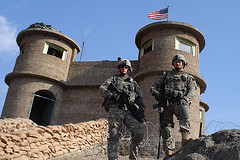
US soldiers in AfghanistanIt’s not been mentioned much on this side of the pond, but I imagine Stateside readers will have already heard about the US soldier allegedly “sold” to a militant Afghani clan by local-level insurgents. Here’s hoping he gets hauled out of there sooner rather than later. [image by Soldier’s Media Centre]

John Robb points out the marked difference in military networking that this sort of action represents; the Haqqanis are leveraging an entrepreneurial instinct in their local supporters, a sort of monetized and crowdsourced insurgency that relies less on having a standing army and more on rewarding local people for doing things your way.

As Fourth Generation Warfare becomes increasingly prevalent, perhaps the military forces of the West should take a page or two from the playbooks of their opponents – maybe wallets and billfolds are better targets than hearts and minds. After all, if your country is being torn apart economically by a war you don’t understand, who are you going to support – the alien invaders with expensive military hardware who blow a lot of stuff up in the name of political concepts that you don’t fully understand, or the guys who reward you for easily accomplished favours on your home turf?

Modelling the climate

weatherAn interview with Gavin Schmidt over on Edge explores the nature and development of climate modelling:

What we have decided, as a scientific endeavor, is to extrapolate as much as we can from our knowledge of the individual processes that we can measure: evaporation from the ocean, the formation of a cloud, rainfall coming from a cloud, changes in the wind patterns as a function of the pressure field, changes in the jet stream. What we have tried to do is encapsulate those small-scale processes, put them altogether, and see if we can predict the emerging properties of that fundamental complex system.

He explores the sometimes contradictory predictions of different climate models:

In the same way that you can’t make an average arithmetic be more correct than the correct arithmetic, it’s not obvious that the average climate model should be better than all of the other climate models. So for example if I wanted to know what 2+2 was and I just picked a set of random numbers, the answer by averaging all those random numbers is unlikely to be four. Yet when you come to climate models, that is kind of what you get. You get all the climate models and they give you some numbers between three and five and they give you something that is very close to four. Obviously, it’s not pure mathematics — it’s physics, it’s approximations, there is empirical tuning that goes on.

You need to have some kind of evaluation. I don’t like to use the word validation because it implies a kind of binary/true-false set up. But you need an evaluation; you need tests of the model’s sensitivity compared to something in the real world that can give you some credibility that that model has the right sensitivity. That is very difficult.

It is a lengthy essay/video interview but well worth the read/watch, as it is refreshing to hear firsthand from a professional climatologist.

[at Edge][image from Nicholas T on flickr]

Self-publish and be damned… or not?

There’s lots of discussion going on about self-publishing for authors at the moment. Over at Apex Online, Maurice Broaddus talks about why he’s resisted the temptations of self-publication:

I know the temptation of going the self-publishing route. I have a novel that I’ve shopped around, but have been rejected. I believe in the book, I want to see it in print, but I won’t self-publish it. The rejections have taught me that the book isn’t ready. Self-publishing would mean that I would have a bad (at worse) or prematurely released (at best) novel on my resume.

[…]

Self-publishing if fine if you’re a hobbyist and just want to see your name in print. It’s fine if you have a small niche you wish to reach. It’s also fine if you have a guaranteed audience that you can get product to. I know a few writers with dedicated fan bases for whom it made perfect sense to self-publish a project. It’s your career choice. Do your research.

The prevailing wisdom is that self-publication is a mistake for an aspiring author, though attitudes are relaxing in some quarters as times change. Here’s Jeff VanderMeer laying out the situations in which he thinks it can be beneficial:

I self-published my first fiction collection, The Book of Frog, and also The Surgeon’s Tale & Other Tales (with Cat Rambo)–the context for each consistent with my views on self-publishing as it exists today. If you can’t get traction in the publishing world with a first collection despite having had stories in good publications, I think it’s okay to self-publish. If you’ve got books out from major publishers and you want to do a less commercial project, I think it’s okay to self-publish. That said, within five to ten years, self-publishing in general will probably lose its stigma altogether and we’ll have a situation closer to what you find in indie music.

Self-publishing’s image is tarnished primarily because it gets used as a short-cut to publication for writers who – to be nice about it – simply aren’t yet up to writing a decent book. The obvious defence to that accusation is that not all unpublished writers are bad writers, and that’s certainly true… but I know from my editing work that the overwhelming majority certainly are.

So, as Jeff points out, things will be come much like the indie music circuit: the barriers to participation and distribution will be much lower, but it’ll be no easier to sell your work to people if you’re just not writing what people want to read (or writing it very well). Perhaps that will raise the profile of reliable reviewers and critics? A medium operating under the economics of abundance has a greater need for aggregators and gatekeepers to filter the infinity of choices, after all.

Any of you lot read any good self-published books that don’t deserve the stigma? And are there any self-published authors who’d like to share their experiences?
The bankruptcy auction that wasn’t

Here’s an interesting art installation that involves some science fictional thinking. Toys by Tomasso Lanza features digital renderings of assets to be sold at auction following the bankruptcy filing of a fictional Enron-like corporation. we make money not art explains:

The quick collapse of the company led to a fire-sale of most of ENT’s assets. In the months following the Chapter 11 filing, the liquidation team split the enormous sale across a number of auction dealers. Lanza created a photographic essay of some of the items surfaced by the bankruptcy auction, some of them perfectly mundane (executive chairs, workstations, gold balls and clubs, luxury cars, a range of sat nav, etc.), others fictitious. They are listed in the catalogue of an auction that dealt with low to mid-valued items and leftovers from previous auctions; despite the low-key of the sale, the dealers got their hands on a few items which were sold at much higher prices than originally expected thanks to their unique nature.

The fictitious items are straight out of a near-future/present day satire of corporate secrecy and hubris.

stock value viewfinder

This lot consists of an off-the-shelf viewfinder, plugged into some sort of digital tuning device with the words FTSE, DAX, HSI, DSM200, PHLX/KBW, MIBTEL, NIKKEI, NYSE, NASDAQ etched on. There is no documentation provided, although it is believed that these devices were secretly owned by a small number of executives and used for monitoring stocks and other financial products too sensitive to be displayed on-screen or retrieved on the company’s computers.