Category Archives: Blog

AI up the game

cardsA fascinating article in the FT magazine over the weekend on the ongoing arms race between those who program the software bots in online gaming rooms, one Martin Smith, and those who play against them:

These are contests that take place on constantly shifting terrain. Smith releases his latest version of a program: it wins for a couple of weeks, then the humans figure out how to beat it and they win for a couple of weeks while Smith goes away and works on his software – algorithms, probability calculations, search techniques – and scratches his head. Then he comes back with a new version of the program that wins for a couple of weeks, while the humans go away and think about it. “We have this ratcheting up,” Smith says. “It’s a very intellectually rewarding thing.”

“There’s a very big difference between computer intelligence and human intelligence. This is clearly indicated in games. Back in the ’70s, it was considered that in order to get computers to play chess like a grandmaster, they had to think like grandmasters. That turned out to be wrong. Computers can play fantastic chess and they don’t do anything remotely like what human grandmasters do.”

It is interesting how the upgraded software eventually becomes beatable after sufficient practice by large groups of humans. It’s also interesting for the insight into what a particular flavour of AI researchers actually spend their time doing.

On the distinction between mind and computers, this article at The New Atlantis makes for an interesting read.

[image from Malcav on flickr]

Culture wars: Authors, social media and the tribes of entitlement

We all know that the web and social media are useful things for authors, enabling them to keep in touch with each other and their fans and – when used inventively – add some buzz and cachet to a newly published book.

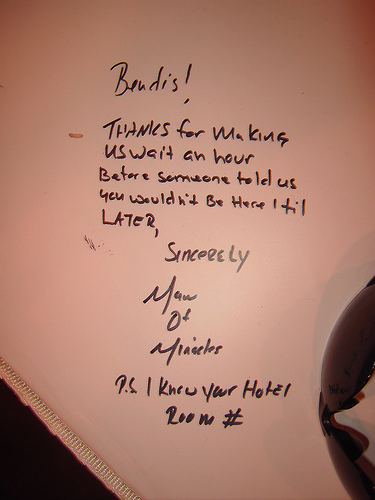
But – as with all things – there’s a dark side, and recent events have gotten me wondering whether the unprecedented level of access we have to the creators of our favourite cultural currency isn’t breeding a sense of entitlement above and beyond the appropriate. The trigger was this photo on Warren Ellis’ blog, showing a note written to comics maven Brian Michael Bendis from a disgruntled fan who’d not found him signing books when he expected him to be:

A "fan" note to Brian Bendis

Creepy and threatening – you can see why Ellis isn’t keen on doing convention appearances and signings (though woe betide the fan who hassled a cane-wielding Ellis in need of another Red Bull and nicotine fix).

Now, this sort of behaviour is hardly new, and as pointed out in the comments thread the root of the word “fan” is “fanatic”. But authors especially seem newly exposed by social media, because they’ve always been one of the less public types of artist – writers historically do not “perform” in public in the same way as musicians, for example, and would have been protected from a lot of the weirder communications from the outside world by having their publisher as an intermediary.

But not so much these days – look at the recent wave of bitching from George R R Martin’s fans when they discovered the next instalment of his current series would be delayed. You’d think that die-hard fans would be the first to sympathise with a creator’s need for a life beyond their work, but there’s a vocal minority who are anything but. As Scalzi points out, such people are fools – but the web has made them fools with metaphorical megaphones and your home address.

A related phenomenon seems to be arising on review and discussion blogs, something that Larry of OF Blog of the Fallen has labelled “The New Tribalism” – a situation where groups of fans with closely related passions fall into a kind of groupthink. This has its upsides – it’s that sense of tribe that motivates many fans in the first place, and there’s nothing wrong with discussing art you love with others who appreciate the same material – but there are downsides too, which manifest themselves as vocal disapproval of voices from outside the tribe (or occasionally within) who dare to criticise the tribe’s focus of interest.

This isn’t new either – as any member of any subculture anywhere will surely agree – but again the mobility and power of the phenomenon is amplified by the web. Debate around cultural opinions is a good thing, but mob psychology and the web’s potential for anonymity seems to be an open invitation to be taken to task for daring to have a different opinion to someone else.

Some of my concerns are professional in nature: I advise my clients about the the benefits of a strong web presence, and it’s almost shaming to have to confess that there’s this negative aspect to it. That said, I still hold that it’s worth the risks – why let a few bad apples spoil the barrel for everyone? Writers like Ellis and Scalzi have developed good tactics for dealing with trolling and tribalism; the primary component seems to be developing a thicker skin, though a strong sense of personal space and practiced rhetorical chops seem to be pretty useful as well.

But there’s a more Futurismic edge to it all as well, because it feels safe to assume that web-based creator-consumer relations are likely to become more prevalent as time goes by. As such, it’s not impossible to image a fandom with similar clout to the fabled Anonymous: what might said flashmob do in response to criticism of their totem? As the barriers between physical and informational realities become increasingly permeable, comment-thread flamewars and denial-of-service attacks would be just the start. Vernor Vinge’s Rainbows End features warring fandoms battling it out in augmented reality, with the action spilling out into damage to property and people; the more I think about it, the more plausible it becomes.

After all, we’re prone to going to war over ideologies; given the decline of interest in religion and politics among the younger and more net-native generations, it’s easy to see cultural affiliations taking their place. These culture-mobs could easily be great forces for fun and creativity, but the potential for the opposite to occur can’t be brushed aside. How might Brighton have looked had the mods and the rockers had mobile phones with web access to coordinate with?

Friday Free Fiction for 26th June – the end of an era

It’s Friday afternoon here in the UK, which can only mean one thing – it’s free fiction round-up time here at Futurismic!

But it should be noted that nothing is permanent in this universe – indeed, this is going to be the last ever Friday Free Fiction at Futurismic. Not because there’s any less good science fictional stuff to read on the internet – quite the opposite, in fact, as regular readers are doubtless well aware – but because it’s becoming increasingly hard for me to keep up with it all and paste it all together.

And when I can see someone else doing a far more complete job elsewhere (namely the doubtless pseudonymical Quasar Dragon over at SF Signal), I think it’s only fair to send them the kudos and the traffic they deserve. Getting back three or four hours of my working week is an added bonus, of course… 😉

So, in short: if you’ve been a loyal follower of Friday Free Fiction here at Futurismic, you should immediately subscribe to SF Signal‘s RSS feed, assuming you’re not subscribed already. Their daily free fiction posts cover fantasy and horror as well as science fiction, so you can pick and choose from the best of the genre writing available on the intertubes. You’ll also get all the other SF Signal posts, which are great stuff for genre heads of every stripe, and it’ll cost you nothing at all. Makes sense, doesn’t it? So make with the clicky.

(I also recommend our regular tipsters to send future notifications to SF Signal for inclusion in their round-ups; I’m sure they’ll be just as grateful for your input as I’ve always been!)

But let’s just tie up this week’s batch before we sign off for the last time, eh?

***

A big bunch from ManyBooks:

***

And a load more from FeedBooks:

***

Issue #90 of HUB Magazine features an extract from nerw Angry Robot-published novel Moxyland by Lauren Beukes

***

Strange Horizons presents “Another End of the Empire” by Futurismic fictioneer Tim Pratt.

Tim’s also starting a free-to-read donation-supported serial novella:

Bone Shop is a serialized, donation-funded urban fantasy novella, available for anyone to read for free. New chapters will go up every Monday. The Bone Shop website is here, though there’s not a lot there at the moment. I’ll post the first chapter on June 29.

Times are tough in the Pratt household, so if you can part with a few dollars a week to help out a very talented writer in exchange for him giving away some of his work, please do so.

***

Tor.com presents “The House That George Built” by Harry Turtledove

***

The ongoing serialisation of Jason Stoddard‘s Eternal Franchise continues with chapter 9.2

***

Some dreamscape weirdness from Captain VanderMeer: “Three Dreams and a Fabrication

***

Angry Robot Books has a sample extract from Chris Roberson‘s Book Of Secrets (as well as from some UrbFant zombie/detective mash-up which didn’t much appeal to me, but which might flick your switches).

***

Sumit Dam chips in with “The Heroism of Colonel Pussy

***

And as mentioned above, here are those incomparably complete free fiction round-ups from SF Signal over the last week: Saturday, Sunday, Monday, Tuesday, Wednesday, Thursday and today. That’s the way the professionals do it. 🙂

***

And that’s that, ladies and gentlemen; thank you all for reading along and sending in your tip-offs. I’ve discovered a lot of new writers and webzines through doing these round-ups, and I’m sure there’ll be more to come yet – so keeping watching your feeds! Meanwhile, it’s fiction and futurism business as usual at Futurismic from here on in.

Have a great weekend. 🙂

The key to ending ageing?

This week’s inescapable big science story is that of Brooke Greenberg, the teenage girl whose physical and mental development has seemingly  stalled at the stage of an 11 month old infant. In addition to the lamentable tabloid freak-show component to the story, however, is the claim from a researcher that Brooke’s genetic make-up may hold the key to arresting the ageing process.

Walker thinks that Brooke is the first recorded case of what he describes as “developmental disorganization”. His hypothesis is that the cause is disruption of an as-yet unidentified gene, or genes, that hold the key to ageing by orchestrating how an organism matures to adulthood, reproduces, then gradually ages and dies.

Walker believes that Brooke lacks this “regulator” of development – first proposed in 1932 by British marine biologist, George Parker Bidder. Like Bidder, Walker believes that the regulator guides organisms through to adulthood, but also works beyond then to orchestrate ageing and, eventually, death.

It bears repeating that this is one man’s hypothesis rather than a species-wide day-pass to the fountain of youth, but let’s assume for a moment he’s right. The first ethical question here is whether Brooke should be treated as a potential source of human immortality rather than simply as an unfortunate girl in need of a lifetime of care. Personally I don’t see a problem with researching the implications of a condition alongside giving palliative care for it, as discussed in the neo-eugenics post the other day.

The second ethical question – and, to my mind, the much more important one – is whether we’re right to be chasing after human immortality as a goal. It’s a much fuzzier line; while I don’t see any problem with wanting to extend the human lifespan and eradicate the negative aspects of the physical ageing process (a matter on which I am somewhat on-side with the transhumanists), I’m not sure that we’re yet in a geopolitical state as a species where we could cope with radically extended lifespans.

Most of our modern wars revolve around resources, and resources are becoming scarcer because people already live much longer than they did a century or two ago; how much more of an issue will energy supply be in developed nations when the average life expectancy has an extra handful of decades tacked onto it? Will birth rates decline in proportion to increased lifespan, and if not, how will we cope with a population that is both expanding and greying?

Neuromarketing – time for the revenge of the consumer?

showroom signRegular readers will be aware that technological marketing is one of my perennial topics here at Futurismic; it never ceases to amaze me how far companies will go to find new ways of selling us stuff more effectively. Neurological research is the cutting edge of the field these days, with Honda kitting out test customers with clothing that reports on their physiological status as they’re given the latest pitch in a gussied-up showroom:

Honda found the results so persuasive that it is remodelling showrooms and retraining staff to tailor pitches according to a potential buyer’s state of mind. “The hypothesis is that if you get the [sales] experience right, you may not need that price promotion to sell a product,” explains Ian Armstrong, manager of customer communications for Honda UK. “Conventional research only gets you so far because it’s rationalisation after the event, and most decision-making is done subconsciously. We set out to measure physical changes people cannot consciously control.”

Honda is not alone in believing brain science can boost the bottom line. A growing number of businesses say that traditional ways of understanding consumers – direct questioning, observing our behaviour – don’t explain why we buy one product over another. And they are turning to neuroscience for the answers.

All well and good for Honda, I guess – though I’d be immensely amused if at the end of it all it was discovered that purchasing choices are largely sub-rational and random. For now, though,  I’m inclined to see the sales floor as the battleground of an arms race. After all, the technologies Honda are using are comparatively lo-fi, the sort of thing that a smart independent researcher could knock up on a budget. So maybe consumer advocacy groups will start their own counter-research programs, offering tactics and training to enable shoppers to spot when they’re being manipulated by environmental factors or neurolinguistic programming techniques, and ways of turning the tables on the salesmen. Knowledge is power, right? [image by mrflip]

Of course it’ll be a while before grass-roots research can match the sort of data that fMRI scans can gather, but if there’s one up-side to the economic slump it’s that people already seem to be thinking far more carefully about what they buy; all the crafty persuasion techniques in the world won’t do you any good in an empty showroom, after all. And just to go all the way with the blue-sky thinking, perhaps we’ll eventually end up in a world where manufacturers realise the best way to sell us something is to have a robust and functional product that people actually need…

… hey, a guy can dream big on a Friday, can’t he?