
Category Archives: Blog

Pseuicide – faking your death on the internet

fake death?Via Chairman Bruce comes a great article at Wired UK about the phenomenon of Munchausen By Internet – members of online communities who fake serious illness or death for a variety of reasons, be it to dig themselves out of their other untruths or because they enjoy being the focus of mass sympathy:

In his 2004 book Playing Sick, Dr Marc Feldman, a clinical psychiatrist at the University of Alabama, offers the first published investigation into a disorder he refers to as “Munchausen by internet”, or MBI, which introduces an online element to the symptoms of Munchausen syndrome, the condition whose sufferers fake sickness and may demand medical treatment for a illness they do not really possess.

“The easy and ready access to the internet propagates MBI,” said Feldman in a recent email. “In fact, I believe that MBI is more common than MS in ‘real life’. The reason is that it is so easy to use the net to research medical conditions, post fallacious materials, and engage others without the need to literally enact an ilness. Many of these people seem to be very lonely, and the internet offers a readily and continually-available source of unconditional support.”

In one startling case, a woman from New Zealand named “Sara” approached Feldman with an 8,000-word confession of her own Munchausen by internet, a story of vast complexity and novelistic detail in which she created more than eight online aliases, constructed intricate relationships between them, and killed at least five.

It’s grimly fascinating to see how the internet is amplifying some of the weirder parts of human psychology. I can’t help but wonder whether or not this might become some sort of performance artform, though; one of the earliest examples of a faked death online was a guy on USENET:

In 1999, when online interaction was still in its relative infancy, a prominent poster on the popular usenet group alt.religion.kibology perpetrated one of the earliest fake deaths, partly as a way “to be a fly on the wall at my own funeral” but also purportedly as part of an investigation into the nature of online relationships. A long-time and regular poster named M Otis Beard suddenly became unusually argumentative with fellow contributors over a brief period, before one of Beard’s friends, who had met him in real life, posted a muted and thoroughly credible notice that Beard had killed himself.

[…]

Some days later, Beard himself resurfaced with a message that, while overbearingly smug in tone, is underpinned by what he claimed was an intellectual motive. After a gleeful pronouncement that “rumors of my death have been greatly exaggerated”, Beard announced that his “little escapade” had been a method of testing the sense of community in the group and had been designed to offer a perverse sense of catharsis when the deception was revealed.

“You thought you had irretrievably lost something; that something is now returned to you,” he wrote. “If I hadn’t made you sad by pretending to be dead, I wouldn’t have been able to make you happy (well, OK, angry and THEN happy) by jumping out of my coffin, whole and hale. Forgive me for putting you through the emotional roller coaster ride, which I hope was a healthily cathartic experience for all of you.”

That sounds exactly like the sort of stunt that the 4chan/Anonymous massive might come up with, keen as they are to shatter expectations, wind up the over-emotional and disrupt internet communities using the very tools used to construct them. I can easily imagine some sort of annual awards for the most convincing, most audacious or most ridiculous faked deaths… and increased awareness of the phenomenon will only make it seem more of a challenge. [image by aliscarpulla]

Bussard ramjet revisited

star_and_barsAn interesting discussion of Bussard ramjet interesteller propulsion technology here at Centauri Dreams and Adam Crowl:

Robert Bussard put the interstellar ramjet into the public eye back in 1960 in a paper proposing that a starship moving fast enough would be able to use the hydrogen between the stars as a source of fuel, enabling a constant acceleration at one g.

One of the key problems with Bussard ramjets is the speed of the fusion reactions:

Physicist Daniel Whitmire tackled this problem in a 1975 paper that proposed using hydrogen for fuel but exploiting a catalytic nuclear reaction chain instead of straight proton burning.

It’s all interesting stuff, but even if the Bussard ramjet is unfeasible as a propulsion system it may be feasible as a brake for interstellar spacecraft.

[image from kevindooley on flickr]

Capitalist education? Kids get better grades if you pay for them

Here’s your second “well, duh” story of the day – experiments in New York schools that serve high-poverty demographics indicate that offering kids financial rewards for good grades makes their average results skyrocket.

About two-thirds of the 59 high-poverty schools in the Sparks program — which pays seventh-graders up to $500 and fourth-graders as much as $250 for their performance on a total of 10 assessments — improved their scores since last year’s state tests by margins above the citywide average.

The gains at some schools approached 40 percentage points.

For example, at PS 188 on the Lower East Side, 76 percent of fourth-graders met or exceeded state benchmarks in English — 39.6 percentage points higher than last year, when the kids were in third grade.

At MS 343 in The Bronx, 94 percent of seventh-graders met or surpassed state standards in math this year — 37.3 points higher than last year, when the students were sixth-graders.

In all, of the 61 fourth and seventh grades involved in the pupil-pay program, only 16 improved less than the citywide average gain in math since last year, while 21 did so in reading.

Principals at the highest-scoring schools cautioned that the Sparks program was just one of many factors in the test-score jumps.

But many reported seeing indisputable academic benefits — including more motivation, better focus and an increase in healthy competition for good grades among students.

Now, there’s probably an argument to be made about the sanctity of education and the corruption of kids with money here, but I’m not sure it holds much water beyond staff-rooms. What matters in education is results, right? If you can get kids who are otherwise completely unmotivated to put some effort into learning and bettering their prospects, where’s the problem with spending some cash to do it?

You might say that education should be pitched as being its own reward, and that’s a charming philosophy familiar to me from my privileged middle-class background, but I think it’s pretty safe to say that system evidently isn’t working well among those who most need it. And hey – if you’re preparing kids for entry into a capitalist economy where making money is a tangible and observable benefit by comparison to the more nebulous notion of “bettering oneself intellectually”, why not use money as the carrot at the end of the stick? When idealism has failed, maybe pragmatism deserves a a crack of the whip. [via SlashDot]

Oil rigs are vulnerable to hacking

oil rigIt shouldn’t come as a huge surprise – after all, anything that uses networked computing is at risk without the proper precautions – but independent researchers have declared oil rigs to be extremely vulnerable to hacking attempts.
While oil companies have made huge improvements in offshore safety and environmental protection, their efforts to secure important data have been poor, the SINTEF team says.

The group says that the current “integrated operations” model, which uses onshore workers to control processes carried out on the platform via networked PCs, leaves communications open to attack.

According to Science Daily, the team interviewed “key personnel in the petroleum sector” to get a sense of the data protection measures currently in place. The interviewees confirmed “that the number of safety incidents on production systems (platforms) has risen during past few years.”

Researchers said that hackers have already made their presence felt on oil platforms.

The worst-case scenario, of course, is that a hacker will break in and take over control of the whole platform,” says SINTEF scientist, Martin Gilje Jaatun. “Luckily, this has not happened yet, but we have heard of a number of incidents that could have turned into something quite dramatic. For example, virus attacks have led to process electronic equipment becoming unstable.

Frankly I’m surprised there haven’t been any major incidents so far, but it’s safe to assume that the inevitable resurgence of oil prices (not to mention the increasingly politicised nature of the fossil fuel industry) will make unmanned rigs into highly appealing target for hackers interested in protest or profit. [image by ccgd]

In fact, the profit motive is probably the stronger of the two… profit, or the prospect of free fuel. Any terrorist group or pirate nation looking for a ready source of the black gold would find it easy enough to hire some disaffected code-kiddie, then pay (or threaten) them enough to get them to bypass the security on an unmanned rig and then fiddle the telemetry for long enough to allow a physical invasion of the platform. Hey presto – a big base in offshore waters with all the oil you could ask for, and a target that even a major government is going to think twice about simply bombing to smithereens

New resin for growing flesh

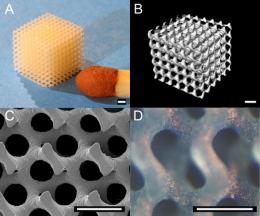
biodegradable_resinResearchers at the University of Twente have developed a biodegradable resin that can be used to create precise replicas of forms within the body around which new tissues can be grown:

The resin can be given different properties depending on where in the body it is to be used. Cells can be sown and cultured on these models, so that the tissues grown are, in fact, produced by the body itself. The new resin has been developed by Ferry Melchels and Prof. Dirk Grijpma of the UT’s Polymer Chemistry and Biomaterials research group. An article on this breakthrough will be appearing in the authoritative specialist journal, Biomaterials

The method used to recreate the specific forms is called stereolithography, the improvement in this system is that the resins have hitherto not been biodegradable. This means:

If, for example, a child has a heart valve disorder, a 3D digital image of the heart valve can be created using a CT scanner. The model in the stereolithograph can be copied exactly with the new resin. If the structure is made porous, the child’s own cells can be placed on it. This porosity also gives nutrients access to the cells. Ultimately, after the carrier structure has broken down, only the natural tissue remains.

Which is a rather wonderful development.

[from Physorg]