Category Archives: Blog

‘Craveable’: Does the food industry play with our heads?

big-boy1Trying to write an optimistic science fiction story for a change has led to some fascinating research avenues. If we want to give our poor put-upon planet a bit of a break, wouldn’t it make sense to change the way we eat? Think of the fuel we could save, the waste we could cut back on…

Not so fast, though. Former U.S. Food & Drug Administration commissioner (under Clinton and W.) and pediatrician David Kessler says one of the reasons Americans overeat is because the food industry, not unlike tobacco before it, is messing with our minds.

At first glance, that sounds obvious, given the myriad of junk-food choices and the constant blare of advertisement. Kessler digs deeper, though, in his new book The End of Overeating:

“The food the industry is selling is much more powerful than we realized,” he said. “I used to think I ate to feel full. Now I know, we have the science that shows, we’re eating to stimulate ourselves. And so the question is what are we going to do about it?”

In good dramatic fashion, Kessler says it’s partly his fault: when he headed the FDA he won battles for better labeling of processed foods, but didn’t push much for labels in restaurants.

His own dumpster-diving research (note to Hollywood: this book needs to be a movie) led him to the conclusion that not only are seemingly healthy menu choices like grilled chicken or spinach dip larded with “fat on fat on salt on sugar on fat on fat,” but that they are more or less deliberately designed to goad you brain into craving more, even when your stomach has had more than enough. He estimates that 15% of the U.S. population is vulnerable to “conditioned overeating.”

(And everytime I visit another country I see more U.S.-based food chains — sorry about that, but I’m guessing this is not just an issue for my own country.)

Willpower, yes; government oversight, maybe, says Kessler. Far better to change the way we look at food – to break the emotional association with good times. Perceptions have changed for the better before this, he points out: consider shifting attitudes towards cigarettes, driving without a seat belt, or drunk driving.

By now some readers are thinking “That’s obvious,” or rolling their eyes at the prospect of more nanny-statism. (I did both.) Skepticism is healthy, too. For starters, I’d like to know more about the neuroscience of those “reward circuits.” Here’s a taste, though:

Yale University neuroscientist Dana Small had hypereaters smell chocolate and taste a chocolate milkshake inside a brain-scanning MRI machine. Rather than getting used to the aroma, as is normal, hypereaters found the smell more tantalizing with time. And drinking the milkshake didn’t satisfy. The reward-anticipating region of their brains stayed switched on, so that another brain area couldn’t say, “Enough!”

You can hear some NPR interviews with Kessler here, there, and everywhere.

[Image: Iconic US diner mascot Big Boy by Patrick Powers]

Forget to remember; remember to forget – daydreaming solves problems

Another data point to add to the collected studies of creativity and problem-solving: daydreaming activates the same parts of the brain that are used in solving complex quandries:

Until now, the brain’s “default network” – which is linked to easy, routine mental activity and includes the medial prefrontal cortex (PFC), the posterior cingulate cortex and the temporoparietal junction – was the only part of the brain thought to be active when our minds wander.

However, the study finds that the brain’s “executive network” – associated with high-level, complex problem-solving and including the lateral PFC and the dorsal anterior cingulate cortex – also becomes activated when we daydream.

Having spent a good half of my life hanging around with artists, writers and musicians – all of whom tend to mental drifting to a greater or lesser degree, especially when working – this doesn’t really seem like a surprising result, but it’s interesting to have scientific support for an observational theory. All I need now is more time to daydream with… [via BoingToTheBoing]

Your new designer brain

neuroneA fascinating article in New Scientist on neural prosthesese and the possibility of a new source of inequality: between those who can afford to pay for technological mental enhancements and those who cannot:
People without enhancement could come to see themselves as failures, have lower self-esteem or even be discriminated against by those whose brains have been enhanced, Birnbacher says. He stops short of saying that enhancement could “split” the human race, pointing out that society already tolerates huge inequity in access to existing enhancement tools such as books and education.

The perception that some people are giving themselves an unfair advantage over everyone else by “enhancing” their brains would be socially divisive, says John Dupré at the University of Exeter, UK. “Anyone can read to their kids or play them music, but put a piece of software in their heads, and that’s seen as unfair,” he says. As Dupré sees it, the possibility of two completely different human species eventually developing is “a legitimate worry”.

But the news is not all bad, with the observation that the human brain is becoming ever more plastic and capable of adaptation:

Today, our minds are even more fluid and open to enhancement due to what Merlin Donald of Queens University in Kingston, Ontario, Canada, calls “superplasticity”, the ability of each mind to plug into the minds and experiences of countless others through culture or technology. “I’m not saying it’s a ‘group mind’, as each mind is sealed,” he says. “But cognition can be distributed, embedded in a huge cultural system, and technology has produced a huge multiplier effect.”

It is interesting to speculate what the long-term consequences of dense technological interconnectedness will be on the human condition. Even assuming actual precise neuroengineering proves difficult, neural prosthesese offer a world of opportunity.

[via KurzweilAI][image from n1/the larch on flickr]

Friday Free Fiction for 15th May

Once again, the weekend has sneaked up on me almost without being noticed… if it weren’t for G-Cal and Remember The Milk I’d probably forget to eat most days. But Friday tends to stick in the mind, because that’s the day I wrap up another big list of the past week’s free science fiction stories on the intertubes. Onward!

***

Here’s few from FeedBooks:

***

Missed this one last week (only human, sorry!); a message from Jeffrey A Carver via Tor.com:

Eternity’s End is my Nebula-nominated novel about a star rigger named Legroeder who sets out in search of the lost ship Impris, Flying Dutchman of the stars. And along the way, encounters interstellar pirates and some deep-cyber romance. This book is free range, free running, cage free, up on the web for you to download for free!

Go fetch!

***

Issue #86 of HUB Magazine includes two stories:

  • “Wink” by Lucy Kemnitzer
  • “Tastes of the Dark” by Malin Larsson

***

Even though Jason Stoddard has now sold the hardback rights to Eternal Franchise, he’s still giving the whole thing away; we’re up to chapter 7.1

***

Another DVD extra from Shadow Unit Season 2: “Scene

***

Strange Horizons presents part one and part two of “The Rising Waters” by Benjamin Crowell

***

From the prolific Lee Gimenez:

I just wanted to let you know that my short story “Unhistory” was just published in the May 2009 issue of Orion’s Child Magazine.

Bravo, Lee!

***

From Nancy Jane Moore:

On Book View Cafe this week, you can read:

Cat T’ai Chi“, a graphic whimsey by Ursula K Le Guin; “Running the Road“, a longish flash fiction from Nancy Jane Moore; Maya Kaathryn Bohnhoff‘s “Heroes“, which is novelette-length; “Waterwoman Nude“, a brand new story from Kate Daniel; a memoir from BVC’s newest member Alma Alexander, “Houses in Africa“; and a bonus scene — not in the print book — from Pati Nagle‘s new book, The Betrayal.

And that’s just a tiny amount of the free material available on the Book View Cafe site, which has everything from serialized novels to plays.

You heard the lady – go take a look.

***

And here’s a few extras via SF Signal and their diligent inter-ma-web filtration-elves:

  • Afterburn SF presents “Ten Little Phobias” by Bev Vincent
  • Issue 131 of AntipodeanSF has appeared, including stories by Kieran Salsone, Tom Williams, David Scholes, Mark Farrugia, Shaun A Saunders, Jamie Richter, Scott Wilson, Jan Napier, Simon Petrie, and Mika F Cella
  • Marie Brennan is offering (in multiple formats) the free novella “Deeds of Men“…a story that takes place between Midnight Never Come and her upcoming novel In Ashes Lie.
  • Baen’s Webscription presents “The Menace from Earth” by Robert Heinlein

***

And it looks like that’s the lot. Unfortunately, Keyboard Cat is contractually unable to play me off unless I bribe his management with cargo containers full of fresh tuna, so I’ll simply end with the usual request to keep us posted about anything you think merits inclusion in next week’s round-up, and the suggestion that you have yourself a damn good weekend. *waves*

Bright-greening Dubai

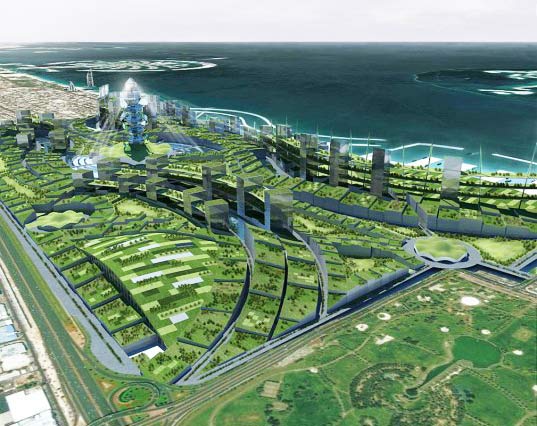
Whatever you may think of Dubai (and however much of it is actually true), you can’t deny that those people know how to dream big. The Dubai Chamber of Commerce has apparently green-lit a plan for a self-sufficient off-grid ecotopian zone, dubbed (with what one presumes is as much hope as anything else) “Food City”. And here’s the proposal from architectural outfit GCLA:

Dubai "Food City" concept

GCLA has described their proposal for Food City as the “the marriage of landscapes and urbanism”. Their project integrates a variety of proposals to decrease overall energy use — concentrated solar collectors, towers covered in thin-film photovoltaic cells, piezoelectric pads in pedestrian areas, and methane harvesting through sewage percolation tanks.

GCLA also proposes water conservation measures critical to off-the-grid survival in water-starved Dubai, like atmospheric water harvesting, solar desalination through concentrated solar collectors, grey water recycling, and application of hydroponic sand to minimize water loss. Essentially, GCLA’s vision is an amalgamation of nearly every urban sustainability initiative in the past few years. It’s certainly utopian, but it may ultimately prove necessary.

Necessary, perhaps; but plausible, practical or realistic? Even assuming the best about Dubai, I’ll be surprised if the application of money and architectural talent alone can build a self-sufficient garden city in one of the dryest places on the planet… but it sure does look pretty. [image copyright GCLA; reproduced under Fair Use terms, contact if takedown required]