Category Archives: Blog

Framing cloning – the media and genetic science

mannequin clonesCloning stories are like buses; you wait for ages, then three come along at once. This has been one of those weeks, it appears, with the tale of yet another outsider scientist claiming to have successfully cloned a human being taking the lion’s share of the spotlight. [image by antmoose]
New Scientist takes a look at the way self-styled pioneers like Zavos court media attention for their activities, and calls them out as – at best – manipulative and misleading:

It doesn’t help that the latest coverage includes a picture of a little girl killed in a car crash – and whose cells were cloned through hybridisation purely for study – alongside a headline in the paper describing her as “The little girl who could ‘live’ again”.

This perpetuates the cruel myth and widespread misconception that cloning is a way of raising the dead. In fact, if it worked, it would simply be a way of creating an identical twin of whoever was cloned, but separated in time.

To some extent, science fiction can be blamed for misconceptions about cloning. The more serious and thoughtful books on the subject have been somewhat overshadowed by sensationalist TV and movie plots or the technophobia of writers in the Michael Crichton mould.

But that’s not for want of the facts being available; as the known sf geek in my local social circle, people ask me about topics like cloning quite a bit, and I try to give them the most realistic overview of the topic I can. It rarely works. The truth is not as compelling a story as a rogue-science thriller or a riff plucked out on the heart-strings. Perhaps I’m just not a good enough storyteller.

But hey – at least we get some cute headlines alongside the shock-horror stories and emotional grandstanding of hucksters. Look – glow-in-the-dark puppies!

All together now: aaaawwwww!

“Good enough” computing – will the recession kill off Microsoft?

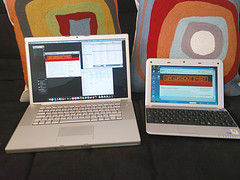
laptop and netbookThis speculative futurism thing is starting to spread! Keir Thomas, Linux columnist for PC World, has posted a future retrospective piece that looks back from 2025 to the present day as the dawn of “good enough” computing… and the beginning of the end for Microsoft.

The lack of desire to relinquish XP by users was part of what became known as the “Good Enough” revolution in both software and hardware. At the beginning of the 21st century, computing hardware had evolved sufficiently to reach a level of performance that allowed for speedy execution of virtually all common computing tasks. Prior to this, the only way to guarantee good performance was to buy expensive cutting-edge hardware. But now chips costing just a few dollars offered more performance than most people would ever need.

Upgrading became less a matter of getting a better PC than about simply replacing old and broken computers with newer models. Ever resourceful during the Great Recession that struck in the early 21st century, PC manufacturers responded with ultra-cheap but “good enough” computers (both laptops and desktops) that were designed to be simple slot-in replacements for existing computers. PC manufacturers had already carved this route with netbook computers, where the goal was to be cheap and usable, with little if any frills.

Obviously there’s an element of fun-poking to Thomas’s piece (alongside the enduring positivity of the committed Linux evangelist) but as a piece of speculative futurism it’s a solid and plausible job. The details may well work out differently – and I’d be surprised to see even the recently-beleaguered Microsoft drop out of the game quite that easily – but the idea of computing as commodity was raised by Charlie Stross a year and a half ago, and many others since. As the line between mobile devices and ‘proper’ computers continues to blur (and convergence with phone handsets accelerates), Thomas’s future doesn’t look too fictional at all. [via the spiritual home of the Linux-takes-all story, SlashDot; image by Matthew Verso]

The first watery exoplanet?

An alien coastline?I’ll wager you’ve caught at least a hint of this story already: astronomers reckon they’ve located the first serious candidate for a water-bearing exoplanet:

… new calculations – made possible by the discovery of “[Gliese 581] e” – show that the larger planet is squarely within the so-called “habitable zone,” neither too far nor too close to the star around which it orbits to support life.

“Gliese 581 d is probably too massive to be made only of rocky material, but we can speculate that it is an icy planet that has migrated closer to its star,” said co-author Stephane Udry, a professor at Geneva University, in Switzerland.

“It could even be covered by a large and deep ocean – it is the first serious ‘waterworld’ candidate,” he said.

A waterworld, eh? As Gareth L Powell put it, maybe we should dispatch Kevin Costner immediately

More seriously, a wet Gliese 581 d is only a possibility as yet, but it’s a possibility that shifts the odds on there being life elsewhere in the universe. When (or perhaps I should say “if”) we manage to confirm the presence of liquid-phase water on other planets, we’ll have to concede that the likelihood of life evolving elsewhere is not as remote as was once thought… which will doubtless be immensely upsetting to some people, but makes me feel pretty good. [image by Paulo Brandão]

Furniture with character

How can we fix our relentless habit of buying new stuff to replace perfectly functional older stuff? James Pierce of Indiana University has an idea: design household objects to interact with us periodically and engage our attention beyond their established roles:

For instance, he has designed a table with an embedded digital counter that displays the number of heavy objects that have been placed on it during its lifetime. The counter becomes blurry or erratic if someone drops a heavy object on the table, only later returning to the correct count.

Another approach is cheeky misbehaviour, such as a lamp that dims if you leave it on for too long; shaking the lamp “wakes” it again. Or a clock that occasionally shows the wrong time, only to correct itself and display a message that it was just joking.

There’s more than a hint of Philip K Dick in that idea… and as much as I can see where Pierce is trying to go, it’s surely a bit too playful and arty to actually swing in the real world. I don’t know about you, but if I had a clock that periodically lied about what time it was, I’d replace it sooner rather than later!

2020 – Varsity’s end?

empty university lecture hallUnless they start to adapt quickly, colleges and universities could become irrelevant in little more than a decade. So claims Professor David Wiley, at any rate, using arguments that should be familiar to die-hard internet denizens and futurists:

America’s colleges and universities, says Wiley, have been acting as if what they offer — access to educational materials, a venue for socializing, the awarding of a credential — can’t be obtained anywhere else. By and large, campus-based universities haven’t been innovative, he says, because they’ve been a monopoly.

But Google, Facebook, free online access to university lectures, after-hours institutions such as the University of Phoenix, and virtual institutions such as Western Governors University have changed that. Many of today’s students, he says, aren’t satisfied with the old model that expects them to go to a lecture hall at a prescribed time and sit still while a professor talks for an hour.

Higher education doesn’t reflect the life that students are living, he says. In that life, information is available on demand, files are shared, and the world is mobile and connected. Today’s colleges, on the other hand, are typically “tethered, isolated, generic, and closed,” he says.

It’s the “open everything” argument, of course, but it’s given a certain extra weight in this instance because Wiley lectures at Brigham Young University, a small private university owned by the Mormon church; if they can see the writing on the wall and admit to it, then change is definitely afoot (although Wiley makes the point that establishments like Brigham Young offer “a religious education and the chance to meet and marry an LDS Church member”, which is effectively a kind of social network attraction, albeit a non-technological one). [via Technovelgy; image by Shaylor]

I’d go a few steps further, though. Wiley suggests that “universities would still make money, though, because they have a marketable commodity: to get college credits and a diploma, you’d have to be a paying customer.” I’m not sure how things stand in the US, but here in the UK we have a saturation of graduates with qualifications that are either oversupplied or effectively irrelevant to obtaining a job (in parallel with a decline in the number of science and engineering graduates); as further education has become much more expensive (as a result of the government’s efforts to make it available to all, ironically) its final product has become devalued. What most employers want now is experience and demonstrable ability – two things that a diploma does not guarantee in any way.

So perhaps we’ll see a return to something like the old guild apprenticeship system, wherein people work for a company at the same time as they take an assortment of modular courses with direct relevance to the job in question, moving up the ranks as they gain – and demonstrate – the specialist knowledge and skills required, at the pace which best suits them. There’d be nothing to prevent someone learning beyond their discipline if they so chose, or spending a lifetime in pursuit of academic achievement.

In fact, the more I think about it, the more I’m put in mind of “Phaedrus’s university” as described in Zen and the Art of Motorcycle Maintenance (yes, I do have a hippie streak, as if you hadn’t guessed), the most important component of which is the way it decouples education from coercion, obligation and standardised achievement metrics. Pirsig’s ideas were considered pretty radical in their time, and largely dismissed as unworkable; in the light of the ever-growing ubiquity of the web and free content, maybe it’s time to take another look.