
Category Archives: Blog

The road to post-scarcity

geodesic architectureIt seems that nothing can prevent Futurismic fiction regular Jason Stoddard from looking for the silver lining to every cloud – even beyond his fictional output. [image by dno1967]

Point in case: his recent article for transhumanist/futurist organ H+ Magazine, which glories in the sprawling title “First Steps Towards Post scarcity: or Why the Current Financial Crisis is the End of the World As We Know It (And Why You Should Feel Fine)“.

A lot of the ideas Stoddard raises will be familiar to science fiction readers, and many of his points are made by looking at the current situation from a different angle to the fashionable mode of doom and gloom. For example:

We’re also already starting to see some examples of near post-scarcity. Consider computers and communications. If you’re willing to use a computer that’s a couple of years old, you can probably find a hand-me-down for free, and then happily talk to your friends around the world on Skype using free public wi-fi.

Or consider that in the last Depression, the main worry was simply getting enough food. Today, the marketplace is more worried about maintaining the marketing budgets of 170 different kinds of toothpaste than about ensuring that everyone has toothpaste. There’s a lot of padding in the system. Couple a financial crisis with this overweight, inefficient system, and you have the stage set for the first transition to post-scarcity: a comprehensive rethink of our concept of value.

You could easily accuse the piece of being Panglossian, but I’m inclined to think that’s a deliberate rhetorical gambit on Stoddard’s part – countering an excess of negativity with a big slice of sf-nal optimism. I’m not that confident that we’ll end up in a nanotech-powered utopia devoid of all wants and needs within my lifetime, but then I’m also not convinced that we’re going to slouch our way into a scenario of global misery and decline. As usual, reality will probably end up somewhere in between the two idealised poles of punditry… but I’m not ashamed to admit I hope it ends up closer to Stoddard’s vision than many of the others.

War-porn for the week – smart bullets

sniperRegardless of your opinion about the Somalian pirate situation, if you’ve a jones for high-tech weaponry you’ll have been enjoying the brief flurry of military hardware reportage that emerged in the wake of the kidnapping rescue mission.

Wired has the low-down on how much more awesome the armed forces might be once DARPA has churned through a bit more R&D work:

Already, we’ve seen Navy SEAL shooters take out three pirates with three trigger-pulls — despite uneven seas and bobbing ships. Imagine how much easier the snipers’ jobs would have been, if they had rounds that could change course in mid-air, to account for crosswinds, air density, and moving targets. Darpa, the Defense Department’s way-out research arm, launched a $22 million effort in November to do just that. By countering these “fundamental limitation[s] of accuracy,” Darpa thinks it can dramatically improve American snipers’ range — and “provide a dramatic new capability to the U.S. military.”

Dramatic? Not the ideal choice of word, perhaps. Surely it would be more dramatic for the sniper to miss with every bullet but his last? But I digress – there’s more to come:

A companion project, Super-Resolution Vision System (SRVS), wouldn’t just make snipers more accurate. It would make them functionally invisible, as well. The system is trying to use “heat haze” — that shimmer you see on summer days, out in the distance — for helping snipers, instead of inhibiting them. In any given instant, the heated air acts as a series of lenses; you may be able to look right through them and see a magnified view of the scene beyond. The trick is to use digital technology to identify the “lucky regions” or “lucky frames” when a clear view appears and assemble them into a complete picture. SRVS researchers are aiming to do just that.

It’s always a relief to know that, even in the depths of a global economic slump, we’re still working hard at finding new and inventive ways to kill one another. [image by mateus27_24-25]

The other side of Dubai

Last week I linked to a lengthy article on Dubai that didn’t paint it in an attractive light at all; it was pointed out in the comments (not to mention in many other places around the web) that said article was a bit of a hatchet job.

Via BoingBoing (from whom came the original story) comes a response from Joi Ito, a recent arrival in Dubai:

I’m still new to the region so I can’t speak definitively as a native, but I do know that the picture that is sketched is pretty biased and I think could be rightly called “bashing”. As far as I can tell there is a crunch going on, just like everywhere else, and the government and businesses are trying to figure out what to keep and what to shut down. There are a lot of solid businesses and a lot of solid business people in Dubai and like anywhere else, consolidation and downsizing is taking its toll.

[…]

I don’t want to sound too defensive about Dubai or the Middle East in general, but one thing I’ve learned from my still brief time is that it’s much more complicated than it appears. Just calling Muslim law and governance “medieval” and writing it off is ignorant. It’s very different and isn’t in sync with what many of us might think is “fair”. They treat bounced checks and drug smuggling very seriously. Moving to the Middle East casually and assuming that everything should be just like home is dangerous and I wouldn’t recommend it. However, I knew about the drug thing even before I visited and I learned about the “bounced checks land you in jail” thing on my first day.

He’s got some important points there; current media coverage is definitely playing to the backlash against conspicuous consumption and weird financial doings. I lived in Saudi Arabia for three years when I was a kid, and that part of the world operates very differently to the West – culturally, religiously and politically. It’s probably not fair for us to judge entirely based on our own standards.

That said, I don’t think it’s entirely out of line to point out that Dubai is still a very weird set-up indeed, and will quite possibly become an emblem of the attitudes and approaches that led us to our current economic situation.

Micro maglev robot has manipulator

microrobot_270x2081Further developments in the field of microtechnology with the development by the University of Waterloo of a magnetically-levitating microbot with laser-controlled manipulators:
The micro-robot has pincers that can be opened by heating them with a laser. When the laser is turned off, the pincers cool and close.

“Since there is no wiring, and the robot freely floats in air, it can operate in an enclosed chamber while the whole setup is outside,” Khamesee said. “It can work in hazardous environments, toxic chambers, and it can be used to conduct bio-hazardous experiments. Also, since there is no mechanical linkage, it has a dust-free operation, suitable for clean room applications.”

This is starting to approach some of the microbot widgetry described in Neal Stephenson’s Snow Crash.

[via Technovelgy][image and article from cnet]

That Twitter revolution – is the web inherently democratic?

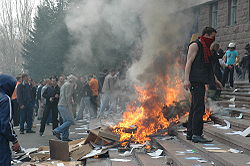
Chisinau riots, Moldova 2009Until last week you’d probably have been forgiven for thinking that Moldova was the country to which expensive tasks are outsourced in the Dilbert cartoons. Well, forgiven by anyone but a Moldovan, perhaps. [image from Wikimedia Commons]

But now Moldova has joined the ranks of former Soviet Bloc countries who’ve had a revolution or political upheaval that was enabled by modern social media and communications technology… and because a good headline always fits nicely into the Zeitgeist, it’s been billed as “the Twitter revolution”. That’s probably a gross oversimplification, though:

It seems unlikely, though, that Twitter was the key tool in a victory of “technology over tyranny”, if that is, in fact, what happened. For one thing, the Communist party in Moldova doesn’t have much in common with the Communists of old – Moldovan communist favor foreign direct investment and promoting entrepreneurship, though they’d like closer involvement with Russia and less with Romania. But to the extent that this was a technological “triumph”, it may have more to do with other social network tools – including blogs, LiveJournal and Facebook – than with Twitter.

Well, even if Twitter can’t take all the credit, hurrah for the inherently democratic potential of modern communications, right? Nicholas Carr would like you to hold on just a moment, though:

No doubt, the Moldovan protests will be used as an example of how the Net and, in particular, its social-networking and personal-broadcasting functions can be used to support popular uprisings and, more generally, the spread of democracy. And rightfully so. But before anyone gets carried away by the idea that the Net is a purely democratizing force, it would be wise to read a longer essay by Morozov, titled Texting Toward Utopia, in the new issue of Boston Review.

I tend to read things that Carr says are worth reading; he’s usually right. So here’s a snippet from that Morozov essay:

Much of the encouraging reporting may be true, if slightly overblown, but it suffers from several sources of bias. As it turns out, the secular, progressive, and pro–Western bloggers tend to write in English rather than in their native language. Consequently, they are also the ones who speak to Western reporters on a regular basis. Should the media dig a bit deeper, they might find ample material to run articles with headlines like “Iranian bloggers: major challenge to democratic change” and “Saudi Arabia: bloggers hate women’s rights.” The coverage of Egyptian blogging in the Western mainstream media focuses almost exclusively on the struggles of secular writers, with very little mention of the rapidly growing blogging faction within the Muslim Brotherhood. Labeling a Muslim Brotherhood blog as “undemocratic” suggests duplicity.

The point being that the Internet is just a tool; the democratizing force is a result of us expressing ourselves through it (and seeing our own reflection in the mirror).

Even so, it can’t be discounted entirely that the Internet and mobile phones have presented the opportunity for networked action and communication to people who even comparatively recently were unable to use technology to circumvent the controls of their governments. Which political cause is the “good” side of any such equation is, as always, a very subjective question.