Category Archives: Blog

The Lunar landgrab – who owns the Moon, anyway?

the moonAfter a few decades of relative hiatus, there’s been a distinct increase of traffic around the Moon of late, and that has legal types scenting potential work in the offing. Once we start colonising our sister satellite – whether in person or via robot proxies – how do we decide who the territory belongs to?

Luckily for us, one Virgiliu Pop is already on the case. He’s a research specialist at the Romanian Space Agency (Romania has a space agency? Who knew?) who has been looking into the laws that might, by precedent, affect lunar settlements… and he reckons it’s rugged individualism and the pioneer spirit that will win the day:

“Homesteading is likely to transform the lunar desert in the same manner as it transformed the 19th Century United States,” he said. “Space is indeed a new frontier calling for individualism rather than collectivism, and its challenges need to be addressed with a legal regime favorable to property rights.”

As many empires have learned the hard way, maintaining control over distant colonies is no easy trick – and when the colony is at the other end of a steep gravity well, that’s only going to be more true. Anyone fancy a sweepstake on the period between first Lunar colony and first colonial secession? [image by jurvetson]

Wind and solar better than nuclear or clean coal

Prof Mark Jacobson of the University of Stanford believes that (for the USA) the best solution to the various problems of energy security, peak oil, and global warming lies in wind and solar thermal power:

The raw energy sources that Jacobson found to be the most promising are, in order, wind, concentrated solar (the use of mirrors to heat a fluid), geothermal, tidal, solar photovoltaics (rooftop solar panels), wave and hydroelectric.

In Prof Jacobson’s research paper he looks at how you could power every road vehicle in the USA using different methods and finds the best combination is wind power and electric battery vehicles.

[at Physorg][image from kevindooley on flickr]

Bail out the writers

Paul Greenberg is writing a book about fish, but you could pay him not to. Noting that in the ’30s, President Roosevelt created a program to keep 6,000 writers working, he adds that the problem today is that too many people want to be writers. So he proposes a program modeled after agriculture subsidies, which would pay people not to write. Andy Borowitz, who he notes had already proposed this in a piece that he (well) wrote, says it would take $400,000 to keep him out of the game.

Of course, putting this kind of money on the table would require the strictest of oversight, and for this we could make use of a structure already in place — i.e., the long-suffering spouses and domestic partners of writers. Under the terms of the bailout, these emotional custodians would be transformed into fiscal custodians and would release funds only when a full cessation of writing activities occurred.

[Image tip: Ex-Boloukos]

Survive the downturn – rent out your swimming pool

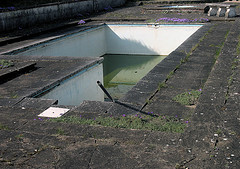
empty swimming poolIf you’re looking for a way to make some extra income in the coming years, you could always consider turning that swimming pool in your back yard into a miniature subterranean apartment and renting it out to the recently-foreclosed-upon. Mooted as a potential solution to the housing shortage in Sydney, Australia, it strikes me that it might also make great economic sense in other warm countries and regions. [via BLDGBLOG; image by Addictive_Picasso]

Of course, I don’t have a swimming pool. But if anyone reading this post in California has an empty backyard bowl that they struggle to keep the skaters out of, I have some great references from my previous landlords…

How much science does a science fiction writer need?

Not just scientific knowledge, but technological, economical, social, geopolitical… you need the lot to be able to write believable near-future science fiction. Or so says the latest missive from Jason Stoddard discussing the burden of the modern science fiction writer:

If you want to write believable near-future fiction, you can’t choose a single point of advancement. You need to have a good understanding of advances in many different fields, and you need to be able to imagine how these can come together, for good or for bad. And to be really believable, you’ll need to know more than you ever wanted to know about how the world works, economically and socially, as well as where the trends are heading.

Otherwise, your fiction will soon read like that Golden Age lit, filled with spaceships manned by human calculators and spinning reels of tape.

He may have a point. But then again, he may have missed the point, or focussed on one that matters more to some than others. Jeremy Tolbert responds to Jason’s closing statement above:

If you’re intimidated by the accelerating advance of the future, don’t let that stop you from writing SF. You don’t have to write it that way. Personally, I take great enjoyment in throwing reality out the window when I write my SF. SF has only ever been about believability to a small subset of readers.  Believability in the context of tech, anyway. It, like all literature, does revolve around the believability of human action and emotion, however. Keep that in mind and you’ll write great fiction, and very few people will care about that other stuff.

I’m not an experienced enough writer to know which angle I prefer, but as a reader I’m quite fond of both – and while we keep the focus near-future here at Futurismic, I don’t think we’re anywhere close to the line of science fiction that’s so hard it’s rigid.

Which do you prefer?