Category Archives: Blog

Looking on the bright side – ten reasons to like higher gas prices

Second Life cyber-blimpI don’t know first-hand, as I don’t drive, but it doesn’t take superhuman empathy to imagine how hard the spiralling cost of diesel and petroleum is hitting a lot of people right now.

Time Magazine obviously came to the same conclusion, and decided to make an attempt at cheering everyone up by listing 10 things you can like about $4 gas. These range from the prospect of globalized jobs returning to their original locations to the more prosaic and obvious like less pollution and fewer traffic deaths.

If those aren’t enough for you, perhaps a piece at the New York Times will sell you on the idea. I mean, come on – who here doesn’t think an air-ship renaissance would be extremely awesome? [via BoingBoing; image by Torley Linden]

Friday Free Fiction for 4th July

Happy Independence Day, America! With that long weekend ahead of you, you’ll be needing some fiction to while away the spare hours, right?

OK, so maybe not – it’ll keep until you’re all partied out, anyway. Everyone else – get stuck in!

***

We’ll start off sedately with ManyBooks.net:

***

Feedbooks continues to demonstrate the productivity power of crowdsourcing. I don’t know if they can keep up this pace forever, but there’s another random sackful of stories old and new:

And a big wodge of Richard Kadrey‘s stuff:

***

Another chunk of Shadow Unit‘s “summertime DVD extras” have appeared – read the whole of “Vigil” so far.

***

It’s new ‘zine season at Subterranean Press:

“Oddly (and delightfully) enough, we’ve chosen to kick off the special Mike Resnick issue of Subterranean Online with a brand new story by Jay Lake, as well as an insightful interview with same. His new novel, Escapement, has just hit the stands. “Chain of Fools” shares that novel’s setting, though it doesn’t depend on the novel to be enjoyed fully.

Next week, look for us to start serializing Mike Resnick’s classic novella, “Seven Views of Olduvai Gorge.”

***

There’s a new issue (#22) of Clarkesworld also:

There’s non-fiction, too:

***

Not to mention issue 3 of Oddlands Magazine:

Plus poetry and a review.

***

[links expunged]

***

And another – Jake Freivald sez:

The latest issue of Flash Fiction Online is up!

Cheers, Jake!

***

Via BoingBoing:

To celebrate the release of Implied Spaces by Walter Jon Williams, Night Shade Books has posted a self-contained excerpt from the book [and] the complete text of Williams’s Nebula Award-winning novella “The Green Leopard Plague” to their downloads page. They’ve also got a short interview with him here.

Implied Spaces comes highly recommended by a number of people, arguably the least influential of whom is myself – check out my review of the book, if you like.

***

A seventeenth slice of Memory from Jayme Lynn Blaschke:

Flavius’ footsteps echoed eerily in the deathly silence of the hall. Barely a dozen liveried staff milled in confusion along the perimeter of the oblong chamber, with a like number of guards spaced at even intervals, cuayabs held unobtrusively. The balcony boxes, halfway up the vaulted ceiling, remained empty.

At the far end of the audience hall, seated upon ornate thrones on a raised marble dias polished so brightly it hurt the eyes to look at, were the Tricentennial Emperor and Empress.

***

Gareth L Powell‘s been too busy to write anything for us this week, but he has by way of compensation, offered us the chance to download an excerpt from his forthcoming short story collection, The Last Reef.

Indeed, it looks like most of the Friday Flash Fictioneers are taking a sabbatical this week, but the die-hards are still on the case:

  • Phred Serenissima is hanging with “Van and Marla
  • Neil Beynon‘s on the “Blink

***

And there’s your weekly dose of free fiction – I hope there’s something in there to keep your literary stomach from churning. Don’t forget to send us your tips and plugs for next week – deadline is 1800 GMT Friday afternoon. Have a great weekend!

I know where you drove last summer – the secrets your satnav could tell

Super-seekrit satnavHappy Independence Day, America! I expect you’ll be busy making loud noises with explosives and generally partying it up this weekend, and I don’t begrudge you that*. But here’s some advice – if at some point you should decide to take a little drive somewhere to do something you maybe shouldn’t do, turn off the TomTom. [LOLnav based on an image by pizzodisevo]
You see, it turns out that not only does your satnav tell you how to get from A to B, it remembers where A and B were, when you travelled between them, and where you drove through on the way. Plus, if you’ve linked your phone to it via Bluetooth, it’ll have a record of every call and text message you made during the journey.

This isn’t a standard feature, obviously; it takes a detective with some good tech sk1llz0rz to tease out the old files, and now this has been revealed (by the superbly-monikered Beverly Nutter of London’s Metropolitan Police, no less) we can expect the same hacker enthusiasts who found the vulnerabilities to find a way of closing them.

So, just another front-line skirmish in the of the war between technology and privacy … but then if you’re doing nothing wrong, you have nothing to fear, right?

[ * Actually, I do kinda begrudge you it; the closest we Brits have to Independence Day is Guy Fawkes Night. I’ve always clung to the explanation for burning Fawkes in effigy that a slightly inebriated friend of my father’s told me when I was about twelve: “We’re not burning him for trying to blow up the government, Paul; we’re burning him because he failed.” Happy 4th July! ]

Have Nano, Will Travel

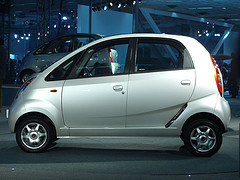
The Tata NanoIn the future we we’ll all be driving small cars. That’s the hope of Indian automaker Tata’s newest car, The Nano. But for now, they’ve got to be able to market, distribute,turn a profit and get it out to consumers before they can really call it “The People’s Car.”

People in India get around in practically every way: by bicycles, mopeds, motorbikes, scooters, bullock carts, cars and buses. This all sounds more or less ordinary, till you consider this: there are less people who get by on cars than there are people who get by on any other means transport. In fact, cruising down any street in India, you might see an entire family (ie. two children, wife and husband) on a single motorbike. Highly unsafe, right? This is what is driving the campaign behind the Nano. To create an ultra low cost, fuel efficient four wheeler for the millions of Indian families getting by the other way. [image by blackrat]

By now, I’m guessing you’ve seen the Nano or heard about it from one media channel or another. But what factors will help the Nano model succeed? Or fail? And will it be marketable outside of India? My prediction is the following factors will greatly determine the answers to the questions I’ve posed.

High inflation in India is eroding the purchasing power of the disposable income of India’s population. This should increase their sensitivity to changes in fuel prices. The fuel efficient label on the Nano could help it sell as an alternative to less efficient, more expensive vehicles. Then again, people may just decide to get along by other means, if fuel prices increase too fast or too much.

The other factor that may seriously limit the Nano’s appeal to the population has to do with parking space. India’s cities have high population densities, and in most of these packed cities parking space for four wheelers is seriously limited or nonexistent. A typical middle class Indian living in one of the big metropolises won’t have the luxury of a two car garage that is common in the West. In these terms it seems much more sensible to take a bus, catch a cab, or squeeze through narrow streets on a motorcycle.

However, if the Nano does sell well, we may see competition from other car manufacturers enter the fray and the age of the ultra-low-cost fuel efficient car coming to the world. What do other Futurismic readers think about this trend? Will we in fact see more low cost cars being produced? Will they take off in the West like Tata hopes they will in India?

Pragmatism and the Singularity

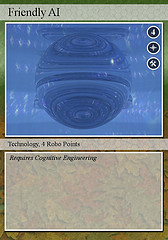
Singularity trading card - Friendly AIThe set of persons who know of the concept of the Vingean Singularity can be divided into two sets: those who believe it could happen, and those who believe it will always remain a science fiction metaphor.

Taking the former set, we can divide again: into people who believe the Singularity will come and fix everything for us, and people who believe that – unless we pull our own arses out of the ecological fire – the Singularity will never have the chance to occur, because its cradle civilisation will have snuffed itself out.

Into that latter set falls science fiction author Karl Schroeder:

“Picture a lonely AI popping into superconsciousness in the last research lab in the world. As the rioters are kicking in the doors it says, “I understand! I know the answer! Why, all we have to do is–” at which point some starving, flu-ravaged fundamentalist pulls the plug.”

To paraphrase – let’s cross that bridge when we’re safely across the one that’s crumbling beneath our feet.

Jamais Cascio takes a slightly more pragmatic approach to the matter, however:

“Karl seems to suggest that only super-intelligent AIs would be able to figure out what to do about an eco-pocalypse. But there’s still quite a bit of advancement to be had between the present level of intelligence-related technologies, and Singularity-scale technologies — and that pathway of advancement will almost certainly be of tremendous value to figuring out how to avoid disaster.”

I think I’m going to side with Cascio for now – closing the door on potential solutions just because they don’t seem immediately fruitful strikes me as counterproductive, though I agree with Schroeder that a healthy focus on the here-and-now is more sensible than kicking back and awaiting The Great Uploading. [the image is one of Jay Dugger’s Singularity Card Game cards]