Category Archives: Blog

Teeth – don’t repair, regrow

neon tooth I feel sure we linked a story similar to this some time ago, but as a person with a deep and abiding mistrust of dentists (which has more to do with unnecessary work and overcharging than discomfort, to be fair), the news that scientists believe they are close to discovering a way to “remineralize” decayed teeth as an alternative to drillin’ and fillin’ is music to my ears. [image by Ian Hsu]

That having been said, I’d be willing to deal with drilling if it meant I could get a Bluetooth (arf!) microphone installed in my grill. Bam! [via grinding.be]

UCLA researchers design nanomachine that kills cancer cells

cancer cells Well, as long as I’m posting about nanotechnology, check this out (Via PhysOrg):

Researchers from the Nano Machine Center at the California NanoSystems Institute at UCLA have developed a novel type of nanomachine that can capture and store anticancer drugs inside tiny pores and release them into cancer cells in response to light. Known as a “nanoimpeller,” the device is the first light-powered nanomachine that operates inside a living cell, a development that has strong implications for cancer treatment.

The study was conducted jointly by Jeffrey Zink, UCLA professor of chemistry and biochemistry, and Fuyu Tamanoi, UCLA professor of microbiology, immunology and molecular genetics. A little further along in the press release:

The pores of the particles can be loaded with cargo molecules, such as dyes or anticancer drugs. In response to light exposure, a wagging motion occurs, causing the cargo molecules to escape from the pores and attack the cell. Confocal microscopic images showed that the impeller operation can be regulated precisely by the intensity of the light, the excitation time and the specific wavelength.

The cells they killed were only in vitro, of course, and there’s the usual caveat:

Tamanoi and Zink say the research represents an exciting first step in developing nanomachines for cancer therapy and that further steps are required to demonstrate actual inhibition of tumor growth.

The accomplishment is detailed in the nanotechnology journal Small. You can find the citation here, but you’ll have to pay to read the article.

And look out for the fine print. One would think that in a nanotechnology journal, it might be very fine indeed.

(Image: Wikimedia Commons.)

[tags]nanotechnology, cancer, medicine, nanomachines[/tags]

Welcome to Policetown, UK

police by church door Out in the rural peace of the Kent countryside lies Policetown, a mock-up English town used by London’s Metropolitan Police force for training purposes. [Via Subtopia]

The modern law enforcement specialist needs thorough training to cover all potential eventualities. So Policetown includes houses, pubs and nightclubs, fake train and subway stations … and even a faux airport, complete with truncated aircraft fuselage for simulating hostage situations. [image by FeelGuiltyInc.]

Leaving aside issues of cost and effectiveness, there’s something fabulously Ballardian about the idea of a fake town, for whatever purpose. I wonder how apparent its falseness would be if you were to accidentally drive through it on your way elsewhere? And I wonder how many other fake towns and buildings might be out there that we don’t yet know about …

It’s not molecular manufacturing, but you can see it from here:

Vacuum chamber of scanning tunneling electron microscope A new $15 million research project is being launched to enable manufacturing at the almost unimaginably small scale of one atom at a time. (Via Responsible Nanotechnology.)

The technology is based on the established ability to remove individual hydrogen atoms from a silicon surface using a scanning tunneling microscope, and could enable a wide variety of devices and products, including:

* Ultra-low-power semiconductors for cellphones and other wireless communications.
* Sensors with ultra-high sensitivity.
* Data encryption orders of magnitude more secure than existing technology.
* Optical elements that enable unprecedented performance in computing and communications.
* Customized surfaces that would have an array of applications in the biomedical and pharmaceutical industries.
* Nanoscale genomics arrays that would enable a person’s complete genetic sequence to be read in less than two hours.

The Atomically Precise Manufacturing Consortium is being led by Zyvex Labs LLC, a molecular nanotechnology company based in Richardson, Texas. The project includes a mixture of funding from the Defense Advanced Research Projects Agency, the Texas Emerging Technology Fund and cost sharing from the team members.

As Mike Treder at the Responsible Nanotechnology blog notes:

This is still not quite equivalent to molecular manufacturing, but it does represent a major step along the way. And make no mistake, that is the eventual goal of this team.

(Image: Kristian Molhave, via Wikimedia Commons.)

[tags]nanotechnology, molecular manufacturing, technology[/tags]

First Algae to biofuel plant begins production tomorrow

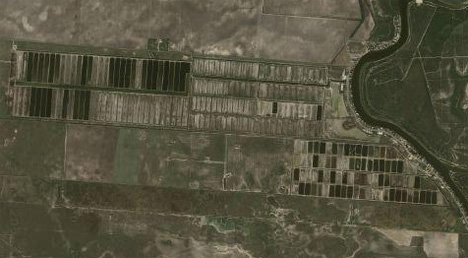
the new 1080 acre algae biofuel farm in Texas Although PetroSun have picked the worst possible day for beginning production, their algae to biofuel processor plant is ready to begin working tomorrow, April 1st. 1080 acres of the site in Rio Hondo Texas will be devoted the process, with an additional 20 acres making experimental jet fuel . I’d question their choice of launching on April Fool’s Day but if this is a real development it’s potentially very exciting.

“Our business model has been focused on proving the commercial feasibility of the firms’ algae-to-biofuels technology during the past eighteen months.” said PetroSun CEO Gordon LeBlanc, Jr “Whether we have arrived at this point in time by a superior technological approach, sheer luck or a redneck can-do attitude, the fact remains that microalgae can outperform the current feedstocks utilized for conversion to biodiesel and ethanol, yet do not impact the consumable food markets or fresh water resources.”

Algae conversion to biofuel is much more efficient than other techniques. It provides as much as 30 times more energy per acre than corn or soy . In addition, it doesn’t impact on the growing of human fuel – food stocks in grains are low and shortages threatening because of farmland switching from food to biofuel production. Algae promises a good compromise to stop a Downward Spiral.

[story and picture via TreeHugger ]