Category Archives: Blog

Combining computing servers with alternative energy

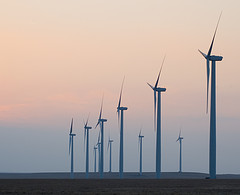
Could servers only be used when the wind blows nearbyThe Guardian has this interesting snippet of an article that makes sense to me on so many levels. Professor Andy Hopper of the University of Cambridge has been looking at the power usage of computers and made an astute suggestion: locate large processing servers near sources of alternative energy like solar or wind farms. When the power is flowing through the turbine or photovoltaic, computers all around the world can tap into the processors of the server farm. When there’s no wind or sun in one location, the network can call on the processors of somewhere there is.

This kind of synergy is fascinating and I think it’ll be a major feature in our future working lives. Flash drives getting bigger, faster and cheaper all the time and programs like Portable Firefox run straight off a portable drive. I’m writing this post on my portable usb, using only the processor and screen of the laptop I’m borrowing time on. Sooner or later all our computers will be a usb-style stick with all our programs, data and settings stored on it. Plug it into a nearby screen (or project your own), whack out your laser keyboard and dial into any heavy processing power from an external server. Who needs a big computer tower in your room when you can fit it in your pocket?

[story via the Guardian, image by Brent Danley]

Boulder, Colorado – smart grid city

electric ultility pylon What the hell is a “smart grid city”? [via Worldchanging]

Well, maybe you could call it “Infrastructure2.0”, but whatever you call it, it’s a new (and hopefully more sustainable) way of looking at the issues of providing utilities to urban areas. According to Xcel Energy:

“The next-generation electricity grid will allow our company to better meet growing demands, address environmental challenges, maximize available resources and optimize the entire energy system. Ultimately, a “smarter” grid helps us serve our customers by creating more options for managing personal energy use, habits and costs.”

All hot air and sales jargon, you might be thinking. Well, Xcel seem to be walking the walk as well talking the talk – they’re going to make Boulder, Colorado into their first Smart Grid City, with the first phase predicted for completion this August. [image by tanakawho]

I’m pretty pleased to see the energy industry acting on these sorts of ideas instead of just paying them lip service, and I hope something similar starts appearing over here in the UK. Perhaps where Xcel leads, others will follow and surpass.

A world without trucks?

CargoCap_Halle_460 Trucks are noisy, smelly, intimidating if you’re in a small car, and just generally a nuisance. So why not get rid of them? Transport your goods instead via automated subterranean networks. (Via KurzweilAI.net.)

Sound a little kooky? Maybe, but:

Some Western European countries are getting serious about transporting consumer goods through automated subterranean networks – introducing a fifth transport mode next to road, rail, air and water. This rare combination of low-tech sense and high-tech knowledge could lead to a further economic growth without destroying the environment and the quality of life. Super fast underground cargo transport is a favourite subject of futurologists. Yet, the key to the feasibility of the proposed systems is their very low but constant speed.

The goods would be transported via electric motors at low speeds of under 35 kilometres per hour along what would essentially be an automated subway line. Belgium, Germany and Holland have all explored or are exploring the possibility:

In Belgium, the University of Antwerp designed and proposed an underground logistic system that would transport large 40-ft containers from the newly built container dock in the harbour to an existing marshalling yard and a planned inland navigation hub on the other bank of the river…

In Germany, the Ruhr University of Bochum is working on a rather different concept, called the CargoCap project. The German system is designed for much smaller loads and makes use of unmanned electric vehicles on rails that travel through pipelines with a diameter of only 1.6 metres. Each vehicle, called a ‘Cap’, is designed for the transportation of two European standard pallets…

The German system resembles research that was conducted in Holland almost ten years ago. The Dutch then investigated the possibility of an underground logistic network that spanned the whole country…with one hub for every 1,000 to 5,000 homes, which boiled down to a maximum walking distance of 750 meters to pick up goods…

I know what you’re thinking, and you’re right: the biggest problem will be the initial cost. The proposed Dutch network would have cost 60 billion Euros ten years ago. Which is why nothing more has been done on it. But the German and Belgian systems might actually come to fruition…and make a little more room on the roads.

And after all, it’s not as if something like this has never been done.

(Image: CargoCap.)

[tags]transportation,technology,traffic[/tags]

What does the financial crisis mean for the future?

A joker puts the value of a share on the $1Billion headquarters of failed bank Bear StearnsWith the sale of Bear Stearns for £2 a share on Sunday (it was worth £170 a share in April last year), the Credit Crunch claimed a high-profile casualty. But in the long run, what does a possible US and global recession bode, after things clear up? Some people think this may be the worst we get, others think there’s a fair few other banks and businesses looking shaky. However it continues, there’s no doubt that the markets are going to change following the collapse of a lot of mortage-based finance.

The crisis has been caused by an decrease in the enforcement on banking legislation. Without sufficient checks, financial companies offered loans to people who couldn’t afford it, then traded the loans like shares across the world economy. As lenders failed to pay up and defaulted, the companies who traded the paper behind the loans began to make losses and a lack of trust led to less liquidity, or money available for lending between firms. Bear Stearns was one of the companies most at risk, like Northern Rock here in the UK.

Many economists and analysts are starting to look at the repercussions of the credit crunch. Some say that the reduced interest rates by the Federal Reserve and Bank Of England will lead to inflation problems, especially with commodities like wheat, gold and oil recently at all-time highs. Others compare the crisis to other recessions around the world. Although Japan in the eighties and the Great Depression are scary comparisons to make, some say that Sweden in the early nineties is the best one to make, and a good example of how the Fed can get out of this situation: more regulation to clear that bad debt quickly.

But if we’re looking at ways to stimulate the economy, surely we should be looking at moving the focus away from the financial markets and ‘bubbles’? During the dotcom and housing bubbles, wages have stagnated and many have succumbed to borrowing large amounts to keep consuming. A possible solution: invest in new infrastructure for alternative energies, mass public transport and energy-efficient products. Jobs will be created to keep the economy afloat and the financial world could settle to a fairer and more balanced system.

[photo via Calculated Risk]

Dave Edelman says the novel will die

old-book-spines I’m out of town and away from the interwebs today (at a conference about Web2.0 in libraries, ironically enough), so I’ve left you these articles to chew over using the magic of scheduled posting. [image by Tom Maisey]

First off, David Louis Edelman repeats the oft-heard assertion that the novel will die, but he doesn’t see it as a downer:

“Very soon we’re going to have a medium for distributing the written word that’s not only easier but better suited to the task than books. So let’s dispense with the silly, sentimental arguments you often hear about why storytelling is never going to go electronic. “You can’t replace the feeling of a holding a book,” “I don’t like reading on a screen,” and “I can’t read an e-book in the bathtub” are some of the sillier excuses you hear all the time for why printed books are going to survive until the end of time.

I’m sorry, but “I can hold my entire library in my hand,” “I can download new books at will,” “I can search my entire library in a nanosecond,” “I can instantly send books to my friends,” “I can translate and define words on the fly,” and “I don’t have to devote an entire room of my house to holding my books” are going to trump reading in the bathtub any day of the week.”

Well worth a read. Now compare and correlate with Jason Stoddard’s recent posts on the future of creative writing … start with this one about creating fully featured alternate realities:

“What do you think this is? This is 100% writing – and this is some of the most powerful writing you can do. Instead of blogging about your dogs and your vacation schedule or how the world is going to hell to create a post every day, turn some of that energy towards this!”

And then move forwards chronologically through the next four posts or so.

And then … discuss, be you writer or reader!