Category Archives: Blog

Asimov’s Three Laws of Weigh-Ins

Alice Wang's half-truth scale Isaac Asimov‘s robot stories were based around his famous Three Laws of Robotics, the first of which states that a robot may not injure a human being.

Asimov got lots of stories out of the many unanticipated behaviours his three laws might provoke in robots under various scenarios. His robots, though, were high-tech sentient creatures with “positronic brains.” I don’t think he ever contemplated applying his laws to everyday household products.

Designer Alice Wang has, though, and regarding Asimov’s First Law, wonders, “Are there existing domestic objects that already break this law?”, and comes up with a surprising answer–bathroom scales:

Scales, although don’t perform physical harm, have been subtly damaging us psychologically. Should objects like these exist in a complex society like ours where people are more emotionally fragile?

She has therefore designed three scales that might reduce the emotional harm caused by the mean old scale. The first, called white lies, allows the person being weighed to lie to him or herself: the further back you stand on it, the lighter you become. “The user can gradually move closer and closer to reality,” she notes. (Via Gizmodo.)

The second, called half-truth, can only be read by a person who is not on the scale: its readout is at the front edge, perpendicular to the floor. “Suitable for cohabiting partners,” notes Wang.

Finally, there’s open secrets, which doesn’t show you your weight at all: it sends a text message to a specified mobile phone, instead. The recipient of the message can then decide whether to share your weight with you immediately, the next time you meet–or not at all. “Suitable for pre-cohabiting couples,” says Wang.

Up next: the Heinleinian Starship Troopers scale, which will only consent to weigh you if you first serve two years in the military.

(Photo: Alice Wang.)

[tags]Asimov,robots,technology,design[/tags]
Infrastructure for the twenty first century

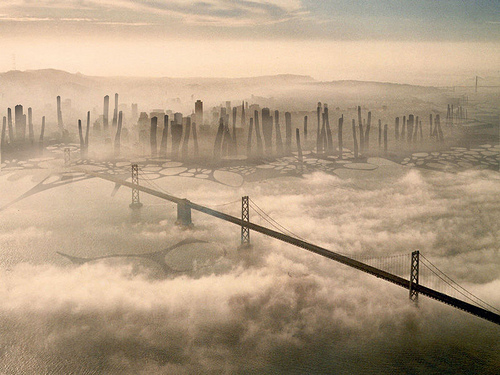
San Francisco in 100 years time looks a little different…
The ever compelling Alex Steffen over at WorldChanging is talking about Infrastructure a lot lately. A lot of the US and much of the world is built on an infrastructure of highways, electric grids and waterways, which are struggling to keep up with population growth and increased costs, especially of fuels. Whilst new technologies like superfast trains and solar panels are good, they need investment in the infrastructure for it to work – as seen by Britain having to spend millions to replace track for the Eurostar because Margaret Thatcher chose the cheaper infrastructure in the eigthies, whilst the rest of Europe put in place track suitable for what became the TGV.

There’s a lot of interesting ideas out there, from Alexander Trevi’s use of carbon-harvesting nanocrystals and radiation reprocessing to produce a green ‘New Chernobyl’, to architects IwamotoScott‘s ‘Network Hydrology’ reimagining of a water and hydrogen-producing algae based 2100 San Francisco. There’s plans to artificially create a new river delta to protect the Louisiana coastline and Amsterdam might drain its canals to create a new underground subcity. Or what about BLDGBLOG’s idea to create housing projects in the same way people make zoos? By combining good design in new infrastructure with the inventions already out there we can start looking at a future way of living rather than just trying to extend the one we have beyond its lifetime. And is it coincidence that most of best ideas also look ridiculously cool?

[picture by IwamotoScott]

Cyber Goggles – wearable memory aid

Tokyo-University-Cyber-Goggles More Japanese cyber-technology! These Cyber Goggles have been developed at the University of Tokyo; they record video footage of everyday objects, run them through an object recognition routine and file them away in a database. End result – a searchable visual log of where you last saw something, suggested as an ideal aid to the elderly whose memories aren’t so sharp as they once were. [image from Pink Tentacle article]

Sure, they look a little clunky right now, but that’s just a prototype – size and bulk won’t be a problem by the time they get these things to production.

The real problem, as pointed out in the comments, is how to make sure the forgetful user doesn’t forget where they left their Cyber Goggles …

Ethics of synthetic biology

There was a great segment on NPR’s Science Friday last, well, Friday.  It dealt with the potential pitfalls of synthetic biology – a brand new field most recently brought into the headlines by Craig Venter’s creation of synthetic bacterial DNA.  The topics ranged widely, from cheap sci-fi thriller plot of rogue scientist creates killer virus in lab, to religious throwbacks to Mary Shelley invoking man-plays-God ideas, with several in between.  One of the guests was a bioengineer, the other was an anthropologist, which gave a good mix of insight into the various problems.  And interesting mention was of a machine that could basically print out DNA from a stored library of DNA structures.  A crude form already exists, which prompted me to think of a question that wasn’t tussled with – if we can print up DNA in the future like we print up documents now, will DNA testing go the way of photoshopped graphics, where people could be framed for crimes by printing and planting DNA evidence at crime scenes?

(image from flickr user chekabuje)

Rudy Rucker disassembles the Singularity

simulated-solitons If I could choose one science fiction author in whose head-space I could spend a lengthy holiday (equipped with copious note-taking equipment and a barrel of synaptic cognition enhancers, naturally), Rudy Rucker would be my first choice by a country mile. Despite having a justified reputation as a quirky and colourful writer, he’s a ferociously smart guy. [image by JonDissed]

Here he is debunking the Singularity – or at least the “even better than the real thing” Singularity that some people advocate – by explaining that no Virtual Reality will ever be able to simulate Real Reality accurately, because Real Reality is already running on an incredibly complex and rich computational substrate:

“VR isn’t ever going to replace RR (real reality). We know that our present-day videogames and digital movies don’t fully match the richness of the real world. What’s not so well known is that computer science provides strong evidence that no feasible VR can ever match nature. This is because there are no shortcuts for nature’s computations. Due to a property of the natural world that I call the “principle of natural unpredictability,” fully simulating a bunch of particles for a certain period of time requires a system using about the same number of particles for about the same length of time. Naturally occurring systems don’t allow for drastic shortcuts.”

Rudy Rucker – substantial proof (if proof were needed) that science and hippiedom are two sides of the same coin. There’s masses of free fiction and non-fiction on his website, by the way.