Category Archives: Blog

Publishing and piracy: more Mamatas

How timely! An SF Signal Mind Meld post on “the future of publishing”… featuring a rather dystopic but all-too-plausible worst-case-scenario from Cheryl Morgan, and another serving of brutal truth from Nick Mamatas:

Piracy will always be with us, and in the end it’ll just be figured into the cost of doing business; ebook prices will come down to a more reasonable level and piracy will be a problem along the lines of shoplifting. Writers will be more likely to license World English rights rather than territorial rights for their books to make them more widely available to readers who pirate out of fannish desperation.

I also anticipate at least one of the major publishers crumbling back into its component imprints, which will actually be a good thing–indeed, it’ll be the thing that will allow ebooks to come down to the $3-5 price range. There’s a lot of whining about how print costs are only 10% of the cover price of a book, so ebooks prices can only sink so low, but the plain fact is that publisher overhead, specifically in the forms of Manhattan real estate and payouts to distributors with giant warehouses, are both utterly superfluous and easily eliminated. The major houses are pigs and some of them are going to die.

[…]

It won’t be bad, unless you’re one of the few people making money right now with mindless hackwork. If you are the 2010s will be your decade to suffer as the rest of us have suffered these past thirty years.

Ouch. Compare and contrast to Gordon Van Gelder’s “I dunno” shrug, which – while honest – smacks more than a little of an ostrich impersonation; F&SF, I’d remind you, still doesn’t accept electronic submissions.

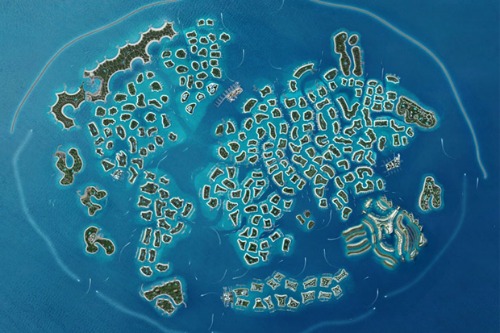
The World sinks into the sea

Another installment in what seems to be an emergent and ill-defined thematic series of Bubble-era vanity projects decaying in the wake of Collapsonomics! Even more ambitious and hubristic than Japan’s Huis ten Bosch, Dubai’s artificial entertainment archipelago, modestly named “The World”, is crumbling away amidst contractual wranglings and other forms of development hell:

The World, Dubai

According to evidence cited before a property tribunal and discovered by the Telegraph, “erosion and deterioration” of the World has been found, with state-run developer Nakheel admitting that the project is “in a coma”. Graham Lovett, speaking on behalf of Nakheel in the tribunal, said: “This is a ten-year project which has slowed down,” but maintained: “this is a project which will be completed.”

Nakheel is part of Dubai World — the conglomerate owned by the gulf state — which was bailed out of $25 billion worth of debts at the end of 2009. The tribunal was set up to hear the cases that emerged from the separation of the companies involved. One of those companies is Penguin Marine, who bought the rights to offer boat travel to the islands — of which all but one are uninhabited. (Greenland, if you’re curious.)

Although Nakheel claims that 70 percent of the islands have been sold, investors have had trouble financing any further work. As a result, while Penguin Marine is paying a million dollars a year to Nakheel, it’s getting very little business, so is trying to exit the contract.

Penguin claims that work on the islands has “effectively stopped”, with Richard Wilmot-Smith, speaking on behalf of the company, telling judges in the tribunal that the islands’ sands are eroding and that the channels between them are silting up. Nakheel disputes this, saying: “Our periodical monitoring survey over the past three years didn’t observe any substantial erosion that requires sand nourishment.”

Now there’s a setting for a novel… where are you, J G Ballard, now that we need you the most?

Tunisia, Egypt… where next?

All that talk over the last few years about the ubiquity of instability? Starting to look a lot less like cynical doomsaying, ain’t it?

Via BigThink, Le Monde Diplomatique gets all brow-furrowed and chin-strokey:

Put simply, global consumption patterns are now beginning to challenge the planet’s natural resource limits. Populations are still on the rise, and from Brazil to India, Turkey to China, new powers are rising as well. With them goes an urge for a more American-style life. Not surprisingly, the demand for basic commodities is significantly on the rise, even as supplies in many instances are shrinking. At the same time, climate change, itself a product of unbridled energy use, is adding to the pressure on supplies, and speculators are betting on a situation trending progressively worse. Add these together and the road ahead appears increasingly rocky.

Chickens coming home to roost… as the West’s privileged lifestyle begins its decline, the rest of the world finally starts demanding its cut of the cake. And this isn’t a religious backlash, or even a classic left-right political clash. It’s plebs versus politicos, the governed lashing back at the governers, and the intertubes are certainly playing their part… but they’re just the conduit, not the cause:

That protests so large in scale could be organized largely over the internet and independent of Egypt’s traditional opposition, particularly the Muslim Brotherhood, should give Egyptian President Hosni Mubarak plenty of cause for concern, says Shadi Hamid, director of research at the Brookings Institution’s Doha Center. It shows the extent to which regular Egyptians are fed up with authoritarian rule, and how quickly that frustration can spread—lending it shades of the uprising in Tunisia. “It’s not an Islamist-organized protest. This really is unprecedented. It’s just everyday Egyptians getting angry,” he says. “If I was a regime official, I’d be pacing in my room right now.”

John Robb is unsurprisingly enjoying a “told you so” moment, and suggesting routes forward for this new insurgency:

For an open source revolt to be successfully formed, it needs a plausible promise.  A meta issue around which all of the different factions etc. can form (remember, most of the groups and individuals involved in an open source revolt can’t agree on anything but some basic concepts).  A generic “day of revolt” doesn’t accomplish that. What could?

Using the multi-million scale No Mas FARC protests as an example and the critical ingredient in the Tunisian protests (extreme corruption that generated an endless wellspring of anger/frustration), a potential “plausible promise” for an Egyptian open source revolt is:

No More Corruption

Not only is a movement opposing corruption something the government will find hard to oppose, it is something every Egyptian deals with on a daily basis.  It also has the added benefit of directly harming the entrenched ruling elite, who are likely to become poster children of the very thing the movement is against.

Hey, kids – can you think of any nation closer to home where citizens have to deal with corruption on a daily basis? Places where budgets are being slashed, where the quality of life is tanking, but where the folk at the top of the pyramid are doing better than ever?

Yeah, me too. Interesting times ahead.
Huis ten Bosch: Japan’s nigh-deserted Little Holland themepark

I’m sure someone has a snappy neologism for things like this, but I’m damned if I can recall (or otherwsie invent) one. Nonetheless, and offered largely just for the WTF? factor, here’s oddball collapse-fetish travelogue-blog Spike Japan describing Huis ten Bosch, a vast Holland-themed amusement park on the shores of Omura Bay, Nagasaki Prefecture:

Huis ten Bosch, Nagasaki Prefecture, Japan

On a busman’s holiday in the Mediterranean in 1979, so the legend goes, Kamichika and his businessman travelling companion, the president of the real estate division of ball-bearing maker Minebea (slogan: Passion is POWER, Passion is SPEED, Passion is the FUTURE), are surveying a shimmering seascape when his companion turns to him and asks:

“Is there a sea like this in all Japan?”

So many consequences were to flow from such a simple question.

“Yes,” Kamichika is reported to have replied vehemently, “the marvelous sea of Omura Bay in Nagasaki, where I was born and raised. It’s every bit as good as the Mediterranean. Why can’t we get people to visit it, just like the Mediterranean?”

[…]

Emboldened by success—at its 1990 peak, Nagasaki Holland Village attracted 2mn visitors—in 1988 Kamichika began planning something a tad more ambitious: Huis ten Bosch. It was the Bubble; anything was possible. Six kilometers of canals, 3.2km of underground tunnels for the communications, energy, and water infrastructure, 400,000 trees, and 300,000 flowers and shrubs—sure, why not? Kamichika took his plans to the bankers and the bankers liked what they saw.

A strange story; almost a Doctorowian fable for the modern age.

Beware Spike Japan, by the way – if you have any interest in Japan (or simply other places in general), collapsonomics, good storytelling or all three, you could get lost for hours wandering the archives. Though there are far worse ways to spend an afternoon… [image is presumably copyright Spike Japan’s author, and hence is reproduced under Fair Use terms; contact for immediate takedown if required]