

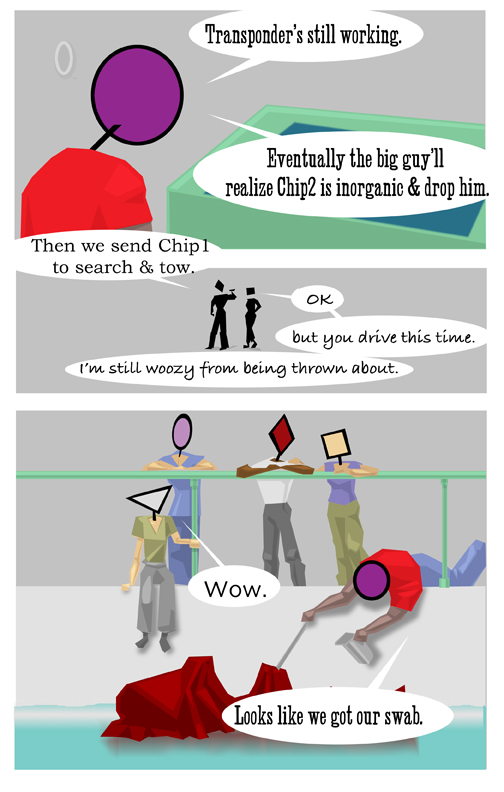
Personal Information is a new serial sci-fi webcomic from Sarah “Does Not Equal” Ennals.
Personal Information is a new serial sci-fi webcomic from Sarah “Does Not Equal” Ennals.
The Harris Corporation supplies instant replay systems to big-brand sports teams, but they may just have cracked a whole new market… one with a budget that (inexplicably) never seems to shrink. The Pentagon has decided that the ability to collect, replay and analyse battlefield video feeds will make it easier to score touchdowns instil shock and awe liberate oil people from oppressive regimes, and they’re working with Harris Corp toward that end:
The system, called Full-Motion Video Asset Management Engine (FAME) uses metadata tags to encode important details — time, date, camera location — into each video frame. In a football game, those tags would help broadcasters pick the best clip to re-air and explain a play. In a war-zone, they’d help analysts watch video in a richer, easier-to-grasp context. And additional tags could link a video clip to photographs, cellphone calls, databases or documents.
Makes a certain amount of sense, but I suspect there’ll be a point where a greater volume of incoming data will become counterproductive, and your multiscreen generals will be so caught up looking at the trees that they forget there’s a forest… which would be business as usual, I suppose, just with more cool toys for the folk behind the front line.
And hey, here’s a potential monetization stream: edit together and sanitise the daily rushes, offer ’em as live streams to warporn fans… or sell the material and outsource the marketing to someone with more experience, like ESPN. Man, this thing’s really got legs – anyone wanna form a collective to buy up Harris Corp shares?
We’ve talked about smart grids before – infrastructure networks for basic utilities that incorporates all sorts of networked active monitoring technologies to make our use of energy and water more efficient. Sounds like a win-win situation for consumers and utilities companies alike, doesn’t it?
That altogether depends on how worried you are about extensive data on your lifestyle and consumer choices becoming easily scraped up by your utility suppliers…
It knows how often you use your microwave, how many loads of laundry you do every week, what kind of television you own and even how often you shower. It can tell how many people live in your home, what time they go to bed and when the house is empty. All of this information and more is gathered by smart grid meters…
[…]
The information could be used in all kinds of ways, legitimate or not, from cities seeking broad information about how well energy-efficiency programs are working to burglars looking for expensive electronics.
Law enforcement agencies want to use smart meters to spot potential marijuana-growing operations or the location of an underground sweatshop. Companies hope the data will help them target marketing to consumers.
Where there’s data, there’s money… and you can’t always trust organisations who promise never to sell your data to third parties to actually keep their word. AMIRITE, Mr Zuckerberg? Smart grids will be a boon to our increasingly energy-hungry planet, but they’ll also be another battleground for the privacy war that’s slowly lumbering its way into the Now.
But hey, think positive: there’s an upside to the fact that utilities companies monitor their grids. If you get lost in the middle of nowhere without a cellphone, you can just cut down an electricity pylon and wait for the repair crew to arrive… [both links via John Robb]
We all know about Afghanistan – a poor and predominantly Muslim nation that’s never really made it out of the Middle Ages, right?
Well, it turns out that’s simply not the case: retconning Afghanistan as a backward barbarian enclave has probably been useful for the global psyops propaganda machine (because what does one do with backward nations but export some much needed corporate democracy, in the hope of neutralising the threat that our earlier meddlings have created?), but as recently as the 1960s, Afghanistan was a modern progressive country… and to look at photographs from that era, you’d be hard pressed to tell at a glance that you weren’t looking at the science classrooms, record stores or factories of some Western nation [via MetaFilter].
Makes you wonder how much of our own national mythology has been carefully constructed retrospectively in order to tell a story we find comforting. For example, I’ve read quite a few books that suggest Britain’s “stiff upper lip” during World War Two was a long way from being as universal as we like to imagine. We’re also pretty fond of mentioning how we stopped the slave trade, but the fact that we played a large part in kickstarting that particular transAtlantic business model is usually left unvoiced…
So, a user-contribution opportunity for a Friday: share a conveniently glossed-over moment from the history of your preferred nation-state!
Martin Ford, much like many of us, has some concerns about the future. Unlike most of us, he’s written a book about it: The Lights In The Tunnel looks at the economic implications of the technological acceleration curve that Singularitarian cheerleaders are so fond of, and suggests it may be at the root of the current economic crisis as well as the ones yet to come. From the website blurb:
The book directly challenges nearly all conventional views of the future and illuminates the danger that lies ahead if we do not plan for the impact of rapidly advancing technology. It also offers unique insights into how technology will intertwine with globalization to shape the twenty-first century and explores ways in which the economic realities of the future might be leveraged to drive prosperity and to address global challenges such as poverty and climate change.
I’ve had a review copy sitting in my to-be-read pile for ages, and hope to get to it eventually (though I’m not expecting a cheery life-affirming feeling as a result – this isn’t the sort of book you write in order to tell everyone how great the future is going to be). If you’re interested in what Ford has to say, however, there’s no need to lash out for the hardcopy – you can now download a PDF version for free at the book’s website, and the license has been tweaked so you’re perfectly at liberty to copy and share it with friends.
If you take a look, why not drop back here and let us know what you think. Is Ford just another doomsayer pundit, or is he onto something? Is he stating the obvious, or unearthing buried truths?