We are all sheep: Avatar, Bayonetta and the hypnosis of low-brow culture

Blasphemous Geometries by Jonathan McCalmont

###

I say this without having actually seen it, but James Cameron’s Avatar (2009) is an interesting film. This is because its success has had the same effect upon film critics and cultural commentators as pissing on an electric fence… people are sore, jittery and annoyed at pretty much everyone, themselves included. Continue reading We are all sheep: Avatar, Bayonetta and the hypnosis of low-brow culture →

Who’ll be next on the Moon now NASA’s doing other stuff?

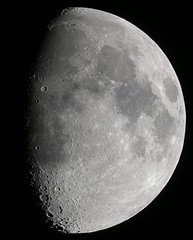
The MoonWell, the new NASA budget from Obama and chums has certainly got people talking… mostly about the fact that the dream of returning astronauts to the Moon is off the table for the foreseeable future [image by ComputerHotline]. Wired has snippets from the budget summary:

“NASA’s Constellation program — based largely on existing technologies — was begun to realize a vision of returning astronauts back to the Moon by 2020. However, the program was over budget, behind schedule, and lacking in innovation due to a failure to invest in critical new technologies,” the budget summary concluded. “Using a broad range of criteria, an independent review panel determined that even if fully funded, NASA’s program to repeat many of the achievements of the Apollo era, 50 years later, was the least attractive approach to space exploration as compared to potential alternatives.”

However, it’s not a massive close-down operation: NASA’s budget has actually been increased, but earmarked for more practical and pragmatic science research, “sustainable exploration”… and keeping some older projects on the books:

Part of that commitment will involve a reprieve for the International Space Station. Instead of being deorbited in the middle of this decade, the ISS will be treated like a national laboratory, and used to pursue research on materials and long-term human habitation in space through at least 2020, with additional construction, including new infrastructure, planned beyond the end of the shuttle program. The budget also includes money for an extension of the shuttle through 2011, which will allow for the inevitable launch delays in its remaining five missions.

io9‘s Annalee Newitz points out that the prospects of the new budget are actually good for pro-exploration types, because it’s a realistic budget that eschews symbolic white-elephant achievements and glory-recapturing in favour of doing affordable things that will teach us lots of useful new stuff. She worries, however, about the fates of those whose expertise will be surplus to requirements now the Constellation project has been shelved:

One of the issues that concerns me the most is what will happen to all the talented NASA employees who have been working on Constellation and related projects. If NASA’s plan is to outsource the development of space vehicles that can carry human cargo, then thousands of jobs will evaporate. Florida alone anticipates losing 7,000 jobs when the Space Shuttle program ends next year. Earlier today Obama told reporters, “We expect to support as many if not more jobs with the 2011 budget,” but those will not be the same jobs. My hope is that some of this budget money that’s been allocated for private sector companies can also be used to place NASA engineers into private sector aerospace jobs. We need to encourage knowledge transfer from NASA to private industry. That way, aerospace companies won’t have to start from square one as they push humans into orbit.

Paging Ben Bova… Sam Gunn‘s time has come, perhaps. After all, there’s nothing to stop private enterprise achieving a Heinleinian dream and setting up a kind of frontier town based on Helium-3 mining and fast-and-loose land claims… well, nothing apart from the same practical difficulties and vast expense that have kept NASA away for the last four decades or so, anyway. But those difficulties don’t seem to be deterring the people behind the Open Luna Foundation [via MetaFilter], which…

… aims to return mankind to the moon through private enterprise. Initial goals focus on a stepped program of robotic missions coupled with extensive public relations and outreach. Following these purely robotic missions, a short series of manned missions will construct a small, approximately 6 person settlement based on a location scouted by the robotic missions. This settlement will be open for anyone’s use (private individuals to government agencies), provided they respect our ethical conduct and heritage policies.

You’ve got to admire the chutzpah, if nothing else… but I think I’ll hold off investing any money in that operation for a little while yet. But it begs the question: if NASA’s putting the Moon on a back burner, who’s going to make it there next? Private enterprise libertarians like Open Luna? China, India, Brazil? Anyone?

Nuclear bomb blast videos redux!

Tobias Buckell’s brief 2007 post of a video snippet showing a Russian weapons test described as the world’s biggest ever nuclear blast has long been the most popular post on this site for search engine traffic. And rather than kvetch about people not coming here for more high-brow entertainment (!), I’m gonna make like a Roman emperor and give out more bread and circuses… pageviews is pageviews, AMIRITE? 😉

So thanks to Wired for rounding up a bunch of video clips from assorted atomic weapons tests; there’s eight over there, if you include the rather harrowing one about the Hiroshima after-effects (which you should surely watch, if only to balance any OMGZ-awesome-big-explosionz!! vibe you get from the others). These two are my personal favourites, though – this one because the mushroom cloud formation is rather beautiful (albeit in a horrifying way):

And this one because it takes you right inside the physical brutality of the blast (not to mention reminding me of a movie about the atomic test programs that I watched as a teenager, the name and basic plot of which is long gone, but the imagery of which haunts me to this day – a Futurismic big-helper gold star to anyone who can point me in the right direction):

Aren’t you glad the prospect of nuclear war is a thing of the past? Oh, wait…

We have the (experimental) technology; we can rebuild you!

cyborg headLost an ear during the Reservoir Dogs Re-enactment Society meeting? No problems – we’ll just grow you a new one on a nanocellulose framework [via NextBigFuture]:
Previously, Paul Gatenholm and his colleagues [at Chalmers University, Sweden] succeeded, in close co-operation with Sahlgrenska University Hospital, in developing artificial blood vessels using nanocellulose, where small bacteria “spin” the cellulose.

In the new programme, the researchers will build up a three-dimensional nanocellulose network that is an exact copy of the patient’s healthy outer ear and construct an exact mirror image of the ear. It will have sufficient mechanical stability for it to be used as a bioreactor, which means that the patient’s own cartilage and stem cells can be cultivated directly inside the body or on the patient, in this case on the head.

“As yet we do not know if it will work. It is an extremely exciting project that brings together expertise in image analysis, prototype manufacturing, biomechanics, biopolymers and cell biology. If we succeed it will open up a whole range of new and exciting areas of use.”

And while we’re speaking about ears, did you ruin your frequency response curve watching avant-noise bands play dingy bars and lofts in eighties New York*? You’ll be needing a hearing aid, then… but not some ugly uncool thing lodged in your ear canal. We’ve got one that’ll slip over one of your back teeth [via BoingBoing]:

There are other hearing aid devices that utilize bone conduction. Most, however, use a titanium pin drilled into the jaw bone (or skull) to transmit sound to the cochlea. SoundBite seems to be the first non-surgical, non-invasive, easily removable device. While they are likely years from retail production, Sonitus Medical plans on having SoundBite ITMs fitted to each individual’s upper back teeth and fabricated fairly quickly (1 to 2 weeks).

Oh, so all that wide-bandwidth noise and late-night hedonism has burned out some of your brain-meat, eh? Well, we’ve got organic transistors that mimic the function of human synapses [via NextBigFuture again]… though quite how we’d patch them into your existing wetware is a bit of a mystery at this point. But hey, they’re called NOMFETs, so the internet should find plenty of macro jokes to make about ’em!

A biological synapse transforms a voltage spike (action potential) arriving from a pre-synaptic neuron into a discharge of chemical neurotransmitters that are then detected by a post-synaptic neuron. These are subsequently transformed into new spikes, leading to a succession of pulses that either become larger or diminish in size. This fundamental property of synaptic behaviour is known as short-term plasticity, which is related to a neural network’s ability to learn. It is this plasticity that Vuillaume and colleagues have succeeded in mimicking.

In the NOMFET, the pre-synaptic signal is simply the pulse voltage applied to the device and the output signal is the drain current, explains Vuillaume. The holes – the charge carriers in the p-type organic semiconductor employed – are trapped in the nanoparticles and act like the neurotransmitters. A certain number of holes are trapped for each incoming spike voltage and in the absence of pulses, the holes escape in a matter of seconds

This time delay is carefully adjusted by the researchers by optimizing nanoparticle number and device geometry. “The output of the NOMFET is thus able to reproduce the deceasing or amplifying behaviour typical of a synapse depending on the frequency of spikes,” said Vuillaume.

Er… your health insurance is fully up to date, right? [image by Bistrosavage]

[ * Guess who’s been reading a Sonic Youth biography this week… 🙂 ]

The mould, the map and the mass transit system

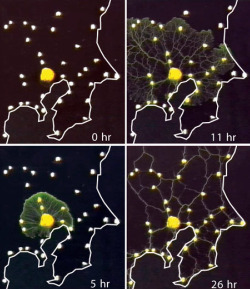
slime mould "transit network" (credit: Science/AAAS)There’s still much we can learn from the natural world – and not just the simple things. Nature has a way of solving complex problems without the need for cognition and abstract thought… or even sentience, in many cases. I remember being impressed as a child by the incredible power of tropisms in plants; the simple behaviour of growing toward a light source, for example, can make dumb vegetable matter seem tenacious, determined, relentless.

Well, it turns out that tropism can be pretty efficient, too, as discovered by a research team based in Tokyo. Having already discovered that slime mould can find the shortest route through a maze (provided there’s a food source to entice it), they made a simple map of Japan which used oat flakes to represent major population centres, and let the mould loose on it. End result: the networks of mould connecting the oat flakes closely resembled the country’s existing mass transit networks, or alternative layouts that were theoretically just as efficient. [via BoingBoing; image borrowed from linked article, credit Science/AAAS]

This reminds me of a (possibly apocryphal) story I read a long time ago about some architect employed to lay out a new section of campus for a college or business or something similar. Having set aside a large green space between a bunch of buildings, he was asked where the paths across it should go; his response was that the best way to make an efficient network of paths was to not lay any at all, and to let people walk as they wished across the green space for the first term. By the end of that time, the paths worn into the grass by pedestrians could be used as a map for the asphalters, showing not only the routes required but the comparative traffic densities thereof.

I’m not sure quite where I’m going with this, but I think it has something to do with dethroning rational planning processes in favour of waiting for the best methods or systems to emerge from the chaos of real life. For all our research, for all our academic disciplines and best practices, sometimes just letting things happen as naturally leads to the most efficient solution. I guess the trick is to recognise which problems are best solved in such a way, and which ones aren’t…

Presenting the fact and fiction of tomorrow since 2001