Merry Christmas; I got you a panopticon

Two quick links; I’ll leave you to do the math yourself. First up – ‘smart’ CCTV system learns to spot suspicious behaviour with a little help from its human operators:

… a next-generation CCTV system, called Samurai, which is capable of identifying and tracking individuals that act suspiciously in crowded public spaces. It uses algorithms to profile people’s behaviour, learning about how people usually behave in the environments where it is deployed. It can also take changes in lighting conditions into account, enabling it to track people as they move from one camera’s viewing field to another.

[…]

Samurai is designed to issue alerts when it detects behaviour that differs from the norm, and adjusts its reasoning based on feedback. So an operator might reassure the system that the person with a mop appearing to loiter in a busy thoroughfare is no threat. When another person with a mop exhibits similar behaviour, it will remember that this is not a situation that needs flagging up.

And secondly – a facial recognition door lock system retailing for under UK£300.

… can store and register up to 500 faces thanks to an internal dual sensor and two cameras. This, claims the manufacturer, “allows it to establish an incredible facial recognition algorithm in a fraction of a second”. Importantly, the system also works at night. A 3.5 inch screen and touch keypad are also included.

The system can also be used to record attendance in an office. There’s a USB and Ethernet port so that managers can download or keep track of who arrives and leaves the office when.

I have the sudden urge to talk at length to people about the findings of the Stanford Prison Experiment.

Permaculture as an MMO?

permaculture produceTaking a brief break from grim predictions of hyperlocal terrorism and the decline of the nation-state, John Robb hypothesises about a way to solve the looming problem of localised food production: why not make permaculture into a sort of MMO game?

Riffing on the popularity of Farmville (which I suspect bears about as much relation to real farming as a round of Arkanoid bears to real atmospheric re-entry in a spaceship), Robb suggests that boosting the fun and competitive aspects of farming projects in meatspace could be a great way to build more resilient communities:

… the current state of software that aids the design of permaculture plots is pretty dismal. The best people can do is cobble together mapping software, 3D landscape modeling software, and some auto CAD. Of course, it is possible if the resources were available (my team of developers could do it), to build software that enables people to design, optimize, and share permaculture plots, that misses a great opportunity.

The real opportunity is to build a learning system via software, one that naturally trains the people that use it, gets better and more sophisticated over time, and is fun. The only way I know how to do that is build a game.

One of the first things to do, is build a simple Farmville type social game that helps people learn permaculture design principles…

I’ll admit to being cynical on this one; I think the fun elements of a social game based on farming would be swiftly forgotten when it came to the first day of digging irrigation channels under a blazing sun. But maybe not… and Robb’s idea might work well in developing nations where the bulk of people are already farmers, enabling them to learn and shift to new and more sustainable techniques over time. [image by JoePhoto]

The web =/= the mob?

Network diagram of macaque brain connectivitySeeing as how I ended up with a whole bunch of related links, I thought they might as well all fit in one post. So, your overarching thematic question is: the power of the web and social media is pretty much a given, but does it empower us in ways that are beneficial or detrimental?* [image by arenamontanus]

For a start, Bruce Sterling points to what must be the third story I’ve seen in the last year about what happens when jurors are accustomed to social media and ubiquitous information access. In a nutshell, it’s almost impossible to keep people in an informational vacuum without locking them up in a Faraday cage, or to keep them from Tweeting about a case they’re hearing… so what happens to the existing legal model of the unprejudiced jury of your peers? Pandora’s box is well and truly open; how can we develop fair trials in the information age? Expert systems instead of juries? Crowdsourced multiplex juries? Or a trial process that not only accepts but embraces its position at the centre of a media ecology based on novelty and shock?

Over in Egypt, however, the political counterculture is just starting to flex the lithe and slippery new limbs that the internet has provided it, thanks to the incumbent government’s possibly self-defeating decision to leave the internet predominantly uncensored in the hope of encouraging international trade and domestic development. Decentralised networks like Twitter are undermining the official media controls and embargoes that are the hallmark and lynch-pin of the despot… with the end result that the Egyptian government is falling back on the time-honoured (if counterproductive) methods of intimidating and threatening the loudest dissenting voices.

Meanwhile, televangelist megapastor Rick Warren caves in to public opinion and writes publically to Ugandan ministers to condemn their violent persecution of homosexuality. While it’s impossible to truly know the mind of another, I think I can safely assume that Warren would have lost no sleep over the Ugandan lynch-mobs; the bad publicity focussed on himself as a result of staying quiet, however, was simply unacceptable. A small victory for public opinion, perhaps.

But that knife cuts both ways. Remember me linking to an interview with Indian science fiction author Ashok Banker, in which he took the Western publishing industry to task for institutionalised racism, accompanied by a chorus of voices denying that any such racism existed? Well, that interview has been deleted from the World SF Blog at Banker’s request, because he and his family have been receiving death threats in response to it, through assorted social media channels. A sad story, and one that pretty much proves his initial point… as well as demonstrating that the “pure” democracy of the web can enable the primacy of hatred just as easily as justice (your postcard from Switzerland has just arrived). It all depends on which group cares enough to do the most hard work with that media lever.

And speaking of inequalities, here’s a post from a well-known figure in the copywriting blogosphere, wherein he reveals that he’s actually a she. And no, it’s not even some dramatic story of gender confusion and coming out: it’s an inside account of the glass ceiling that still exists in the Western world for women who dare to make their own way in a male domain. Long story short: after a long period of crap work, poor pay and demanding clients, she started using a male pen-name and found that everything improved drastically.

In some ways, there’s a small victory for the web here: intertube anonymity overcomes the gender boundary, saves family from poverty! But the story overall is a sad one, highlighting an institutionalised misogyny that we still perpetrate at a subconscious cultural level, even on the supposedly egalitarian plains of the internet. Worth bearing in mind next time the subject of female authors submitting stories using their initials rather than their first names comes up, and folk start saying that they’re doing themselves a disservice by doing so, eh?

[ * Obviously the answer is “both”, but I think there’s a lot of value to be gained by thinking about how these things happen. We’ve asked whether the web is an inherently democratising force here before, and the stories above seem to suggest that social media empowers the most vocal and/or powerful groups that possess the savvy and access to use them effectively. In Egypt, that appears to be the good guys (at least from my perspective); unfortunately, that doesn’t seem to be the case everywhere. ]

Unplugged: the Web’s Best SF/F anthology now available!

Unplugged: The Web's Best Sci-Fi & Fantasy 2008Almost exactly a year ago I had the pleasure of announcing that a story originally published here at Futurismic – Jason Stoddard’s “Willpower”, to be precise – had been selected by Rich Horton for reprinting in his inaugural Unplugged: The Web’s Best Sci-Fi & Fantasy anthology.

And now I have the pleasure of announcing that copies of said anthology are now available from Wyrm Publishing (the people who bring you the excellent Clarkesworld online magazine, and much more); US$14.95 nets you fourteen stories from newcomers and luminaries of the genre fiction scene alike, which strikes me as pretty decent value… not to mention a great way to support the writers who contribute to online publications just like this one.

A recent Publisher’s Weekly review of Unplugged suggested that “[a]fter reading this 14-story compilation, online publishing naysayers may rethink their position.” I suspect we have a way to go before that happens, but anthologies like this are certain to help things along… not to mention reminding us web publishers that we’re doing something worthwhile!

So why not go buy a copy of Unplugged, and show some support for the writers (and publishers) who’ve provided you with great stories that you could read for free?

The physics of space battles

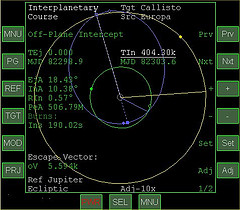
Interplanetary course plotting software screenshotWe all know that space battles as depicted in films and television tend to reuse the paradigms of more familiar planet-side combat types – the naval manoeuvres of Star Trek, for example, or the dog-fighting planes of Star Wars. But what would real combat between space-faring civilisations actually involve, strategically and tactically?

Well, Joseph Shoer’s the man to ask! He’s an aerospace engineer and physicist, and he recently wrote a post running through the main considerations of realistic space combat – everything from the difference between engagements in orbit and engagements in “deep space”, to why kinetic weapons are more efficient than explosive payloads, and plenty more in between. If you’re a fan or writer of space opera, it’s a must-read; here’s a taster.

First, let me point out something that Ender’s Game got right and something it got wrong. What it got right is the essentially three-dimensional nature of space combat, and how that would be fundamentally different from land, sea, and air combat. In principle, yes, your enemy could come at you from any direction at all. In practice, though, the Buggers are going to do no such thing. At least, not until someone invents an FTL drive, and we can actually pop our battle fleets into existence anywhere near our enemies. The marauding space fleets are going to be governed by orbit dynamics – not just of their own ships in orbit around planets and suns, but those planets’ orbits. For the same reason that we have Space Shuttle launch delays, we’ll be able to tell exactly what trajectories our enemies could take between planets: the launch window. At any given point in time, there are only so many routes from here to Mars that will leave our imperialist forces enough fuel and energy to put down the colonists’ revolt. So, it would actually make sense to build space defense platforms in certain orbits, to point high-power radar-reflection surveillance satellites at certain empty reaches of space, or even to mine parts of the void.

Go read the whole thing! Hat tip to Ian Sales on Twitter. [image by FlyingSinger]

Presenting the fact and fiction of tomorrow since 2001