The imminent future of contextual advertising

Virtual worlds of all stripes are becoming the next gold-rush frontier for an increasingly beleaguered advertising industry, with lots of research being expended on finding the best way to gets brands in front of the captivated gaze of the average computer gamer.

Trouble is, it’s not quite as simple as cutting a product placement deal and hoping for the best. Ars Technica reports on one research paper that claims the important things to do are to not interrupt the game, and to make sure the brand “fits”:

When ads were placed into Sony’s WipeOut HD they played within the game’s loading screen, and artificially inflated the time it took to get into a game. The ads were quickly pulled, but it’s a powerful object lesson: don’t mess with the game itself. Any company that bought time in such a slot could easily do damage to their brand instead of spreading awareness.

[…]

The most important aspect of ads that follow the rules of fitting into the game world and not interrupting the flow is placement, which the study calls the “key element,” explaining “why some advertisements do not get much attention or are not remembered, even though they are constantly present in the field of view.” Brand awareness does not matter, it was found, so even a popular brand can’t overcome poor placement.

There is always a risk when advertising within a game. “If the advertising is presented at the wrong time or place, it just does not catch the player’s attention in the best case. In the worst case the player might even develop a disliking for the advertised brand,” the study showed. Of course, to find the optimal placement found in the study, you’ll have to buy the results, which will run you €800.

Meanwhile, The Guardian mentions another report which suggests (rather shakily, from the look of it) that brand recall is enhanced by violent game content:

The team based at the University of Luxembourg created a simple driving game named AdRacer in which players needed to drive over targets to gain points, while adverts were displayed unobtrusively on roadside billboards. In one version of the game, the targets were just symbols, in another, players had to run over pedestrians to increase their scores. Apparently, “Those who played a violent version of the game […] demonstrated significantly better recall of advertised brands than those who played the regular version.”

The problem is, although the violence seems to trigger something in the mechanism of human memory – it’s not always good news for the advertiser; the connotations can be rather destructive, negatively impacting the gamer’s opinion of the brand.

Why mention the crude commercial nastiness of marketing on a near-future science fiction blog? Well, even I can think up a passable plot for a story from the above two articles, for a start…

But we’ve also been talking about augmented reality a fair bit of late, and the metaverse is a perennial here as well – and both of those conceptual spaces can – and will – be colonised by marketing in exactly the same way that the physical surfaces of the “real” world already have been.

Forewarned is forearmed, as the saying goes… and as Jan Chipchase points out, if you already find regular ads to be ugly, annoying and intrusive – be they on the internet or on a wall – the future of contextual advertising isn’t going to be pretty at all.

Compressed-air-punk, chemical-punk: non-silicon computing

Computers are made from slices of etched and doped silicon, right? Well, yeah, most of ’em are – but you can use other substances or mechanisms as a processing substrate, too. While the mechanical clockwork computer remains a fascinating and romantic anachronism in the steampunk style, how about an 8-bit microprocessor that runs on nothing other than air itself?

The complicated nest of channels and valves made by Minsoung Rhee and Mark Burns at the University of Michigan, Ann Arbor, processes binary signals by sucking air out of tubes to represent a 0, or letting it back in to represent a 1.

A chain of such 1s and 0s flows through the processor’s channels, with pneumatic valves controlling the flow of the signals between channels.

Each pneumatic valve is operated by changing the air pressure in a small chamber below the air channel, separated from the circuit by a flexible impermeable membrane. When the lower chamber is filled with air the membrane pushes upwards and closes the valve, preventing the binary signal flowing across one of the processor’s junctions.

Sucking out the air from the chamber reopens the valve by forcing the membrane downwards, letting the signal move across the junction.

Mechanical computing isn’t your only alternative, either – you can also move into the world of chemical computing. You know the “hot ice” stuff you get in those chemical hand-warmer packets? Well, not content with having already made a computer from a slime mold, one Andrew Adamatzky has been using sodium acetate as a processing substrate, with some degree of success [via SlashDot]:

The basic idea is to exploit the travelling wavefront of crystallisation to perform calculations […] So the speed of the wavefront as it moves through a Petri dish and the way it interacts with other wavefronts effectively performs computations.

Adamatzky inputs data by triggering nucleation at multiple points in parallel by immersing aluminium wires powdered with sodium acetate into a supersaturated solution in a Petri dish. He “processes” the wavefronts using blobs of silicone to steer them around the dishes and has used the technique to create AND and OR gates.

The results of a computation are determined by recording the movement of the wavefronts and analysing the edges of the resulting crystal structures.

So there’s two more potential ways of building computers that could survive the radiation levels of outer space – though whether they’d ever scale up to a useful level of power-to-size remains to be seen. I wonder what else we might use to fuel our ever-expanding hunger for processor cycles?

One-way ticket to Mars, redux

Earth-Mars montageThe one-way mission to Mars is becoming one of those hardy perennial stories, earning a mention here back in the spring of 2008 when former NASA engineer Jim McLane spoke out in favour of the idea.
Now it’s the turn of Lawrence Krauss, who sums up his attitude to Mars missions with the phrase “to boldly go where no one has gone before does not require coming home again”.

The most challenging impediment to human travel to Mars does not seem to involve the complicated launching, propulsion, guidance or landing technologies but something far more mundane: the radiation emanating from the Sun’s cosmic rays. The shielding necessary to ensure the astronauts do not get a lethal dose of solar radiation on a round trip to Mars may very well make the spacecraft so heavy that the amount of fuel needed becomes prohibitive.

There is, however, a way to surmount this problem while reducing the cost and technical requirements, but it demands that we ask this vexing question: Why are we so interested in bringing the Mars astronauts home again?

His arguments focus on finance (a one-way mission is far cheaper and more logistically simple) and anthropological pragmatism (the journey might well reduce the astronauts’ lifespans considerably, so why waste the remainder of their lives dying in an Earth hospital when they could be doing useful stuff on Mars?). It’s a very cold set of equations, of course… but as has been pointed out before, there’d probably be no shortage of volunteers, be they elderly scientists or younger bold adventurers. Hell knows I’d love to go.

Furthermore, Krauss is probably correct in suggesting that Congress and NASA would never take the political risk of a mission that could be seen as signing a definite death warrant for American citizens, even if they chose to go. So perhaps that one-way ticket will be supplied by a private company… if it’s ever supplied at all. [via SlashDot; image by Bluedharma]

Japanese plan space-based solar power

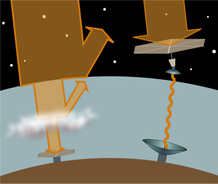
714px-Space_solar_powerThe Japanese government has taken another step towards actually building a space based solar power plant. Mitsubishi Electric Corp and industrial design company IHI Corp are to develop a design for a SBSP plant to be up and running at some point in the next three decades:

By 2015, the Japanese government hopes to test a small satellite decked out with solar panels that beams power through space and back to Earth.

There are still a number of hurdles to work through before space-based solar power becomes a reality though. Transportation of the solar panels into space is too expensive at the moment to be commercially viable, so Japan has to figure out a way to lower costs. Even if costs are lowered, solar stations will have to worry about damage from micrometeoroids and other flying objects. Still, space-based solar operates perfectly under all weather conditions, unlike Earth-based panels that are at the mercy of the clouds.

It makes sense to start moving in this direction, but will practical implementation arrive fast enough to help reduce global warming emissions?

[from Inhabitat, via Slashdot][image from Wikimedia]

Pain-free animals and ethical carnivorism

cowsAll but the most ardent and uncaring carnivores among us would probably agree that factory farming is a cruel and unpleasant lifestyle for the animals that eventually become our food. There are numerous answers to this ethical dilemma (aside from vegetarianism, of course), the newest of which is the suggestion that livestock be genetically re-engineered so that they don’t feel pain:

“If we can’t do away with factory farming, we should at least take steps to minimise the amount of suffering that is caused,” says Adam Shriver, a philosopher at Washington University in St Louis, Missouri. In a provocative paper published this month, Shriver contends that genetically engineered pain-free animals are the most acceptable alternative. “I’m offering a solution where you could still eat meat but avoid animal suffering.”

[…]

Performing brain surgery on livestock wouldn’t be feasible on an industrial scale. Livestock would have to be genetically engineered to be pain-free for it to be profitable.

Zhou-Feng Chen, a neuroscientist at Washington University in St Louis and colleagues are identifying the genes that regulate affective pain. Already, they have engineered mice that lack two enzymes which help neuron-to-neuron communication in the ACC. When the team injected a noxious, painful chemical into their paws, the mice licked them only briefly. In contrast, normal mice continued to do so for hours afterwards. This suggests that livestock could be spared persistent, nagging pain.

Now, I’m no militant animal rights campaigner, but Shriver’s suggestion sounds like aside-stepping of the issue rather than a solution. The ethical problem is the way we farm animals, and their suffering is a function thereof; removing their ability to feel pain would be like treating the symptoms of a disease rather than aiming to cure the disease itself, and the ethics of such a sweeping piece of genetic engineering is a whole new can of worms in and of itself. It certainly wouldn’t buy off my own guilt about factory farming… and it seems that I’m not the only one:

“Large farms have become an environmental disaster,” agrees Alan Goldberg at Johns Hopkins University in Baltimore, Maryland. They generate enormous amounts of waste and greenhouse gases and breed antibiotic resistance. “I think factory farms have to go, it’s that simple.”

Goldberg also contends that public attitudes may make pain-free livestock a non-starter. He and colleague Renee Gardner conducted an online survey on the use of pain-free animals in research and found little public support, even among researchers who experiment on animals.

Even Shriver (apparently a life-long vegetarian himself) agrees that the better option is to abolish factory farming entirely, which makes me wonder whether his suggestion is in fact a form of deliberately provocative rhetorical gambit. Personally, I think that vat-grown meat is the best long-term solution… as well as the only one that has a chance of scaling in response to global consumption patterns. [image by law_kevan]

Presenting the fact and fiction of tomorrow since 2001