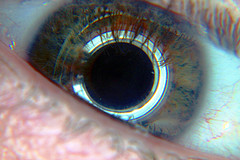
Augmented reality contact lenses

cyborg eyeAll this talk about augmented reality is all well and good, but wandering around holding up a little rectangular gadget to see things through is hardly an elegant science fictional solution, now is it?

As a fully paid-up cyberpunk, I want everything as tightly integrated to the meat as possible – so I want my AR operating no further from me than the surface of my eyeballs. Luckily I shouldn’t have too long to wait – at least not if Babak Parviz of the University of Washington has the successes he hopes for with his augmented reality contact lens concept:

Conventional contact lenses are polymers formed in specific shapes to correct faulty vision. To turn such a lens into a functional system, we integrate control circuits, communication circuits, and miniature antennas into the lens using custom-built optoelectronic components. Those components will eventually include hundreds of LEDs, which will form images in front of the eye, such as words, charts, and photographs. Much of the hardware is semitransparent so that wearers can navigate their surroundings without crashing into them or becoming disoriented. In all likelihood, a separate, portable device will relay displayable information to the lens’s control circuit, which will operate the optoelectronics in the lens.

These lenses don’t need to be very complex to be useful. Even a lens with a single pixel could aid people with impaired hearing or be incorporated as an indicator into computer games. With more colors and resolution, the repertoire could be expanded to include displaying text, translating speech into captions in real time, or offering visual cues from a navigation system. With basic image processing and Internet access, a contact-lens display could unlock whole new worlds of visual information, unfettered by the constraints of a physical display.

Parviz has a long old article there, and for those with a more technical bent it gives an insight into the way the contacts will actually work… though he’s canny enough not to put a solid date on the technology becoming available. [via New York Times; image by pasukaru76]

I wonder if he needs any test subjects?
Sifting through the genes that make humans unique

AnimaBiologists used to think that new genes “could only evolve from duplicated or rearranged versions of preexisting genes.” Now, though:
Scientists have made a crucial discovery of genes that have evolved in humans after branching off from other primates, opening new possibilities for understanding what makes us uniquely human….

Researchers have found genes that arose from non-coding DNA in flies, , and primates. No such genes had been found to be unique to humans until now, and the discovery raises fascinating questions about how these genes might make us different from other primates….

The authors [David Knowles and Aoife McLysaght of the Smurfit Institute of Genetics at Trinity College Dublin] also note that because of the strict set of filters employed, only about 20% of human genes were amenable to analysis. Therefore they estimate there may be approximately 18 human-specific genes that have arisen from non-coding DNA during human evolution.

This discovery of novel protein-coding genes in humans is a significant finding, but raises a bigger question: What are the proteins encoded by these genes doing? “They are unlike any other human genes and have the potential to have a profound impact,” McLysaght noted. While these genes have not been characterized yet and their functions remain unknown, McLysaght added that it is tempting to speculate that human-specific genes are important for human-specific traits.

[Image: Dollar Bin]

The future’s alright

futureThe role of science fiction vis a vis the future and predictions thereof has always been a target of lighthearted mockery. However Centauri Dreams articulates, with the help of futurist Peter Garretson, what science fiction can offer, even if predictions aren’t always on the mark:

Many forays into fictional futures, then, can give us alternative ways to make a new concept real. We can try on those futures by reading stories that make them come alive, seeing what effects these changes would have on society. And we can do more. By placing futuristic concepts in a tangible, fictional context, we can encourage their growth and dissemination.

Science fiction explores how human beings respond to change and disruption, and as such helps us explore ourselves. It can also offer pictures of how the world could be, so as to encourage us to actualise these images and build a better future.

[from Centauri Dreams][image from doug8888 on flickr]

E.O. Wilson tells Will Wright: ‘Games are the future in education’

dragonNational Public Radio just aired a wonderful conversation between Spore and Sims creator Will Wright and Harvard biologist E.O. Wilson, well worth a read or listen. But the chat didn’t go the way Wright thought it would:

I came into the interview with all these questions I wanted to ask him about evolution,” Wright said, “but his first response was, ‘Oh, I thought we were going to talk about games!'”

Wright wasn’t completely surprised. One of Wilson’s goals has been to “unify science with disciplines such as the humanities,” Wright said. “He is one of the few scientists who really has the guts to do that.”

So, asked by Wright about the role of games in education, Wilson said:

“I’ll go to an even more radical position,” Wilson said. “I think games are the future in education. We’re going through a rapid transition now. We’re about to leave print and textbooks behind.”

Wilson imagines students taking visits through the virtual world to different ecosystems. “That could be a rain forest,” he said, “a tundra — or a Jurassic forest.”

Wilson said that for the most part, we are teaching children the wrong way. According to the biologist, “When children went out in Paleolithic times, they went with adults and they learned everything they needed to learn by participating in the process.”

That’s the way the human mind is programmed to learn, Wilson said.

But he believes that today, virtual reality can be a steppingstone to the real world. It can motivate a child to exploration.

Wilson had a very different experience growing up. He explored the real world — and its creatures and plants — from a very young age. He credits his permissive parents and the schools he attended for allowing him to “disappear” into the forest.

“No one knew what I was doing,” he said.

Wilson is now studying the origins of altruistic behavior, taking his cue from Paul Gauguin: “Where did we come from? Who are we? Where are we going?” An education system that produces that kind of curiosity is the one I want for kids today.

Such ideas aren’t new to most of us, but it’s encouraging to hear them nudge their way towards conventional wisdom.

[Image: Torley]

NEW FICTION: IS THIS YOUR DAY TO JOIN THE REVOLUTION? by Genevieve Valentine

If you asked me for three words to describe this month’s Futurismic fiction offering, I’d give you “short, sharp and timely”. Genevieve Valentine wastes no words in revitalising (and spoofing) the classic sf dystopias in this brisk story of an all-too-plausible tomorrow. “Is This Your Day To Join The Revolution?” Read on and find out…

Is This Your Day To Join the Revolution?

by Genevieve Valentine

When Liz left her building, Disease Control workers were standing on the corners, handing out pills and little paper cups of Coke.

“Do you need one?” the old lady asked, holding up a handful of paper masks stamped with ads for Lavender Fields Sterile-Milled Soap. Liz pulled out the one she kept in her bag, and the lady smiled.

The TV in her subway car showed “What You Can Do on a Date.” The young man and woman went to the fair twice – once where he screwed everything up, and again where he helped her into the Ferris Wheel and handed her a paper mask before he put on his own.

The movie closed with swelling music and a reminder in cursive: ARE YOU DUE FOR A DATE? CHECK WITH YOUR DOCTOR. Continue reading NEW FICTION: IS THIS YOUR DAY TO JOIN THE REVOLUTION? by Genevieve Valentine →

Presenting the fact and fiction of tomorrow since 2001