Merging with your avatar

avatarAn interesting discussion from Thomas Frey at the DaVinci Institute on at which point our individual identity merges with that of our avatars:

With each generation of avatar, they will become more life-like, growing in realism, pressing the limits of autonomy as we become more and more reliant on them for experiencing the world. The avatar will become an extension of ourselves. The pain that we feel is the same pain that they feel, and vice versa. Like symbiotic twins separated only by a dimension or two, we are destined to become one with our avatars.

Karl Schroeder explores a similar notion of avatars becoming extensions of ourselves in Lady of Mazes.

[via FutureBlogger][image from TheAlieness GiselaGiardino²³]

Forty years since Armstrong’s one small step – where next?

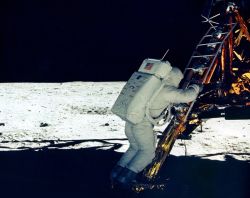
Buzz Aldrin begins his moonwalkI’m too young to join in the first-hand reminiscences of the Moon landings, but it’s still an event that played a huge role in my imaginative development – as it doubtless did for many other geeks and science fiction fans. [image courtesy NASA]

I think the Apollo project’s biggest symbolism for me is that of the bitter ironies of human technological achievement: to have sent a man into space, had him walk on the Moon and come back safely is quite simply a staggering achievement by whatever metric you choose to use; to have only found the motivation and political will to do so because of a geopolitical/ideological pissing match is rather sad. And it’s that very motivation that ensured us never returning to Luna, as Tom Wolfe points out:

Everybody, including Congress, was caught up in the adrenal rush of it all. But then, on the morning after, congressmen began to wonder about something that hadn’t dawned on them since Kennedy’s oration. What was this single combat stuff — they didn’t use the actual term — really all about? It had been a battle for morale at home and image abroad. Fine, O.K., we won, but it had no tactical military meaning whatsoever. And it had cost a fortune, $150 billion or so. And this business of sending a man to Mars and whatnot? Just more of the same, when you got right down to it. How laudable … how far-seeing … but why don’t we just do a Scarlett O’Hara and think about it tomorrow?

And that NASA budget! Now there was some prime pork you could really sink your teeth into! And they don’t need it anymore! Game’s over, NASA won, congratulations. Who couldn’t use some of that juicy meat to make the people happy? It had an ambrosial aroma … made you think of re-election …

But hey – this site’s about the future, so let’s look forwards, eh? Former NASA administrator Alan Stern reckons that private industry is the future of spaceflight, and that sub-orbital tourism might be ubiquitous in another decade or so:

I think that when anyone can fly in space, rather than just those that governments choose to send in to space, it’s going to really revolutionize, not only how we look at it, but it’s going to be an accelerant to the desires to have even more of that.

The prices start off pretty high – it’s tens of millions of dollars to fly in space, but those prices will come down, and fly sub-orbitally, ticket prices are in the range of a couple hundred thousand dollars, but those are going to come down a lot to I think over time. I expect that 10 years from now, they’ll be a fraction of that.

And it turns out there may be another motivational force to pull us back to the Moon – if we ever manage to crack commercial fusion power generation, we’d be able to rake up a whole lot of fuel up there:

… the Moon’s soil is rich in helium-3, which comes from the outer layer of the Sun and is blown around the Solar System by solar winds. The element is rarely found on Earth, unlike on the Moon, where it is heavily accumulated because it is pushed away by the Earth’s magnetic poles.

[…]

Reserves of helium-3 on the Moon are in the order of a million tonnes, according to some estimates, and just 25 tonnes could serve to power the European Union and United States for a year.

That’s a whole lot of fuel… but it’s still a finite resource, and historically those tend to lead to trouble and strife of some sort as the world’s powers jostle for the biggest slice of the pie. At least if colonialism reaches the Moon there won’t be any natives to exploit introduce to civilisation…

… none that we know of, anyway.

A cure for radiation sickness?

radioactive materials hazard signHey, great news! A group of researchers have discovered a medicine that can alleviate the damaging effects of radiation sickness… at least in mice and monkeys:

The first series of tests included experiments on more than 650 monkeys. Each test featured two groups of monkeys exposed to radiation, but only one group was given the medication. The radiation dosage was equal to the highest dosage sustained by humans as result of the Chernobyl mishap.

The experiment’s results were dramatic: 70% of the monkeys that did not receive the cure died, while the ones that survived suffered from the various maladies associated with lethal nuclear radiation. However, the group that did receive the anti-radiation shot saw almost all monkeys survive, most of them without any side-effects. The tests showed that injecting the medication between 24 hours before the exposure to 72 hours following the exposure achieves similar results.

Isn’t that brilliant news? Think of all the great things we could achieve if we could prevent radiation from damaging the human body! As its lead hook, Ynetnews gleefully trumpets about the geopolitical edge that this medicine will give to Israel in dealing with their ongoing paranoia about uppity Muslims with nuclear weapons, but follows with a more broadly humanitarian application:

Gudkov’s discovery may also have immense implications for cancer patients by enabling doctors to better protect patients against radiation. Should the new medication enable cancer patients to be treated with more powerful radiation, our ability to fight the disease could greatly improve.

Think also of clean-up operations in locations with similar problems to Chernobyl, or time spent in space beyond the Earth’s handy and life-saving magnetosphere. The list of places that people can’t go just got shorter. [via SlashDot; image by 7263255]

Femtotech: the next big small thing

Still battering on about nanotech? Man, you’re soooo noughties, get with the program. The new small-scale frontier is femtotech – we’re talking customised atomic nuclei strings here. Says Professor Alexander Bolonkin:

The form of matter containing and subsuming all the atom’s particles [from nucleons (neutrons, protons), electrons and other nuclear particles] into the nucleus is named degenerate matter. Degenerate matter found in white dwarfs, neutron stars and black holes. Conventionally this matter in such large astronomical objects has a high temperature (as independent particles!) and a high gravity adding a forcing, confining pressure in a very massive celestial objects. In nature, degenerate matter exists stably (as a big lump) to our knowledge only in large astronomical masses (include their surface where gravitation pressure is zero) and into big nuclei of conventional matter. Our purpose is to design artificial small masses of synthetic degenerate matter in form of an extremely thin strong thread (fiber, filament, string), round bar (rod), tube, net (dense or non dense weave and mesh size) which can exist at Earth-normal temperatures and pressures. Note that such stabilized degenerate matter in small amounts does not exist in Nature as far as we know.

All strictly theoretical at the moment, it seems. But hey – if you were worried that putting nanotech into a science fiction story sounds a bit passée nowadays, at least now you can make the jump to the next level without worrying that you’re just making it up out of whole cloth.

Beyond Molecular Nanotechnology is Femtotech : Proposal for Synthesizing Degenerate Matter

Presenting the fact and fiction of tomorrow since 2001