Oil rigs are vulnerable to hacking

oil rigIt shouldn’t come as a huge surprise – after all, anything that uses networked computing is at risk without the proper precautions – but independent researchers have declared oil rigs to be extremely vulnerable to hacking attempts.

While oil companies have made huge improvements in offshore safety and environmental protection, their efforts to secure important data have been poor, the SINTEF team says.

The group says that the current “integrated operations” model, which uses onshore workers to control processes carried out on the platform via networked PCs, leaves communications open to attack.

According to Science Daily, the team interviewed “key personnel in the petroleum sector” to get a sense of the data protection measures currently in place. The interviewees confirmed “that the number of safety incidents on production systems (platforms) has risen during past few years.”

Researchers said that hackers have already made their presence felt on oil platforms.

“The worst-case scenario, of course, is that a hacker will break in and take over control of the whole platform,” says SINTEF scientist, Martin Gilje Jaatun. “Luckily, this has not happened yet, but we have heard of a number of incidents that could have turned into something quite dramatic. For example, virus attacks have led to process electronic equipment becoming unstable.“

Frankly I’m surprised there haven’t been any major incidents so far, but it’s safe to assume that the inevitable resurgence of oil prices (not to mention the increasingly politicised nature of the fossil fuel industry) will make unmanned rigs into highly appealing target for hackers interested in protest or profit. [image by ccgd]

In fact, the profit motive is probably the stronger of the two… profit, or the prospect of free fuel. Any terrorist group or pirate nation looking for a ready source of the black gold would find it easy enough to hire some disaffected code-kiddie, then pay (or threaten) them enough to get them to bypass the security on an unmanned rig and then fiddle the telemetry for long enough to allow a physical invasion of the platform. Hey presto – a big base in offshore waters with all the oil you could ask for, and a target that even a major government is going to think twice about simply bombing to smithereens…
New resin for growing flesh

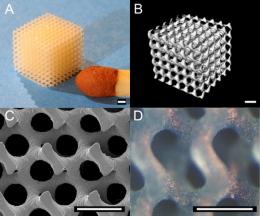
biodegradable_resinResearchers at the University of Twente have developed a biodegradable resin that can be used to create precise replicas of forms within the body around which new tissues can be grown:

The resin can be given different properties depending on where in the body it is to be used. Cells can be sown and cultured on these models, so that the tissues grown are, in fact, produced by the body itself. The new resin has been developed by Ferry Melchels and Prof. Dirk Grijpma of the UT’s Polymer Chemistry and Biomaterials research group. An article on this breakthrough will be appearing in the authoritative specialist journal, Biomaterials

The method used to recreate the specific forms is called stereolithography, the improvement in this system is that the resins have hitherto not been biodegradable. This means:

If, for example, a child has a heart valve disorder, a 3D digital image of the heart valve can be created using a CT scanner. The model in the stereolithograph can be copied exactly with the new resin. If the structure is made porous, the child’s own cells can be placed on it. This porosity also gives nutrients access to the cells. Ultimately, after the carrier structure has broken down, only the natural tissue remains.

Which is a rather wonderful development.

[from Physorg]

The romance of steam power returns

steam valveDespite its association with a bygone era of anachronistic and bulky (but very stylish) technology, steam power is making a comeback thanks to stimulus money from the US government. Combined Heat and Power (CHP) systems are appealing to large organisations because of the efficiency they offer, but the same logic could apply to more domestic situations as well:

Today, most of the time, we make electricity and generate heat in different places. We get our electricity for lighting and power from a central station located far away and transmitted to us through the grid. Heating or cooling, on the other hand, is often accomplished with on-site boilers or electric radiators. Both systems work less efficiently when they stand alone. Together, waste heat generated during the process of making electricity can be scavenged and piped around to provide climate control.

Makes sense, right? It sure does – and it’s environmentally sound as well.

A DOE report released late last year found that CHP was already responsible for reducing American emissions by 248 million metric tons of CO2, which is equivalent to taking 45 million cars off the road. That’s a lot more than wind, solar or any of the other renewables. They have such a big impact because they effectively double the amount of work that we get from burning the same amount of fossil fuel.

With the extra impetus to reduce carbon dioxide emissions to combat global warming, these electric plants that also use their excess heat could experience a lot more growth over the next 30 years. To do so, though, they have substantial challenges to overcome.

For one, many of the regional benefits of CHP are not recognized by existing environmental and utility regulations. Utilities resist CHP systems because they complicate their transmission infrastructure and they say that’s costly. And people have grown used to having their power generated in some far off place and often object to the installation of a power plant nearby.

Ah, good old NIMBYism… but perhaps those complaints will be fainter once the markets have made fossil fuels into ludicrously expensive commodities again. [image by waddie]

It’s interesting to note yet another field of concern and endeavour where the solution might involve a move back from centralised provision to localised. Economics, politics and now energy… is it time for the return of the city-state?

Inflatable tower to reach the edge of space

Step aside, space elevator evangelists – here’s an idea for joining the earth’s surface to space that’s much simpler, cheaper and safer than a big ribbon of carbon nanotubes.

A team of Canadian researchers have proposed a hollow tower constructed from the inflatable tubular modules that are used in some modern spacecraft, which – if built on top of a suitable mountain – could reach 20 kilometers above the Earth’s surface and act as a staging point for space launches… or a tourist destination with much lower risks and costs than suborbital rockets.

The team envisages assembling the structure from a series of modules constructed from Kevlar-polyethylene composite tubes made rigid by inflating them with a lightweight gas such as helium. To test the idea, they built a 7-metre scale model made up of six modules (see image). Each module was built out of three laminated polyethylene tubes 8 centimetres in diameter, mounted around circular spacers and inflated with air.

To stay upright and withstand winds, full-scale structures would require gyroscopes and active stabilisation systems in each module. The team modelled a 15-kilometre tower made up of 100 modules, each one 150 metres tall and 230 metres in diameter, built from inflatable tubes 2 metres across. Quine estimates it would weigh about 800,000 tonnes when pressurised – around twice the weight of the world’s largest supertanker.

Of course, the caveat is that this is just a theory at the moment – but it at least has the merits of being based entirely on existing technology. It seems that inflating things to reach space is quite the fashion at the moment…

Psikharpax: the robot rat

Psikharpax the robot ratDespite some freaky-looking androids coming out of Japan, we have yet to develop robots that can reproduce complex autonomous human behaviours. Perhaps the problem is that we’re aiming too high?

That’s the theory held at the Paris-based Institute for Intelligent Systems and Robotics, at least, who’re looking to the rodent world for inspiration:

Rather than try to replicate human intelligence, in all its furious complexities and higher levels of language and reasoning, it would be better to start at the bottom and figure out simpler abilities that humans share with other animals, they say.

These include navigating, seeking food and avoiding dangers.

And, for this job, there can be no better inspiration than the rat, which has lived cheek-by-whisker with humans since Homo sapiens took his first steps.

“The rat is the animal that scientists know best, and the structure of its brain is similar to that of humans,” says Steve Nguyen, a doctoral student at ISIR, who helped show off Psikharpax at a research and innovation fair in Paris last week.

The goal is to get Psikharpax to be able to “survive” in new environments. It would be able to spot and move around things in its way, detect when it is in danger from collision with a human in its vicinity and spot an opportunity for “feeding” — recharging its battery at power points placed around the lab.

“We want to make robots that are able to look after themselves and depend on humans as least as possible,” said Guillot.

Seems like a good idea… provided they don’t build in the natural rodent propensity for rapid reproduction. [via GlobalGuerillas; image borrowed from linked PhysOrg article]

Presenting the fact and fiction of tomorrow since 2001