How will the earliest nanofactories emerge?

dimensionsJ Storrs Hall of the Foresight institute comments on what the earliest nanofactories will be like, and Michael Anissimov responds:

If nanofactories work at all, they will be very powerful. A nanofactory would be a very complicated, “huge” thing. The Center for Responsible Nanotechnology compares the complexity of a molecular assembler to that of a Space Shuttle. I think the analogy would be apt for a nanofactory as well. We are talking about a miniature factory with more moving parts and individual computers than a typical 100 million-dollar modern factory today. Difficulties with the basic technology will manifest themselves in the pre-nanofactory stage, working with individual assemblers or small ensembles of assemblers. If you’ve made it all the way to nanofactory-level MNT, you’ve already jumped the primary technological hurdles.

A point of disagreement between Anissimov and Hall is the precise definiton of “nanofactory.” Is it simply a general term for a device that can create many other things including a copy of itself, or it is a specific desktop-scale universal assembler?

Assuming the latter definition, Anissimov argues that widespread adoption of desktop nanofactories will happen much more rapidly than that of personal computers because:

There are simply too many moving parts for micromanagement to be possible — either the “code-level” operations are automated or they haven’t been established yet.

Either they work or they don’t. The smallest replicating unit is equivalent to the transistor in a personal computer – to the user it is expected to behave as a black box that performs a specific function – and if it fails to there is not much the user can do about it (if a transistor fails on a microchip can it even be repaired?).

The appropriate analogy is therefore between computers and nanofactories is between the existence of nanofactories and the existence of microchips. Microchips have found their way all over the place…

If Anissimov is right then it raises the interesting possibility that mature, desktop-scale nanofabrication may achieve widespread consumer adoption over a startlingly short period, given the ability of the machine to make copies of itself and the fact if it fulfils its basic function then it can become incredibly useful to many people very quickly.

[via Next Big Future][image from jurvetson on flickr]

21st Century digital boy – Milo, the virtual kid

He’s still only a demonstration at the moment, but maybe your kids will be hanging out with Milo in a few years’ time:

Milo is the creation of Peter Molyneux, founder of Lionhead Studios and developer of ambitious games such as “Black and White” and the “Fable” series. Those games tried to present players with moral choices that had consequences for their characters, and also tried to play on people’s real emotions.

Molyneux’s latest effort takes advantage of Microsoft’s new full-body controller for Xbox 360, known as Project Natal. The controller’s sensor bar tracks the real-world movements of Xbox players and translates them into the game, which allows them to practically play with Milo in person.

Yup – Milo is an AI avatar of a boy, and (by all accounts) an impressively convincing one. Here’s the demo video:

As LiveScience puts it:

The E3 demo shows Milo responding to a developer’s questions with some fairly convincing facial expressions, body behavior and voice tone. He even “talks” and looks at a real-world drawing, courtesy of the Natal controller scanning it into the game. It’s an impressive display that appears very human-like, and does not evoke any “uncanny valley” sensations of eerie or weird behavior that make people nervous.

Of course, that’s just the recorded demo. A Kotaku editor who got hands-on time with the Milo demo did run into moments of awkwardness, such as Milo waiting for him to say something. But he also described the magic of the virtual boy complimenting him on his blue shirt.

Molyneux continually beats a drum about “science fiction writers never having imagined such a technology”, and I’m pretty sure he’s wrong on that count, but I was genuinely blown away by that video, even after factoring in a degree of cynicism appropriate to a demonstration given at an industry junket.

Now, Milo as a playmate and companion for kids is a marketable deployment of this technology, sure. But wait until the beleaguered porn industry gets hold of the same algorithms…

Nanoscale etchings make liquid flow uphill

OK, I can’t resist it – here’s an OMGZ SCIENCE!!1 story that is too good to pass up: nanoscale laser etchings on metallic surfaces can produce weird effects in their interaction with liquids, including the ability to make them flow against gravity.

Chunlei Guo, associate professor of optics at the University of Rochester in New York State, says: “We’re able to change the surface structure of almost any piece of metal so that we can control how liquid responds to it. We can even control the direction in which the liquid flows, or whether liquid flows at all.“

That’s pretty cool in and of itself, but here’s your real sensawunda kick:

Guo and his assistant, Anatoliy Vorobyev, alter the surface of the metal using an ultra-fast burst of light from a laser. Science Daily reports: “The laser, called a femtosecond laser, produces pulses lasting only a few quadrillionths of a second—a femtosecond is to a second what a second is to about 32 million years.” It adds that this one burst unleashes as much power as the whole of North America’s electric grid delivers, but “focused onto a spot the size of a needlepoint”.

Science FTW! It’s days like this I wish I’d actually finished my undergraduate courses…

Is Chinese web censorship effective?

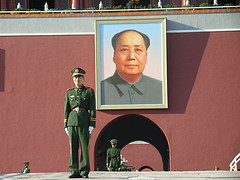
Soldier guarding portrait of Mao Zedong in Tiananmen SquareThe last week or so has seen a number of stories regarding today being the anniversary of the Tiananmen Square massacre in China, many of them focussing on the sad but unsurprising fact that the Chinese government has locked down access to a swathe of web tools (like Twitter) and news sites (like HuffPo) in anticipation of its citizens talking about a subject on which it is still hugely touchy.

The first question I asked myself was “how effective will that be, anyway?” I’m obviously not the only person to wonder the same thing – though it seemed my initial optimism was unfounded, as BoingBoing linked to a short post by Beijing-based journalist James Fallows, who reports that knowledge of the Tiananmen protests among young Chinese is virtually non-existent:

I have spent a lot of time over the past three years with Chinese university students. They know a lot about the world, and about American history, and about certain periods in their own country’s past. Virtually everyone can recite chapter and verse of the Japanese cruelties in China from the 1930s onward, or the 100 Years of Humiliation, or the long background of Chinese engagement with Tibet. Through their own family’s experiences, many have heard of the trauma of the Cultural Revolution years and the starvation and hardship of the Great Leap Forward. But you can’t assume they will ever have heard of what happened in Tiananmen Square twenty years ago. For a minority of people in China, the upcoming date of June 4 has tremendous significance. For most young people, it’s just another day.

Similar sentiments crop up in a series of PBS interviews with journalists and experts in Chinese sociology [via MetaFilter], though there is some hope as well – here’s author and journalist Jan Wong:

I don’t know what it tells you about a country when you could have such a cataclysmic event as Tiananmen Square and then suddenly you lop off the reality for all the people coming after. … But the great thing about China is that history is valued so that it will come out one day. People will keep records, people will eventually write about this. It’s not that it’s disappeared forever. You know, in Chinese history, each dynasty has secrets that it suppresses, and then it’s up to the next dynasty to write the true history of the previous dynasty. Each dynasty writes its own propaganda, the next dynasty writes the true history, so I assume this will happen in China, too.

But how long will we have to wait for this to occur? Has the old cultural chain of the dynasties been snapped by the Communist Party’s ubiquitous censorship, or is it just another Emperor in different clothes?

Of course, one of the great claims about the internet is John Gilmore’s belief that it “treats censorship as damage and routes around it”; whether that is still the case (or if it ever was) is a subject for debate, but it’s reasonable to suggest that the internet must be a difficult beast to cage, even with the immense amount of manpower available to the Chinese government. China specialist Orville Schell suggests that China is the ultimate test of Gilmore’s aphorism:

We do have some interesting wild cards, like the Internet, and I think the Internet is fundamentally a liberalizing force. But I think China, in this regard, is the great petri dish for whether the Internet can be brought to heel, or whether it is, on the face of it, a sort of spontaneous free agent that will catalyse China into a more open direction. And I think the returns are not in yet. China needs the Internet, and it’s using it to good effect in business. And the Party is using it very effectively to help communicate with the provinces, the counties, the police units, the army. It isn’t purely an engine of dissident energy or of individualism or of democracy. We’ve seen many technologies from telegraph to radio to television that have been brought to heel quite nicely by commercial interests. So we’ll see.

Now you can’t control the Internet completely. I don’t even think that’s their aspiration in China. But their aspiration is to make it difficult enough for most people so that they’ll stay within the confines of the intranet, not the Internet. The intranet being China’s sort of hermitically sealed room, which is connected to the outside world by a very limited number of gateways. And it is through those gateways, that all the information to the outside world flows, both ways, and that’s where it can be controlled.

As with so many things, only time will tell. But I find myself wondering about the curiosity that is so much a part of being a young adult, at least here in the West – can censorship and obfuscation have really erased that completely among China’s young citizens? Would they not notice the increase in website blocking and wonder what is being hidden so carefully, like a child told to stay out of the cupboard under the stairs as Christmas approaches?

Maybe I’m more optimistic than I thought – I imagine that knowledge of the Tiananmen massacre isn’t as rare as it might appear to outside eyes, perhaps passed around in secret by good old word of mouth, quiet whispers and hand-written notes guarded closely against the surveillance of the state, a tiny precious flame shielded against the wind and rain, never shown to outsiders for fear that to do so would incur the wrath of the Party.

Or maybe I’m being naive; perhaps curiosity is easily quenched. After all, it’s not as if the ‘free’ West isn’t full of people who cultivate their own ignorance of political history, so as to avoid having to ask themselves awkward questions about the way the world works. [image by Gene Zhang]

Machines That Think

Welcome to the inaugural column of Today’s Tomorrows here at Futurismic. For any readers who missed my introduction, I’m going to explore a science topic a month, with both some evaluation of current news on the topic and a chat about how it has been dealt with in science fiction.

A few days ago, I was at a futurist technology conference called FiRE in San Diego, listening to new developments in multiple fields. The speed of change right now is amazing. We first flew at all in 1903. Today, we have a space program that ranges from commercial ventures like Space-X to NASA flying by Saturn and operating remote-control rovers on Mars. In 1993, the Mosaic internet browser allowed us popular and easy access to the computing tools to create cyberspace; I’m reading information from all over the world in order to compose this article. My iPhone has more computing power than the room-sized computer I used to support the City of Fullerton, CA. Continue reading Machines That Think →

Presenting the fact and fiction of tomorrow since 2001