Don’t Take it Personally, Babe, It Just Ain’t Your Story is the follow-up to Christine Love’s critically acclaimed indie game Digital: A Love Story. Much like its author’s previous work, Don’t Take It Personally is a game devoted to exploring the nature of online identity. However, while Digital expressed a delicately muted nostalgia for a fictionalised past in which cyberspace allowed Mind to detach itself from Body, Don’t Take it Personally expresses a similarly ambivalent attitude to a notional future in which privacy has become an archaic and outmoded concept. Continue reading Don’t Take It Personally, Babe, It Just Ain’t Your Story: High School, Privacy and Blended Identity
More Luddite FUD about kids and computers
I was thinking it had been a while since we had one of these. Via FuturePundit, O NOEZ TEH TECHNOLOGIES BE MAKIN KIDS SUCK AT TEH REEDIN:
“Our study shows that the entry of computers into the home has contributed to changing children’s habits in such a manner that their reading does not develop to the same extent as previously. By comparing countries over time we can see a negative correlation between change in reading achievement and change in spare time computer habits which indicates that reading ability falls as leisure use of computers increases”, says Monica Rosén.
OK, I’ll see your study and raise you with this one:
The e-Learning Foundation says that children without access to a computer in the evening are being increasingly disadvantaged in the classroom. Research suggests that 1.2 million teenagers log on to revision pages every week and those using online resources were on average likely to attain a grade higher in exams.
The charity cites BBC research in which more than 100 students used the BBC Bitesize revision materials before their GCSE examination. The children were found to have achieved a grade lift compared to those who did not use the online revision guides. The BBC study says: “This is compared to factors such as teacher influence, which was found to produce no significant difference.”
Which is right? I have no idea. The point is that if you send social scientists looking for evidence to support a pretty nebulous and hard-to-quantify phenomenon, they’ll probably rustle some up. Seek and you shall find… or, I dunno, spend that research money on looking into ways that we can use technology more effectively? How’s about it, huh?
Computers and the internet are here to stay. The way kids learn and interact with the world has changed hugely in last 100 years, and will keep changing, as it always has since the day some smart hunter/gatherer created the first baby sling. If all you’re gonna do is sit on your porch and kvetch about the good old days, you might as well let the kids get some enjoyment out of running around on the lawn.
David Brin talks sousveillance
Still got a lot of metaphorical balls in the air here, so continued quietness will be the norm for a few more days. In the meantime, here’s Ben Goertzel interviewing David Brin at H+ Magazine; regular readers will know that I’m very interested in Brin’s “Transparent Society” ideas, and sousveillance is the subject matter at hand. Snip:
Brin: Essentially, this is the greatest of all human experiments. In theory… sousveillance should eventually equilibrate into a situation where people (for their own sakes and because they believe in the Golden Rule, and because they will be caught if they violate it) eagerly and fiercely zoom in upon areas where others might be conniving or scheming or cheating or pursuing grossly-harmful deluded paths…
… while looking away when none of these dangers apply. A socially sanctioned discretion based on “none of my business” and leaving each other alone… because you’ll want that other person to be your ally next time, when YOU are the one saying “make that guy leave me alone!”
That is where it should wind up. If we’re capable of calm, or rationality and acting in our own self-interest. It is stylishly cynical for most people to guffaw, at this point and assume this is a fairy tale. I can just hear some readers muttering “Humans aren’t like that!”
Well, maybe not. But I have seen plenty of evidence that we are now more like that than our ancestors ever imagined they could be. The goal may not be attainable. But we’ve already taken strides in that direction.
Goertzel: Hmmmm…. I definitely see this “best of both worlds” scenario as one possible attractor that a sousveillant society could fall into, but not necessarily the only one. I suppose we could also have convergence to other, very different attractors, for instance ones in which there really is no privacy because endless spying has become the culture; and ones in which uneasy middle-grounds between surveillance and sousveillance arise, with companies and other organizations enforcing cultures of mutual overwhelming sousveillance among their employees or members.
Just as the current set of technologies has led to a variety of different cultural “attractors” in different places, based on complex reasons.
Brin: This is essentially my point. The old attractor states are immensely powerful. Remember that 99% of post agricultural societies had no freedom because the oligarchs wanted it that way and they controlled the information flows. That kind of feudal-aristocratic, top-down dominance always looms, ready to take over. In fact, I think so-called Culture War is essentially an effort to discredit the “smartypants” intellectual elites who might challenge authoritarian/oligarchic attractor states, in favor of others that are based upon calm reason.
The odds have always been against the Enlightenment methodology – the core technique underlying our markets, democracy and science – called Reciprocal Accountability. On the other hand, sousveillance is nothing more or less than the final reification of that methodology. Look, I want sousveillance primarily because it will end forever the threat of top-down tyranny. But the core question you are zeroing in on, here, is a very smart one – could the cure be worse than the disease?
It’s also the sort of question that could only be answered one way: by trying it out. Obviously a global roll-out is never going to happen, but this is the sort of thing a small nimble post-geographical state – Iceland, I’m looking at you! – could pilot quite easily. My argument in favour is that the technology of surveillance isn’t going away, and if the choice is undersight or oversight, I’m going with undersight every time.
Interestingly enough, I tend to find that the people who argue in favour of panopticon surveillance with the tired and demonstrably false canard “if you’re doing nothing wrong, you’ve nothing to fear!” are completely unwilling to apply the same reasoning to being surveilled by their fellow citizens. Guessing the reasons why that might be so are left as an exercise for the reader. 🙂
Personal Information, Part 2: episode 3


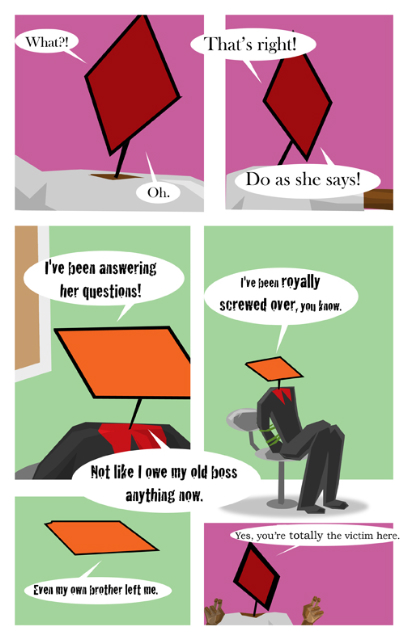
Personal Information is a serial sci-fi webcomic from Sarah “Does Not Equal” Ennals. Wondering what’s going on? Try winding back and reading from the start…
ExPoMo-a-go-go
Another day, another newly-coined paradigm label for the unnamed (or rather polymonikered) present: this is expostmodernism [via Justin Pickard].
The force most people want to talk about is social media and wireless devices, and they are often treated as the only causes of the culture shift happening right now. But that’s a very narrow view. I see a number of major factors driving ExPoMod, including:
- A new boogieman. The Cold War ended in the 90s. Nuclear attacks still pose a risk, but are unlikely to wipe out entire continents. Terror attacks are the new spook, and while devastating, they tend to be localized. When the world is not in danger of ending, there is less motivation for cynicism and apathy.
- The maturing of the internet. In the early 90s, the savviest internet users were teens. The internet was a place of dubious information and anonymity. In the Oughts those users grew up and harnessed the internet professionally. Now people use their real names and information is as accurate (or more accurate) as offline sources.
- The depreciation of privacy. Throughout the postmodern period there was a concern for privacy of personal information. Only government and corporations had the resources to collect and use repositories of personal information, and they weren’t trusted. Since the late 90s there has been increasing value to putting one’s personal information online, and increasing difficulty in keeping it private. With real advantages to sharing personal information, privacy has become a polarized issue and more people are comfortable giving it up.
- A new type of war. The wars of the last 20 years tend to kill thousands or tens of thousands of people, a sharp contrast to the millions of dead in the World Wars, Korea, and Vietnam. Nationalism is less polarized, and discussion of war is more openly couched in economic terms.
- Economic shift. As the housing market fails, people find less security in staying in one location. More people take advantage of the ease of travel and communication, and they spend money differently. Sectors that delivery creativity, information, technology, and experiences are seeing growth.
- Change in education. As the price of college soars and more jobs require Master’s degrees, people increasingly seek ways to self-employ or work creatively. Many people prefer focused training through workshops, conferences and online materials to be preferable to formal institutions of higher learning. With the breadth and depth of information available online, this strategy has become a viable alternative to college for launching a successful career.
Together these factors shape a multi-generational move toward new beliefs, views and lifestyles. The single most notable shift is the decline of alienation. Alienation, the banner trait of postmodernism, occurs when an individual feels their existence has no point—either because their work provides no satisfaction, or because they don’t feel like they fit in with their community.
Not sure how much newness is in that pseudomanifesto, or that I agree with everything it says, and I definitely think “altermodern” has a better ring to it… but the sense that we’re on the cusp of a transition? Yeah, I get that. Hard to look at the news and not get that, really.