GPS for ants (and maybe other animals, too)

Giant bulldog ant; GPS available as optional upgradeLike many naturalists, I’ve always been fairly fascinated by ants – their industrious sense of purpose, their ability to collaborate as a single metaorganism, and so on. Greater minds than myself have often wondered how they navigate over wide areas so effectively, and now an answer has been unearthed: ant antennae incorporate magnetic minerals that may form part of an insectoid GPS system. [image by Arthur Chapman]

“The incorporation of minerals probably starts as soon as ants start getting in touch with soil,” she added, explaining to Discovery News that her team found ultra fine-grained crystals of magnetic magnetite, maghemite, hematite, goethite, and aluminum silicates in ant antennae. These particles could make a “biological compass needle” that drives ant GPS.

[…]

Our planet is magnetized, likely due to rotational forces of liquid iron in Earth’s core. Although the resulting magnetic field is one-twenty thousandth as strong as a refrigerator magnet, ants appear to “perceive the geomagnetic information through a magnetic sensor (the dirt particles), transduce it in a signal to the nervous system and then to the brain,” she said.

Not all ants may use this particular system. Desert ants, for example, appear to have evolved special eyes that detect skylight polarization, which they then use to find their way around their sandy habitat. Magnetic particles, however, have been detected in many fish, birds, butterflies, flies, bees, bats, mole rats, newts, sea turtles and spiny lobsters, suggesting these animals find their way like the Brazilian ants do.

Ain’t nature wonderful?

I wonder if perhaps we humans have  a similar ability lying dormant in our bodies, shoved aside by evolutionary pressures as unnecessary since we stopped being roaming bands of primates and began to settle in stable locations. Perhaps it could be reawakened, or simply installed from scratch by some deft ribofunk biohacking? Imagine a post-fuel future where we have an entire and recently re-greened planet to roam on foot – how wonderful to set out with no map besides the tiny magnets buried in your brain!

Atomic fireballs: the man with the pics

tumbler_snapper_bombThought ya’ll might get a kick of the old sensawunda out of these “rapatronic” high-speed photos of nuclear bombs exploding:

The exposures were often as short as 10 nanoseconds, and each Rapatronic camera would take exactly one photograph.

A bank of four to ten or more such cameras were arranged at tests to record different moments of early fireball growth.

They provide technical information about the device’s disassembly.

Some really awesome images captured here. More on rapatronics here.

[via Sachs Report][image from the page]

1973: Effortful, Sticky, Jammy – Space Ritual by Hawkwind

The Adam Roberts Project

The cover looks pretty exciting, doesn’t it? A flame-haired naked woman with a boomerang on her head standing in a big gold cauldron firing rockets from her fingertips into some cooking pots from which gigantic strands of frogspawn depend – how could that not be brilliant?

Hawkwind - Space RitualBut the truth is that no such woman actually appears in the music of Hawkwind’s Space Ritual (1973). Oh, Hawkwind’s stage show had statuesque topless Stacia, everybody knows about her. But the album itself … not so much. What you get on the album is space rock, and lots and lots and lots of it. Continue reading 1973: Effortful, Sticky, Jammy – Space Ritual by Hawkwind →
GPS FAIL?

lost personGot a GPS in your car? Well, I hope you’ve not become too reliant on it and totally lost the ability to use old-fashioned road maps, because GPS service could start getting patchy next year, when the ageing satellites that make up the system’s infrastructure start falling out of orbit before their replacements can be set up.
Seems like someone’s been blowin’ the boondoggle blues and letting the maintenance schedule slip behind:

The warning centres on the network of GPS satellites that constantly orbit the planet and beam signals back to the ground that help pinpoint your position on the Earth’s surface.

The satellites are overseen by the US Air Force, which has maintained the GPS network since the early 1990s. According to a study by the US government accountability office (GAO), mismanagement and a lack of investment means that some of the crucial GPS satellites could begin to fail as early as next year.

“It is uncertain whether the Air Force will be able to acquire new satellites in time to maintain current GPS service without interruption,” said the report, presented to Congress. “If not, some military operations and some civilian users could be adversely affected.”

The report says that Air Force officials have failed to execute the necessary steps to keep the system running smoothly.

Ouch. As pointed out in the Guardian article, it’s highly unlikely that the USAF will let the system degrade totally – it’s too useful, not just to them but to a lot of people the world over – but just as we have to accept with other ubiquitous services like Google, outages may occur, and there’ll be no one to complain to; it’s all there in the small print, man. [image by Larsz]

That said, it’s a free market, and you can always shop around for alternatives – apparently Russia, China and India are all working on their own equivalent systems, which is probably even more upsetting to the USAF than the possibility of flakey service from their own kit.

Dan Brown’s antimatter bombs are nothing to worry about

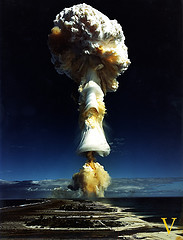
mushroom cloudI miss a lot of things about working in public libraries, but exposure to Dan Brown novels is not one of them. As such, I had no idea that Hollywood had made a movie from another of his books, Angels & Demons, but apparently they have.

Less surprising is the revelation that Brown has played fast and loose with the facts (and the writing, I fully expect); Wired UK takes a look at Brown’s antimatter-bomb-in-the-Vatican plot and points out that we’ve no need to worry about terrorists stealing the stuff from CERN:

And it’s true – scientists there really have  produced antimatter. But only in submicroscopic quantities. “If you add up all the antimatter we have made in more than 30 years of antimatter physics here at CERN, and if you were very generous, you might get 10 billionths of a gram,” CERN’s Rolf Landua, told New Scientist magazine recently. “Even if that exploded on your fingertip it would be no more dangerous than lighting a match.”

It would be possible to make more, of course, but not cheap:

The cost of antimatter is, by [NASA’s] estimates $62.5 million per microgram (£41 million). However, they suggest that a dedicated antimatter production facility, with a pricetag of $3 – $10 billion, would bring the price down to just $25,000 per microgram (a mere £16 million).

But even if that much were just lying around, the storage facilities don’t exactly lend themselves to a cat-burglar raid:

Positrons can be stored in a Penning Trap, a sort of magnetic bottle. (The Air Force bought a new positron trap in December – but only for a device to examine defects in semiconductors.) However, such traps are leaky and you can’t store your positrons indefinitely. There’s also the issue of what happens when the power fails. The trap stops working and all your positrons come into contact with the container walls, which could mean a big boom. Then there’s the question of how many positrons you can store. At the moment storing a microgram of positrons would require a Penning Trap of stupendous size. A 2004 report by the US National Research Council said that much greater energy densities were needed for positrons to be useful as an explosive. The study advised against heavy investment in such a high-risk, immature technology.

So, fear not – the Vatican is safe from antimatter, at least for now. Given the size of the place, I can’t imagine why you’d think you needed anything bigger than a small nuke to take it out… but that doesn’t sound quite as exotic, I guess, and exotic puts the ‘thrill’ into ‘technothriller’. Best leave the plausibility and scientific rigour to those science fiction nerds, eh? [image by V 2]

Presenting the fact and fiction of tomorrow since 2001