
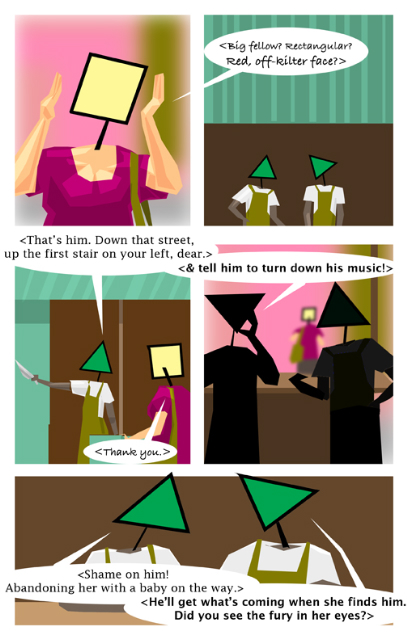
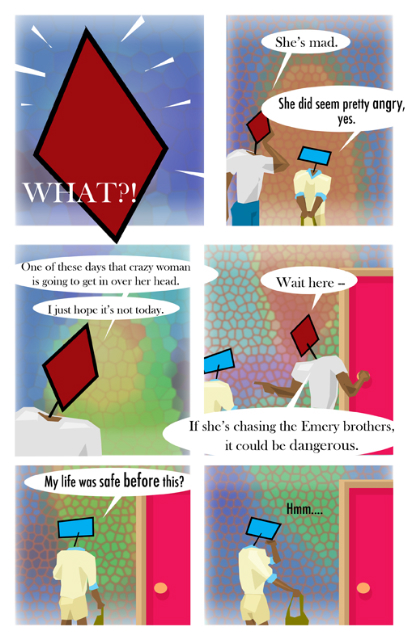
 Personal Information is a serial sci-fi webcomic from Sarah “Does Not Equal” Ennals. Wondering what’s going on? Try winding back and reading from the start…
eBay: cloud storage for physical objects
From the Alt Text comedy column at Wired:
Most of my old games are now eBay-bound — eBound, if you will — as are most of my old books. I don’t think of it as getting rid of them. I still have them, right on my phone.
And if I want them in physical form? Well, I’ve stopped thinking of eBay as an auction site. Now I think of it more as cloud storage for things with measurable volume. I’m putting my possessions into the cloud, and if I want them again I can retrieve them from the cloud for a small fee.
Sure, they won’t be the exact original items I once owned, but that doesn’t bother me any more than it bothers me that the 1s and 0s I retrieve from Evernote aren’t the same electrons I originally stored.
Compare and contrast with the last Viridian Note from Bruce Sterling a few years back:
You will need to divide your current possessions into four major categories.
- Beautiful things.
- Emotionally important things.
- Tools, devices, and appliances that efficiently perform a useful function.
- Everything else.
“Everything else” will be by far the largest category. Anything you have not touched, or seen, or thought about in a year – this very likely belongs in “everything else.”
You should document these things. Take their pictures, their identifying makers’ marks, barcodes, whatever, so that you can get them off eBay or Amazon if, for some weird reason, you ever need them again. Store those digital pictures somewhere safe – along with all your other increasingly valuable, life-central digital data. Back them up both onsite and offsite.
Then remove them from your time and space. “Everything else” should not be in your immediate environment, sucking up your energy and reducing your opportunities. It should become a fond memory, or become reduced to data.
Of course, even as a short-to-medium-term storage medium, eBay is horribly clunky and expensive to use (not to mention lossy as all hell), but it’ll have to do until fabbing technology and truly ubiquitous digital media archiving catches up. The worrying thought is what we – as a culture, rather than as individuals – might lose in the period between now and then…
… but given that my ridiculous and ever-growing library of dead tree books contributed hugely to making my recent house move a waking nightmare, I’m starting to wonder whether I care as much as I think I do. Or rather, more than I should.
Fukushima: eating my words
OK, score one for the pessimist realists among you; looks like Fukushima was a lot messier than we were told, which makes me look a bit of a fool for claiming otherwise. Mea culpa.
That said, I think my overall point still stands: the circumstances of said accident were exceptional, and the course of wisdom would surely be to view it as a cautionary lesson rather than an excuse to completely write off a technology that could be of great use in the medium-term. Yes, it’s a mess that’ll take a long time to clean up… but nuclear has still killed or injured far less people per teraWatt-hour than coal.
Recreational chemistry whack-a-mole continues in the EU
As predicted by myself and a lone commenter last time I picked up this thread around eighteen months ago, European production of so-called “designer drugs” continues to outstrip the ability of legislation to block them.
Rob Wainwright, Europol’s director, said the emergence of the substances was now a major feature of Europe’s drugs problem: “Organised crime groups are increasingly active in producing and distributing drugs which can be associated with ecstasy,” he said. “We are determined to combat this phenomenon.”
… by any means other than the one simple and obvious way of disconnecting drug production and distribution from criminal gangs, namely decriminalisation, licensed production and regulation. Which is politically unpalatable, of course; so whack-a-mole legislative theatre will have to do instead, I guess. After all, the kids who’ll be harmed by the dodgy chemicals probably haven’t even bothered to register to vote, while the knee-jerk tabloid readers of the middle classes certainly have; gotta sing for the peanut galleries, AMIRITEZ? *sigh*
So, I’ll reiterate my question from the afore-linked previous post on the same topic: Is there anyone among Futurismic‘s readership who can say with a straight face that more restrictive legislation will prevent drug abuse, in the UK or anywhere else? If so, tell us how and why in the comments. Feel free to suggest new alternatives to legislation, as well.
Anonymous: an anarchist analysis
Over at The Guardian, Jana Herwig gets all theoretical on Anonymous. It’s probably the most lucid attempt to tease out what Anonymous means in the context of the wider world that I’ve seen in any major publication. There’s also a glorious degree of cognitive dissonance to be had from reading about such an irreverent and vernacular entity in the high diction of academe:
This collective identity belongs to no one in particular, but is at the disposal of anyone who knows its rules and knows how to apply them. Anonymous, the collective identity, is older than Anonymous, the hacktvist group – more to the point, I propose that the hacktivist group can be understood as an application of Anonymous, the collective identity.
This identity originated on imageboard 4chan.org, as a byproduct of a user interface policy called forced anonymity, also known for short as “forced anon”.
Forced anon made it impossible for users to type in their name when they published a forum post. Instead, “Anonymous” would invariably appear as the default author name for any post. As a result, and in particular for the uninitiated, discussions on 4chan would seem like an absurd soliloquy, with “Anonymous” posting a message and “Anonymous” and “Anonymous” responding.
What this interface policy prevented was the creation of a hierarchy among users, which is known to quickly establish itself in online forums, with older forum members dominating and “newbies” having little weight in the discussion. Anonymous’s (the group’s) present dismissal of hierarchies and leadership has its roots in this practice. The uncertainty about who is talking (or probably just talking to him or herself, feigning conversation) is characteristic of the “forced anon” experience.
Herwig’s piece is in part a response to the recent schism within Anonymous; within any “normal” hierarchical group, such a schism would probably spell its imminent demise, but I suspect the very nature of Anonymous will ensure its survival, even if it mutates and undergoes a sort of metastasis. The choice of the V For Vendetta masks as part of their iconography is quite telling; the point Moore was making in the book about emergent resistance to hierarchy and fascistic control is echoed in the unpredictability of their target choices. Dissent cannot be bridled or steered; that is its power, and its self-limiting principle.
To unpack that last statement: self-identifying as a member of Anonymous is a lot like self-identifying as an anarchist, in that anyone can slip on the mask at any time, and the non-hierarchical nature of the collective means that there is no authority with the power to deny your validity. This has its downsides, in that it makes for easy pillorying and demonisation of the collective identity (such as the way that a few self-identifying anarchists bricking windows on protest marches are conveniently assumed to be representative of all anarchists), allowing a convenient way to obscure the genuine problems of hierarchy by focussing on the more foolhardy and socially unacceptable attacks made upon it.
But there are upsides, too, in that the more nihilistic wearers-of-the-badge tend to perform acts that are self-limiting in the long term; because the collective is headless, it cannot be destroyed, so the hierarchical world has to content itself with the sort of decapitations that symbolically represent the defeat of a system or group in their own narrative, while all they’re doing is trimming the wilder edge-growths of the rhizome and preventing it from becoming a hierarchy itself.
All of which is to say that I think Anonymous – and anarchism-as-philosophy – aren’t going anywhere soon; in fact, I’m beginning to think they’re an inevitable product of a global networked culture, a counterweight to the structure of society that increases in mass in proportion to the rigidity of the systems it opposes. Neither are an end-point or a goal; those that join in the hope that they are will soon leave, disappointed, because the individual reward they subconsciously seek for their actions are incompatible with the anonymity under which they are obliged to operate.
Of course, you may think I’m blowing pretentious smoke out of my own arse here; it wouldn’t be completely out of character, after all. So why not tell me why I’m wrong in the comments, eh? 🙂