Grid2.0 – electricity as commodity

electricity pylonsMuch attention is currently (arf!) focussed on making our energy grids cheaper and more efficient, with lots of new ideas being batted around. Here’s a proposal which already appears to be working in one region: start treating electricity as a commodity as well as a utility.

Treat electricity like a commodity—something for which you can gauge demand and set a price in advance. That’s what New England’s independent system operator started doing last year. In its Forward Capacity Market, the ISO projects how much power the region will need three years ahead and then runs a descending-clock auction for the right to provide it. The ISO doesn’t care whether it gets its power from increased production of megawatts or from efficiencies added to the system, so-called negawatts. The agency simply sets the starting price.

Result: money saved in power plants and wires, more stable electricity bills, and a homegrown incubator for getting bright green ideas off the drawing board.

Anything that can prevent my quarterly electricty bill from doubling in cost as it did over the winter just past sounds like a good plan to me, though I’m never astonishingly keen on introducing middleman agencies into an already costly system.

Furthermore, I’m not sure how much protection the commodity trading of electricity would grant us from the civilisation-smashing power of solar weather[image by aloshbennett]

Travel to Mars… without ever leaving the parking lot

MarsSo, do you think you could cope with the cramped conditions and prison psychology that would be an inevitable part of a manned mission to Mars and back?

Well, here’s the test – we’ll lock you in a fake space capsule that’s sitting in a parking lot somewhere outside of Moscow for about a hundred days with five other people and watch you through cameras to see how you get on.

The idea is for the 550 cubic-metre “ground exploration complex” (GEC) to recreate as closely as possible the atmosphere of a spacecraft racing through the solar system, bombarded by cosmic radiation. Any return flight to Mars – at least 34 million miles from our planet – would take between 18 months and three years, including landing and exploration.

The volunteers – four Russians, a French airline pilot and a German army engineer – will be kept under constant camera surveillance to record the physical and psychological impact of their time in the isolation chamber.

Isn’t this lifted wholesale from a J G Ballard story? You’re surely going to get some industrial-grade cabin fever going on…

Mark Belokovksy of the IMBP admitted the psychological pressure of living in close quarters with five other human beings could crack even the toughest guinea pigs.

“Tension is inevitable,” he said candidly. The fact the 105-day “flight” will be a single-sex trip on this occasion may be a blessing. During a similar experiment in 1999 the participants were given vodka to celebrate New Year’s Eve: two members then got in a fist fight after one tried to kiss a female volunteer from Canada.

Yeesh; the green-eyed monster in outer space, no less. I wonder where I can find details about that Canadian experiment – I’m curious to know whether the women fared any better at the isolation than the men did. Would an all-female crew be more stable, or less? How about a crew of eunuchs?

But if you’ll permit me a brief flight of fancy, mashing up this story with that half-remembered Ballard piece and the Moon hoax conspiracy theories: I wonder if it would be possible for a government with sufficient space capability to run an entirely faked CGI Mars mission that fooled everyone, even the cosmonauts themselves? [image by jasonb42882]

Uxo, Bomb Rat

RatWe interrupt our usually po-faced seriousness for a brief dose of vaguely topical cute… assuming your definition of cute extends to rodents.
You may have read and enjoyed Eliot Fintushel’s “UXO, Bomb Dog” when we published it here last year (and if not, you should, because it’s a great story), but you may not have been aware that even smaller animals can be trained to de-mine battlefields – like rats.

Trainers begin socialising the young rats to the sights, sounds, and textures of the world by walking them on wet grass, going for a ride in a lorry and interacting with humans.

Then the sniffer rats are taught to recognise the smell of metal land mine casings in return for a food reward.

Thirty sniffer rats are already being used in Mozambique, Africa, and have proved incredibly successful for the detection and removal of land mines.

The rodents are fitted to a leash before scrambling their way over a piece of ground, sniffing out any explosives.

A trained rat can clear 100 metres square in 30 minutes, equivalent to two days work for a manual de-miner.

I used to share a house with a guy who kept rats, and I can vouch for their intelligence… and their tenacity. Their ability to come when they’re called? Not so much. [via grinding.be; image by charlycoste]

Blinded by the laser light

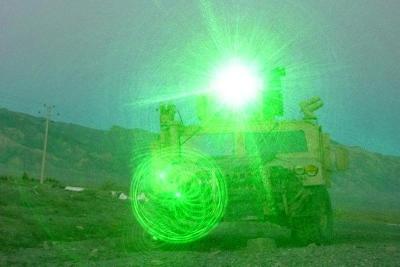
green_laserIn what won’t be the last instances of laser-related “friendly fire” three US soldiers in Iraq have been hospitalised, and one has been blinded in one eye, by a green dazzling laser:

Since November 2008, a single unit in Iraq “has experienced 12 green-laser incidents involving 14 soldiers and varying degrees of injury. Three soldiers required medical evacuation out of Iraq and one soldier is now blind in one eye,” writes Sgt. Crystal Reidy

[from Wired][image from Wired]

Malthus and the vampires

A vampire, yesterdayEver wondered why there aren’t more vampires around? Why more people haven’t seen one? You’re not alone – Laura McLay applies stochastic equations to the possible population fluxes of vampires and determines that they’d either over-run the planet or die out in short order:

I have yet to see a vampire movie that implicitly assumes that there is a reasonable model for vampire population dynamics (using a stochastic process framework or something else). And frankly, I’m pretty disappointed. Until I am offered a reasonable explanation for why there aren’t more vampires, I won’t be able to jump on the vampire bandwagon. If I had free time, maybe I would write a mathematically consistent vampire novel.

Please don’t bother, Laura. Maybe you could write a mathematically consistent novel about a genre trope that hasn’t been relentlessly flogged to death over the last decade instead?

Just sayin’. [via New Scientist Short Sharp Science; image by Robert Couse-Baker]

Presenting the fact and fiction of tomorrow since 2001