Oddball galaxy discovered

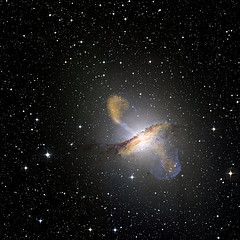
The Centaurus A galaxySeems there’s always something new to discover in the field of astronomy. The latest nugget of cosmological excitement is a tiny, dark-matter-free and closely-packed galaxy out in the direction of the Sombrero:

“It was only the size of a star cluster – which typically contain about one million stars – but it shone as brightly as a small galaxy. This indicated the object was an ultra-compact dwarf galaxy, a very unusual object, possibly containing 10 million stars,” he said.

[snip]

“There is much debate in the astronomical community about how these things form. The prevailing theory is that they are dwarf galaxies that have been stripped of their outer halo of stars by the gravitational forces of the large parent galaxy, leaving only the bright inner core of stars. But we think it may be something else: a massive star cluster that has formed independently,” Hau explains.

Another unusual aspect of the ultra-compact dwarf galaxy is that it is very old – perhaps 10 billion years, indicating it was formed in the early stages of the universe, when things were all the more violent and energetic. Furthermore it appears to consist mainly of stars, rather than the still-enigmatic dark matter, which dominates the mass of most galaxies.

Small it may be, but SUCD1 is hardly peaceful, spitting out a powerful stream of X-rays. The team believes this to be the first time that X-ray emissions have been clearly detected from an ultra-compact dwarf object.

So, not your average ball of stars, then. And it may well turn out to be a natural (if freakish) example of the way the universe evolved…

… but indulge me a minute here, OK? An object much smaller than a normal galaxy, but which shines as brightly as one; an unusual topography of stellar density; an absence of the dark matter we’re accustomed to finding in such objects; a fierce source of X-ray emissions. You know that theory that says we’re most likely to find other advanced civilisations by looking for evidence of mega-engineering projects on the scale of Dyson Spheres and so on? Well, if I was one of the guys at SETI, I’d be booking some radio telescope time to scope out that little dwarf cluster.

Just sayin’. 😉

[Yeah, I know it’s probably just the first weird little galaxy of its type we’ve seen. But what can I say? I like Greg Egan novels. Image by thebadastronomer; it’s not of the galaxy in question, I’m afraid, but it is very pretty.]

Global collapse? What global collapse?

Apocalypse later?Futurist Brian Wang has had it with the doom-mongershe’s pretty sure there’s not going to be any global collapse, and he’s got a list of reasons why. Here are just a few:

1. Efficiency, conservation and an energy plans can be enhanced beyond current levels with minimal strain. There has been partially voluntary reductions in energy demand during the credit crisis. 10% reductions with minimal effort and 20% reductions with more austerity.

OK, seems reasonable.

5. In regards to global warming and environmental concerns:

  • a rapid switchover to totally clean power would stop the air pollution of coal and most oil and would greatly reduce any additional CO2
  • geoengineering can be used to reduce global temperatures if necessary
  • if the beliefs of climate change being from man-made sources are right then we are already geoengineering by accident as a side effect of our industry. It will be cheaper and easier to geoengineer to cancel those accidental side effects with intentional reversal efforts

Well, possibly, but geoengineering is a very speculative field indeed, as noted yesterday. And how are you going to defeat the political inertia on energy source changes?

9. Financial doom scenarios

  • Mandated resets of debt forgiveness, re-issuing script etc… can be used to reboot a country or a financial system
  • People and systems for production would still exist even if there was 1000 trillion in debt

Yes, but where’s the motivation for those hungry and desperate people going to come from?

Wang’s points all make sense, but they all seem to assume the presence of a strong and clearheaded global or national leadership which, most importantly, hasn’t lost the respect of its subjects or its power to organise them into productive and efficient units.

Wang frequently compares these potential responses to war-time mobilisation efforts, and as regards the scale of effort needed that comparison has validity. But I’m not so certain about his confidence in the psychology of a mobilisation of that sort; before his list, he says:

One thing of note is that most people usually think that Hitler and Stalin were bad guys for killing or causing the death of about 100 million people. Most of the civilization die off scenarios are that level of death each and every year for 70 years. 1000 times the number of deaths in the holocaust. Why is there the belief that significant mitigation efforts would not be made ?

Because political rhetoric is more easily focussed on an enemy with a face, perhaps?

The problem with existential threats is that they’re hard for our fundamentally selfish and short-range psychology to focus on. When you’ve not got enough to eat, your first priority will be filling your stomach, not saving the world. Mobilising people on the scale of nations takes a government with its people’s ear and trust, or at least their obedience under pressure… and with exception of some of the more totalitarian regimes on the planet, those are in short supply at the moment, and likely to be more so as the number of tangible existential risks increases, in my opinion. [image by sashomasho]

What do you think – would the world come together in the face of a genuine extinction event, or would it be every man for himself in the last days of civilisation?

When geoengineering goes wrong

Barcelona sunsetWhile it’s probably a bit too soon to go rushing into geoengineering projects in an attempt to readjust the earth’s runaway climate, discussing the ideas thoroughly is of great benefit – principally because it gives people a chance to pick holes in the plans and think of potential downsides before we do something irreversible.

Exhibit A: seeding the atmosphere with dust to increase the amount of sunlight reflected away into space might actually be shooting ourselves in our renewable foot, so to speak:

While such atmospheric modifications would only be expected to deflect about 3 percent of the sunlight incident on the earth, Murphy has found that solar energy collectors would face a reduction of up to one-fifth of the usable energy that they collect presently. Even though 97 percent of the sun’s light will make it through the Earth’s modified stratosphere, much of it will be scattered, making the light diffuse. Diffuse light cannot be focused in the same manner that direct light can be, which lessens its usability in most optical systems. Almost all projects that harness solar energy require a large portion direct sunlight that can be focused and concentrated on a cell of some kind.

So: reduce the bad effects of sunlight, and you’ll reduce the useful ones as well. Best relegate that plan to the back-burner… at least until someone finally develops a usable fusion system.

On a similar note, it looks like iron-dumping in the ocean is off the menu at least for us. For a certain type of shrimp, however, it’s very much on the menu:

The iron triggered a bloom of phytoplankton, which doubled their biomass within two weeks by taking in carbon dioxide from the seawater. Dead bloom particles were then expected to sink to the ocean bed, dragging carbon along with them.

Instead, the bloom attracted a swarm of hungry copepods. The tiny crustaceans graze on phytoplankton, which keeps the carbon in the food chain and prevents it from being stored in the ocean sink.

Back to the drawing board. Thank goodness for thinking ahead, eh? [image by papalars]

Moats in Mexico – villages under siege

The moat around Cuauhtemoc, MexicoThings are getting pretty rough in the northern states of Mexico, with criminal gangs acting increasingly like marauding guerrilla armies. So much so that the tiny town of Cuauhtemoc has taken medieval measures to prevent further attacks:

Since right before Christmas, armed raiders repeatedly have swept into both villages to carry away local men. Government help arrived too late, or not at all.

Terrified villagers — at the urging of army officers who couldn’t be there around the clock — have clawed moats across every access road but one into their communities, hoping to repel the raids.

It’s probably not very reassuring to find yourself in a position where the army tells you that you’re pretty much going to have to look out for yourself against armed gangs. Sure, the Mexican government has its work cut out dealing with the problem, but that’s going to be cold comfort to townspeople who just want to be left alone to get on with their lives… and it leaves the door wide open for another gang to step in and offer protection, which will destabilise the region even further. [via Global Guerrillas; image by Julian Cardona for the Houston Chronicle – contact for take-down if required]

The US economy is a myth

Chicago skylineA provocative headline, no? I wish I could say it was my own invention, but I can’t, because the Washington Post got there first:

So contend Bruce Katz, Mark Muro and Jennifer Bradley in the latest issue of the journal “Democracy.” The United States is not a single unified economy, they say, nor even a breakdown of 50 state economies. Instead, the country’s 100 largest metropolitan regions are the real drivers of economic activity, generating two-thirds of the nation’s jobs and three-quarters of its output. The sooner we reorient federal economic policies to support this “MetroNation,” the quicker we can fix the mess we’re in.

I’ll freely admit I don’t know enough about economics to tell whether Katz Muro and Bradley are actually right about that, but it makes a certain amount of sense… mapping economic activity like wi-fi signals, at their strongest near to the biggest routers. Maybe withdrawing economic focus from rural areas would make sense… but I can’t see it being a popular idea with people who live there. [via Bruce Sterling; image by doug.siefken]

Presenting the fact and fiction of tomorrow since 2001