The terrible cost of cash

a pile of Euro notesIt sounds like a tautology to say that cash costs money – ten bucks costs ten bucks, right? But for every ten-spot note you carry in your wallet or purse, you’re paying extra in banking fees elsewhere for the maintenance of the cash storage and distribution system – the upkeep and servicing of ATMs, for example. And then there are the subsidies, and the social costs…

David Birch suggests that, while we’re looking around for ways to make our economic systems more rational, ditching cash in favour of all-digital transactions would be good for us. But he’s aware it’ll be a hard sell:

I can’t see how the pricing problem is going to be resolved. Telling consumers that they will have to start paying more at the ATM because they will gain more overall will never work because the costs are immediate and visible but the benefits are diffuse and invisible. Perhaps use e-money fans should refocus. As Leo pointed out to me, almost two-thirds of the euros in circulation are in high denomination notes: these are not used for everyday transactional purposes but as stores of value in the less-regulated parts of the economy. Could be then achieve the goal of reducing total social costs and boosting the net welfare by explaining to our elected representatives that cash is not simply expensive, but dangerous?

The implicit point in there is that large amounts of circulating cash are of benefit to those who already have more money than everyone else, and to businesses whose legitimacy may not be entirely unquestionable; history suggests that asking governments to make things harder for such groups is unlikely to be a great success, for a variety of reasons. [image by stefan]

I remember being told at school in the late eighties that by the time I was part of the adult world, no-one would be using cash any more; a cashless society is well within our technological grasp, yet still we tote around slugs of metal and grubby slips of paper to pay for things. Would we really be better off without physical currency? And if so, why aren’t we already rid of it?
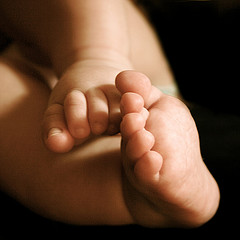
Are “designer baby” fears actually prolonging children’s suffering?

baby feetMedia hysteria about “designer babies” maintains ethical pressure on IVF genetic screening techniques and keeps them from becoming more widely used. Michael Le Page at New Scientist suggests IVF-PGD should in fact be mandatory, comparing a refusal to use the technique to the actions of parents who refuse medical treatment for their child on religious grounds:

We now have the ability to ensure that children are born free of any one of hundreds of serious genetic disorders, from cystic fibrosis to early-onset cancers. But children continue to be born with these diseases.

All would-be parents should be offered screening to alert them to any genetic disorders they risk passing on to their children. Those at risk should then be offered IVF with pre-implantation genetic diagnosis (IVF-PGD) to ensure any children are healthy.

Why isn’t it happening? Because most people still regard attempts to influence which genes our children inherit as taboo.

He goes on to point out that IVF-PGD can’t be used for ‘designing’ a child, and takes the view that if every life is a gamble, screening for inheritable diseases is a way of stacking the deck in your favour… and in the child’s.

Of course, that view is contrary to the “pro-life” philosophy, but even someone more moderate than that might see Le Page’s approach as callous. And there’s the argument that it’s immoral to attempt to eradicate disability entirely; remember the deaf couples who use genetic screening to select in favour of a child with deafness? [image by lepiaf.geo]

What do you think – should we use science to engineer away our physical defects before they happen, or to make life as comfortable as possible for those afflicted with them?

Outsourcing prayer as a hardware routine

This is something straight out of a Philip K Dick story… or maybe a Douglas Adams novel. Worried that your hectic lifestyle doesn’t leave enough time for prayer? Concerned that your panoply of Earthly duties might detract from your devotionals? Never fear – the good people of Information Age Prayer have got your back:

Information Age Prayer is a subscription service utilizing a computer with text-to-speech capability to incant your prayers each day. It gives you the satisfaction of knowing that your prayers will always be said even if you wake up late, or forget.

We use state of the art text to speech synthesizers to voice each prayer at a volume and speed equivalent to typical person praying. Each prayer is voiced individually, with the name of the subscriber displayed on screen.

Somewhere there is a room full of computers* that sounds like a chorus of Stephen Hawkings reciting the Beatitude… which is a pretty weird thought for a Monday morning. Or any morning, come to think of it. And hey, just in case you were thinking that Information Age Prayer was some sort of cop-out or shortcut:

At Information Age Prayer we think our service should be used like a prayer supplement, to extend and strengthen a subscriber’s connection with God. Traditional prayer is an integral part of this connection and should never be forgone, even after signing up.

I think my brain is broken. More coffee is needed… [via Pharyngula]

[ * – The more I think about this room-full of chanting computers, the more I suspect that it may not actually exist. ]

Presenting the fact and fiction of tomorrow since 2001