Chinese to launch military space station

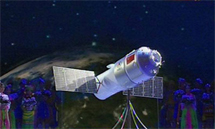
china_stationThe Chinese government has announced its intention to launch two space stations over the next two years, one for civil use and one for military activities:

The design, revealed to the Chinese during a nationally televised Chinese New Year broadcast, includes a large module with docking system making up the forward half of the vehicle and a service module section with solar arrays and propellant tanks making up the aft.

The concept is similar to manned concepts for Europe’s Automated Transfer Vehicle.

While used as a target to build Chinese docking and habitation experience, the vehicle’s military mission has some apparent parallels with the U.S. Air Force Manned Orbiting Laboratory (MOL) program cancelled in 1969 before it flew any manned missions. MOL’s objectives were primarily reconnaissance and technology development.

This is all due to happen in the same year that NASA is phasing out the space shuttle: how will Chinese progress in space affect US space policy?

[from SPACE.com via Slashdot][image from SPACE.com]

David Marusek on posthumanism and a soft singularity

Mind Over Ship by David MarusekWe’ve had it straight from the horse’s mouth that Charlie Stross isn’t an ideologue for the a posthuman future, but it appears (allowing for a little authorial hyperbole) that David Marusek is a little more bullish on the matter, due to his own reconception of what a singularity might really mean:

I sincerely believe that our near future includes the existence of posthumans. That is, if secular civilization survives and science advances, our subspecies Homo sapiens sapiens will branch out. Whether through purely biological means or in combination with some sort of inheritable machinery or machine interface, a new subspecies of human will coexist alongside us. Nothing like this has occurred for 30,000 years when our hominid cousin, the Neanderthal, was still around, or 200,000 years when we shared the planet with possibly three other human species. But this time we’ll be the obsolete species.

The idea of humans creating their own successors has been around for a long time and provides rich material for storytelling. The thing is, in most sf tales, you have to go through a Vingean Singularity to get to the Posthuman Future. We old model humans do poorly in singularities; by definition we are the past. Thus posthuman stories tend to be about trying to fight off the posthumans, especially if they’re machines. Brave humans strive to prevent their rise and maintain our biological supremacy. And this is where I try to break new trail in Mind Over Ship. I’m proposing a singularity that does not deny the importance of the human body but instead relies upon it.

The loathing of the body is one of the many detractions used against Singularitarian thinkers, and it’s easy enough to understand why (although, on some mornings, I’d gladly upload myself out of this damage-prone meat-machine). Perhaps Marusek’s new take on the trope will inspire another schism in post-human philosophy – a ‘soft’ singularity, perhaps?

And while we’re on the subject, Marusek’s new novel Mind Over Ship is a brilliant read, and comes heartily recommended to anyone who likes their sf to come packed to the brim with brain-bending ideas and complex plotting. Go buy it.

Sueing Google – how far does the law extend into the internet?

judge's gavelOK, you’ve probably seen this story already, primarily re-reported with a certain muted gloating that someone got one over on the Big G; a guy called Aaron Greenspan has successfully retrieved $721 of AdSense earnings from Google by filing a small claims lawsuit against them after his account was closed without explanation.

This is great news for all the people who fear Google’s monopoly on search, but what bothers me here is the question of whether the spirit of the law that governs an internet user need necessarily prevail in any section of cyberspace said user chooses to use.

I spoke with Adam C. of AdWords once more on the phone. After pointing out that in the United States of America, the accused are generally given the right to know both the crimes they are being accused of, and the identities of their accusers, Mr. C. responded by saying that such thinking did not apply to Google’s terms of service. Effectively, Google’s position was that it was above the law, and if not any law in particular, then at least the spirit of the law.

In this case, the judge disagreed with that stance (though it should be noted that, as it appears above, it has been paraphrased by Greenspan rather than quoted directly). With the inevitable caveat that I am not a lawyer or legal professional, it strikes me that this sort of question will become increasingly important as virtual worlds proliferate.

Let’s say you get burnt in a gold-trading deal in your favourite MMO; who has legal jurisdiction over an exchange that happens entirely electronically? Just how binding is that click-through EULA for the game, or for the trading site? If you’re based in the US but the huckster is based in China, how would you go about prosecuting (if you could at all)? [via The Guardian; image by steakpinball]

Questions like this are a reminder that the internet is still a wild frontier with a whole lot of loopholes. If nation-states are weakening in influence, how will they project the legal protections of their citizens into a space that has no geography?

Fabbing your new fingerbones

X-ray of a human handWhile 3D printing may be used predominantly for rapid prototyping of consumer goods (with all the potential risks that entails), it may turn out to have more humanitarian deployments as well. Proving a concept we mentioned a while back, a team of Swiss doctors have used a 3D printer to build replacement bones for a man’s thumb:

Weinand loaded the printer with tricalcium phosphate and a type of polylactic acid – natural structural materials found in the human body. The resulting bone “scaffolds” contained thousands of tiny pores into which bone cells could settle, grow and eventually displace the biodegradable scaffold altogether.

The bones still have to be ‘grown’ around the scaffold (using a surrogate mutant mouse, much like the famous Vacanti ear experiment), so it’s not a completely non-biological process. But it’s a step closer to a world where we can buy spare parts for our meat-machines ‘off the shelf’. [image by ansik]

Wolfram Alpha: Answering the questions that matter…

whyPolymath Stephen Wolfram (famed for AOT Mathematica and his book entitled A New Kind of Science) has been developing a knowledge engine that uses a natural language interface. It’s a bit like Google except:

Where Google is a system for FINDING things that we as a civilization collectively publish, Wolfram Alpha is for COMPUTING answers to questions about what we as a civilization collectively know.

It’s the next step in the distribution of knowledge and intelligence around the world — a new leap in the intelligence of our collective “Global Brain.” And like any big next-step, Wolfram Alpha works in a new way — it computes answers instead of just looking them up.

So basically you type in a question in normal language and it should provide an answer, rather than links to webpages that might contain the answer.

Anyway Wolfram Alpha will be launching in May.

[via Charles Stross, ComputerWorld, Physorg etc][image from e-magic on flickr]

Presenting the fact and fiction of tomorrow since 2001