Lubing the unregulated edges of the internet

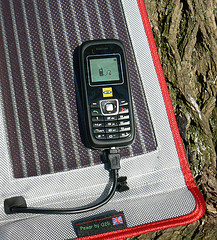
cellphone solar chargerIsn’t that the best title ever? Jan Chipchase strikes again, talking about the anthropological outcomes of the proposed universal micro-USB phone charger format:

Widespread adoption of Micro-USB lowers barriers to entry for would-be services providers – they currently need support a range of memory cards, umpteen data cables, Bluetooth and InfraRed […] A mobile phone optimised Bollywood movie can take 20 minutes to transfer from a laptop onto a generic micro-memory card – currently it’s hardly convenient.

If you follow Chipchase’s Future Perfect blog (and if you enjoy the stuff we talk about here at Futurismic, I suggest that you really should do) you’ll be aware that developing nations are far more dependent on their cellphones for infrastructural purposes than we are in the West; universal accessories would remove a number of small and pointless obstacles from the flow of commerce. In other words:

There is a place at the edges of the internet where the level of friction makes content and data grind to a halt. It’s largely unregulated. And it just got seriously lubed.

[Image by Ken Banks, kiwanja.net]

The costing of ebooks

Yeah, another ebooks post, but new material is coming in so thick and fast that every day I seem to find an answer to a question that was raised the day before. Point in case – why aren’t ebooks priced at a tiny percentage of the cost of a hardback? Take it away, HarperCollins:

We still pay for the author advance, the editing, the copyediting, the proofreading, the cover and interior design, the illustrations, the sales kit, the marketing efforts, the publicity, and the staff that needs to coordinate all of the details that make books possible in these stages. The costs are primarily in these previous stages; the difference between physical and electronic production is minimal. In fact, the paper/printing/binding of most books costs about $2.00…

In other words, a $26 hardback equates to a $24 ebook.

Now, I’m in no position to refute those figures, but I don’t think it takes an economics expert to look at them and realise why the publishers are struggling at the moment; if their analysis people can only shave off $2 per unit by removing the printing, shipping, warehousing and remaindering from the equation, then there’s a business model that was on shaky ground before the ebook entered the picture. I suspect the bits I’ve bolded are where the haemorrhaging could be stemmed most effectively.

But it’s easy to say that from the outside looking in; if anyone among Futurismic‘s readership can supply hard figures on this stuff, I’d be glad to give you a soapbox, so drop us a line.

Don’t burn all the fossil fuels (yet)

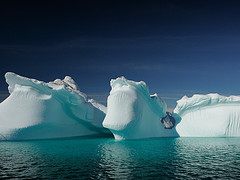
icebergAccording to Professor Gary Shaffer of the University of Copenhagen we should stop burning fossil fuels now so that we will have enough coal, oil, and gas left when we need to fend off the next ice age over the next several hundred thousand years:

…for a management scenario whereby fossil fuel use was reduced globally by 20% in 2020 and 60% in 2050 (compared to 1990 levels), maximum global warming was less than one degree Celsius above present. Similar reductions in fossil fuel use have been proposed by various countries like Germany and Great Britain.

In this scenario, combustion pulses of large remaining fossil fuel reserves were then tailored to raise atmospheric CO2 content high and long enough to parry forcing of ice age onsets by summer radiation minima as long as possible. In this way our present equable interglacial climate was extended for about 500,000 years, three times as long as in the “business as usual” case.

Nice to see some people are cranking up their Buxton indices into the 100, 000 years range.

[via FuturePundit][image from nick  russill on flickr]

Solar eclipse ‘diamond ring’ as seen from the moon

A little snippet of space-pr0n for ya; last week, the Japanese SELENE/Kaguya lunar orbiter probe shot some video footage of the Earth passing between the Moon and the Sun.

The ‘diamond ring’ effect is only ever seen on Earth on the rare occasion that we witness a total solar eclipse; this is probably the easiest way to see something otherwise incredibly rare (and mind-expandingly awesome, as far as I’m concerned). [via PinkTentacle]

You are reading Futurismic. You find a post about how you imagine the events described in narratives…

406px-Kuniyoshi_Utagawa,_Woman_reading I mostly write novels in third person, although one of my YA novels (Andy Nebula: Interstellar Rock Star) was written in first. Now research has come along that examines how pronouns influence the way we imagine events being described in narratives (Via PhysOrg):

In these experiments, volunteers read sentences describing everyday actions. The statements were expressed in either first- (“I am…”), second- (“You are…”) or third-person (“He is…”). Volunteers then looked at pictures and had to indicate whether the images matched the sentences they had read. The pictures were presented in either an internal (i.e. as though the volunteer was performing the event him/herself) or external (i.e. as though the volunteer was observing the event) perspective.

The results, reported in Psychological Science, a journal of the Association for Psychological Science, indicate that we use different perspectives, depending on which pronouns are used. When the volunteers read statements that began, “You are…” they pictured the scene through their own eyes. However, when they read statements explicitly describing someone else (for example, sentences that began, “He is…”) then they tended to view the scene from an outsider’s perspective. Even more interesting was what the results revealed about first-person statements (sentences that began, “I am…”). The perspective used while imagining these actions depended on the amount of information provided – the volunteers who read only one first-person sentence viewed the scene from their point of view while the volunteers who read three first-person sentences saw the scene from an outsider’s perspective.

So if you really want someone to imagine they’re experiencing the events described in a story first-hand, you need to write in second person. Even with first-person fiction, your readers step outside your narrator’s point of view and imagine things as if they’re viewing it on TV.

Does this presage a vast upswelling of second-person fiction?

I hope not. ‘Cause the one thing the researchers haven’t explained is why second-person fiction is so intensely annoying. Plus it makes everything sound like a Choose Your Own Adventure book.

“You are reading a novel written entirely in second person. You try one paragraph, then a second. Then a third. You get fed up with the constant repetition of the word ‘you’. You swear at the author. You throw the book across the room…”

(Image: Kuniyoshi Utagawa, via Wikimedia Commons.)

[tags]reading, writing, fiction, brain, psychology[/tags]
Presenting the fact and fiction of tomorrow since 2001