Moral medicine

Always keen to fabricate spurious definitions of illness in need of treatment on the lookout for problems to solve (so long as there’s a good profit margin involved), the world of pharmacology is looking to the sticky and complex field of human morality for its next conquest. This Guardian piece earns bonus points for including an “it’s a long way from being science fiction” soundbite

… would pharmacologically-induced altruism, for example, amount to genuine moral behaviour? Guy Kahane, deputy director of the Oxford Centre for Neuroethics and a Wellcome Trust biomedical ethics award winner, said: “We can change people’s emotional responses but quite whether that improves their moral behaviour is not something science can answer.”

He also admitted that it was unlikely people would “rush to take a pill that would make them morally better.

“Becoming more trusting, nicer, less aggressive and less violent can make you more vulnerable to exploitation,” he said. “On the other hand, it could improve your relationships or help your career.”

Kahane does not advocate putting morality drugs in the water supply, but he suggests that if administered widely they might help humanity to tackle global issues.

Gee, thanks, Doctor Kahane – it’s good to know you think that spiking our water is a step too far. That’s hugely reassuring. No, really.

I’m far from being the only person to find the whole idea instantly repellent. Elegantly-outfitted author Ryan Oakley sums up my main concerns concisely:

I don’t want any of that. I don’t trust the morality of people who’d make a pill to make moral people.

Besides, morality? What the fuck is morality? Is that like gravity? Some measurable force?

Cops, soldiers or leaders won’t be taking these pills. Just criminals and problem people. And guess who gets to decide who those people are.

Kyle Munkittrick takes a more moderate stance:

… drugs like Prozac and chemicals like oxytocin have the ability to make some people calmer, more empathetic, and more altruistic. Calm, empathetic, and altruistic people are far more likely to act morally than anxious, callous, and selfish people. But does that mean mood manipulation going to let us force people to be moral? And if it does, is that a good thing? Is it moral to force people to be moral?

[…]

Some drugs affect, that is, influence or temper a person’s response to a moral dilemma. Your initial response might be, “I don’t want my decisions being influenced by a drug!” We see ourselves as rational beings in control of our emotions. But our mood is often critical to our decision making, particularly in regard to how we react to others.

[…]

I might take a pill that makes me more more likely to be empathetic and altruistic, but it doesn’t guarantee that I will be any more than me having a crummy day will make me a jerk to others. Humans are able to exercise reason and willpower over our emotions and moods to control our actions. The great thing about mood enhancers is that they make it so that our reason and willpower don’t have to overcome anger, fear, and angst to enable us to do the moral thing. A person in the right mood has an easier time making good choices when faced with moral dilemmas.

As Munkittrick’s post title summarises: [mood manipulation] != [mind control]. But mood and character are deeply interlinked, and the ceaseless goldrush to identify, diagnose and treat behavioural or emotional “dysfunction”does not fill me with trusting appreciation for the idea of a pill that can “help us be better people”. If some kid chewing at his own lower lip in a rave made the same claim for MDMA, we’d rightfully think he or she was being naive at best, or deluded at worst; why is such a statement more acceptable when it comes from someone who wears a labcoat and (presumably) doesn’t eat their own dogfood, so to speak?

I guess the issue for me boils down to “who gets to define what’s morally good?” Given the historical record, I’m afraid that governments and pharmacology companies would be a long way down my list of reliable authorities on morality.
Fair Trade goldfarms

The market for intangible goods just isn’t going to go away. Indeed, it seems to be one of the few markets that hasn’t withered horribly under the global economic whatever-we’re-calling-the-SNAFU-this-week, and while it’s a pretty exploitative business in many respects, it’s not as nasty as some of the other markets that rely on the poorest nations for manpower and exports:

Ultimately, the report’s authors say, the size of the virtual economy and the potential for citizens of poorer nations to pocket a significant amount of money from it suggest that virtual goods and services should be taken seriously by any group that’s looking at ways to help lift people out of poverty. The authors estimate the size of the market for third-party gaming services alone was $3 billion in 2009. Significantly, most of this money went directly to the developing countries, as opposed to being eaten up by Western intermediaries. The report contrasts this with the market for coffee, which was $70 billion globally in 2009, but only $5.5 billion went to countries that produce the coffee beans.

Factor in rising costs for the shipping of physical goods, and things could start looking real weird real fast: a shift in output from plastic tchotchkes to digital ones. Can’t say I’d consider that to be an entirely bad thing.

Architectural fabrication: printing buildings

Via Alex “Robot Overlords” Knapp, here’s a Technology Review piece about architect and MIT Media Lab boffin Neri Oxman, who’s picking up the architectural-scale 3D printing ball – still currently in its crude early phases, but eminently plausible – and running with it. The possibilities offered by bespoke design speak seductively to these geologically troubled times:

The work is at an early stage, but the new approach to construction and design suggests many new possibilities. A load-bearing wall could be printed in elaborate patterns that correspond to the stresses it will experience from the load it supports from wind or earthquakes, for instance.

The pattern could also account for the need to allow light into a building. Some areas would have strong, dense concrete, but in areas of low stress, the concrete could be extremely porous and light, serving only as a barrier to the elements while saving material and reducing the weight of the structure. In these non-load bearing areas, it could also be possible to print concrete that’s so porous that light can penetrate, or to mix the concrete gradually with transparent materials. Such designs could save energy by increasing the amount of daylight inside a building and reducing the need for artificial lighting. Eventually, it may be possible to print efficient insulation and ventilation at the same time. The structure can be complex, since it costs no more to print elaborate patterns than simple ones.

Just a proof-of-concept at this point, admittedly, but given how quickly 3D printing at a smaller scale has moved from theoretical future-thing to affordable DIY technohobby, the way we design and build our buildings – at least in the affluent parts of the world which can afford to consider aesthetics and disaster-proofing, rather than focussing on the simple need to construct a shelter quickly and cheaply – could change pretty rapidly. Which means that the Walkabout 3D Mobile augmented reality app is the precursor of a tool that will be essential to privileged NIMBYistas everywhere… after all, everyone loves progress, right up until the point that it interferes with their line of sight or property values. (NIMBYism is inherently a legacy of Gothic Hi-Tech; Favela Chic accepts intrusions and makes the best it can of them.)

Form and function

As I progress into my thirties, I’m becoming more aware of my status as a demographic that is targeted with nostalgia-based marketing. In terms of pop culture ephemera, I’ve remained relatively immune – the mainstream music and fashion of the eighties repelled me at the time, and has not lost its power to do so – but there is no escape; the technology industry has matured to an extent which allows it to mine its own past for aesthetic triggers that hit us lifelong early adopters like a punch to the gut, even when the product itself is quite obviously pointless in practical terms.

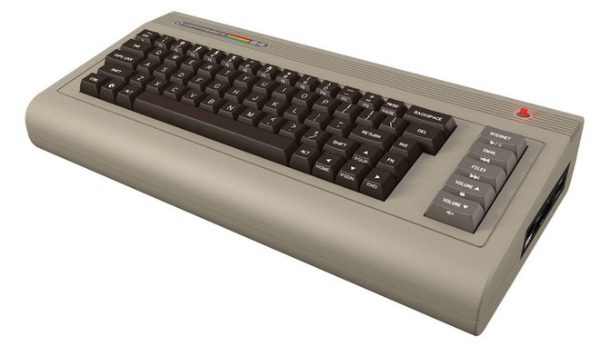
Point in case: Commodore returning to the computer hardware market with Linux-powered PCs dolled up in the form factors of their classic consumer-level home computers. This is the C64x:

Commodore C64x

Hi-ho, atemporality; there’s no point whatsoever in buying one of those unless you’re jonesing for the “authenticity” of the near past (which is itself pretty close to mythological anyway). Though we’re not quite at the point where ubicomp is a reality, Commodore’s “new” products represent an interesting point in the commodification curve of computing. Function is so cheap and easy to produce that form no longer has to play second fiddle; there’s more computing juice in your smartphone than was used to run the entire Apollo moon landings program, and you can shoehorn a useable computer into pretty much any container you desire. (Worth noting that this was an enthusiast’s hobby long before the manufacturers jumped the bandwagon; casemodding has transcended its initial geeks-only cachet thanks to economies of scale.)

When computers first arrived, they looked like the vast, complex and aesthetically sterile engineering devices that they were. Now computing is sufficiently ubiquitous that they can look like whatever we want them to look like (which means that making them look like older and significantly less powerful machines is a momentary fillip of aesthetic irony; expect an imminent rash of computers that don’t look anything like what folk of my age-bracket think of when we hear the word “computer” – remember the Sandbenders custom computer from Bill Gibson’s Idoru?). The end-point of the curve will be the point where computers become effectively invisible; I hesitate to predict a solid time-scale for that, but I’d be surprised if it takes more than another decade.

Presenting the fact and fiction of tomorrow since 2001