INTERVIEW: BRUCE STERLING on Caryatids, Viridian and the death of print

Bruce SterlingNovelist, pundit, design theorist and iconoclast – Bruce Sterling is all of these and more, and is one of the people that the Futurismic project has always looked to for inspiration.

Sterling has a new novel called Caryatids out at the end of February, the writing of which has somehow been shoehorned in between him bouncing around Europe, lecturing on design theory and keeping an eye on the maelstrom of global multimedia culture and politics.

He was good enough to cave into the pestering of this irredeemable fanboy and answer some questions about the new novel, the closing of the Viridian Green project and the relentless demise of science fiction print media. Continue reading INTERVIEW: BRUCE STERLING on Caryatids, Viridian and the death of print

Gattaca becomes reality – all babies to be DNA sequenced at birth by 2020?

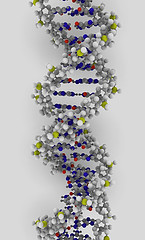
digital rendering of DNAA genetics outfit named Illumina is preparing to launch an affordable genetic mapping service in the next couple of years. Its first few customers can expect to pay between US$10,000 and US$20,000 for a complete mapping of every gene in their DNA, but their chief executive has told The Times that by 2020 the equipment should be so affordable that all newborns will have their genomes sequenced at birth:

“The limitations are sociological; when and where people think it can be applied, the concerns people have about misinformation and the background ethics questions.

“I think those are actually going to be the limits that push it out to a ten-year timeframe,” he added.

Of course, he’s bound to be positive about the prospects; CEO of the company isn’t exactly a disinterested position. But I think that’s a pretty plausible timeframe, if only so far as the capability is concerned.

And there will be resistance to the idea, even if the Gattaca comparison is rather overstated. Given the UK government’s current obsession with storing the minutia of its citizen’s lives, I’d be worried about letting them have my entire genetic sequence – though not because of what they would use it for so much as that I couldn’t trust them not to leave it in a briefcase on a rush-hour train

Even that makes light of a potentially sticky ethical quagmire, though; we won’t get to see everything that’s hidden in Pandora’s box until we actually open the lid. Let’s just hope we’ve gotten over our little global obsession with copyright and intellectual property by the time the street-corner sequencer shacks open for business, eh? [story via FuturePundit; image by ynse]

Drake equation crunched – 361 civilisations in our galaxy alone?

Messier-74 galaxyHey, great news for SETI fans! The latest work on the Drake equation suggests that we can all get our Fox Mulder on:

The current research estimates that there are at least 361 intelligent civilisations in our Galaxy and possibly as many as 38,000.

Awesome! Wait, what?

Even with the higher of the two estimates, however, it is not very likely that contact could be established with alien worlds.

Ah. Bugger.

Of course, the Drake Equation is only as good as its input data, and much of that remains wildly speculative. But the above is the result of factoring in the sudden rash of exoplanet discoveries we’ve made in the last few years; according to Centauri Dreams, the little we’ve learned about them means we can simulate the potential parameters of their atmospheres in order to guess how statistically likely they are to harbour the potential for life. Even that’s mostly guesswork, though:

… in biological terms, we are even more up the creek, since we base our thinking on observations of a single biosphere, our own. To keep the number of free parameters to a minimum, Forgan works with “a biological version of the Copernican Principle,” the notion that our Terran biosphere is not special or unique, so that we can think about life on other worlds as sharing many of the same characteristic parameters.

So keep watching the skies, folks! And don’t forget the hypothesis of Futurismic‘s own Mac Tonnies, which suggests that what we think of as extraterrestrials may in fact be something much more local… [image by jimkster]

1 tree = 111 books: is reading an environmentally sound pastime?

book stacksOver at Tor.com, novelist M M Buckner does a bit of soul searching regarding her reading pastime; if one tree makes 111 books, is the environmental sacrifice justifiable?

How long does it take you to read 111 books? What if you count magazines, newspapers, catalogs, photocopies , billing statements, Valentine cards to loved ones? Every year, one tree absorbs 26 pounds of carbon dioxide and exhales enough oxygen to keep four people alive. The UN says, to make up for all the trees we’ve killed in the last decade alone, we’d need to plant a forest the size of Peru. Only, Peru is just not into that.

So is buying a book a form of murder? When I leaf through the latest science fiction thriller, am I suffocating some future possible infant in the crib? Does reading make me a baby killer?

Her response is that the ebook revolution that’s currently gathering pace is the antidote to any such worries, and it comes with a side serving of “literary egalitarianism” – in other words, it activates a kind of Long Tail economics where more obscure titles become better business propositions, which is something that one would hope even the most die-hard climate skeptic can get behind. [image by ginnerobot]

Of course, if you’re still worried about atoning for your book habit, you could always reduce your footprint in some other way, like eating less meat

Catholic Church bringing back indulgences

indulge-me

Full disclosure: I was raised Catholic. So maybe I could use one of these.  And when I told like-backgrounded friends and relatives about this New York Times story, the reaction was uniform: “You’re kidding.” No:

In recent months, dioceses around the world have been offering Catholics a spiritual benefit that fell out of favor decades ago — the indulgence, a sort of amnesty from punishment in the afterlife — and reminding them of the church’s clout in mitigating the wages of sin.

The fact that many Catholics under 50 have never sought one, and never heard of indulgences except in high school European history (Martin Luther denounced the selling of them in 1517 while igniting the Protestant Reformation), simply makes their reintroduction more urgent among church leaders bent on restoring fading traditions of penance in what they see as a self-satisfied world.

Pope John Paul II liked the idea of bringing them back, and Pope Benedict is even more enthusiastic. What indulgences are:

According to church teaching, even after sinners are absolved in the confessional and say their Our Fathers or Hail Marys as penance, they still face punishment after death, in Purgatory, before they can enter heaven. In exchange for certain prayers, devotions or pilgrimages in special years, a Catholic can receive an indulgence, which reduces or erases that punishment instantly, with no formal ceremony or sacrament.

There are partial indulgences, which reduce purgatorial time by a certain number of days or years, and plenary indulgences, which eliminate all of it, until another sin is committed. You can get one for yourself, or for someone who is dead. You cannot buy one — the church outlawed the sale of indulgences in 1567 — but charitable contributions, combined with other acts, can help you earn one. There is a limit of one plenary indulgence per sinner per day.

It has no currency in the bad place.

Confession is a prerequisite. Dammit. (Oops.)

[Plenary indulgence. Inscription on the left transept of the Basilica of St. John Lateran (Rome): Wikimedia Commons]

Presenting the fact and fiction of tomorrow since 2001