Mini fuel cells

mini_fuel_cellEntering a key stage in the development of fuel cells: making them small enough to be ubiquitous, what’s the betting these’ll be in everything everywhere within 20 years?

The world’s smallest working fuel cell has been created by US chemical engineers, at just 3 millimetres across. Future versions of the tiny hydrogen-fuelled power pack could replace batteries in portable gadgets.

While batteries are used to do that today, fuel cells are able to store more energy in the same space. Even the most advanced batteries have an energy density an order of magnitude smaller than that of a hydrogen fuel tank.

[from New Scientist, via Bruce Sterling][image from New Scientist and Saeed Moghaddam]

Corb v2.0 – mutating shipping container condos

The humble shipping container has been reimagined quite a few times in recent years, and has appeared as a potential housing solution in sf novels and stories from (among others) Ken MacLeod, Neal Stephenson and Gareth L Powell, as well as starring as a plot McGuffin in William Gibson’s latest; the BBC are even following a shipping container by GPS for a year.

But nothing quite prepares you for the bright day-glo architectural enthusiam of the guys who’ve come up with CORB v2.0, a kind of mutating condominium made from shipping containers:

CORB v2.0 shipping container condominium - image copyright Anderew Maynard Architects

Changing your view or neighbours with the seasons or on a whim is not a problem at Corb. Changes in family dynamics or space requirements are easily dealt with.

Traditional hierarchies determined and reinforced by wealth are void here. When you live at Corb, everyone gets a penthouse just as often as they get a ground floor apartment.

One can only hope that, unlike Hiro Protagonist, you don’t end up with a choice of views over the runways of a major airport… or, as seems more likely, over a busy freight port. [image borrowed from Maynard Architects site; all rights reserved by owner, reproduced here under Fair Use terms; story via Justin Pickard]

Living la vida geo-loca

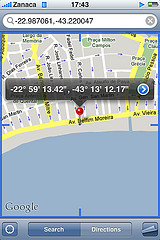
iPhone geo-locational software screenshotOver at Wired last week, they ran a piece by Matthew Honan about his experiences with the new wave of geolocational software for the iPhone and Google’s G1. He starts off by asking fellow users in his locality what they use the systems for:

My first response came from someone named Bridget, who, according to her profile, at least, was a 25 year-old woman with a proclivity for scarves. “To find sex, asshole,” she wrote.

“I’m sorry? You mean it’s for finding people to have sex with?” I zapped back.

“Yes, I use it for that,” she wrote. “It’s my birthday,” she added.

“Happy birthday,” I offered.

“Send me a nude pic for my birthday,” she replied.

A friendly offer, but I demurred. Anonymous geoshagging is not what I had in mind when I imagined what the GPS revolution could mean to me.

I don’t think anyone who has looked at the adoption curve for new networking technology will be particularly surprised by Bridget’s response… [image by zanaca]

Honan goes on to look at the pros and cons of what is admittedly still a technology in its applicational infancy, which he finds fun and intriguing at the same time that it seems creepy and intrusive – the latter response being one that I’d attribute to his age. When these apps have matured in a few years, however, the Facebook generation will have no qualms or fears about them whatsoever.

Whether they should have qualms is another question, of course. If nothing else, geolocational apps are a reminder that the tin-foil hat brigade’s warnings about The Feds being able to follow your cell phone weren’t entirely fictional; the potential for stalking someone is obvious.

But would stalking be as big a risk in a society where many people’s locations were public knowledge? If lifelogging catches on at the same time, we might all become one big happy globally geolocative panopticon…

NEW COLUMN: announcing The Adam Roberts Project

It is with great pleasure that I can announce that the coming week sees the first instalment of a new monthly column here at Futurismic!

Its creator is no stranger to the site – having been a regular commenter, as well as providing us a review of all of the Arthur C Clarke Award shortlist nominees for 2008 – and may well be no stranger to your bookshelves, whether in the form of his science fiction novels, criticism or histories.

Of whom do I speak? Well, let’s let The Adam Roberts Project explain it for [him/it]self, shall we?

The Adam Roberts Project is an algorithm for observing the world and generating text. It belongs to the future (hence ‘futurismic’) but more specifically to a 1970s future. The future promised us by Prog. The future we have been hitherto denied.

Among Adam Roberts Project’s previous productions are the concept albums Genesil, Land of Head-Yes, 21st Century Swiftly Man and Yellow Blue Tarkus.

Columns will be monthly and will be varied. No refunds will be offered.

The Adam Roberts Project also blogs at europrogovision.blogspot.com

Next Wednesday, we will be told why all genre fiction awards shortlists are rubbish.

Rest assured, I shall be pushing for a future column that explains the ongoing absence of our jetpacks…

Presenting the fact and fiction of tomorrow since 2001