Not just scientific knowledge, but technological, economical, social, geopolitical… you need the lot to be able to write believable near-future science fiction. Or so says the latest missive from Jason Stoddard discussing the burden of the modern science fiction writer:
If you want to write believable near-future fiction, you can’t choose a single point of advancement. You need to have a good understanding of advances in many different fields, and you need to be able to imagine how these can come together, for good or for bad. And to be really believable, you’ll need to know more than you ever wanted to know about how the world works, economically and socially, as well as where the trends are heading.
Otherwise, your fiction will soon read like that Golden Age lit, filled with spaceships manned by human calculators and spinning reels of tape.
He may have a point. But then again, he may have missed the point, or focussed on one that matters more to some than others. Jeremy Tolbert responds to Jason’s closing statement above:
If you’re intimidated by the accelerating advance of the future, don’t let that stop you from writing SF. You don’t have to write it that way. Personally, I take great enjoyment in throwing reality out the window when I write my SF. SF has only ever been about believability to a small subset of readers. Believability in the context of tech, anyway. It, like all literature, does revolve around the believability of human action and emotion, however. Keep that in mind and you’ll write great fiction, and very few people will care about that other stuff.
I’m not an experienced enough writer to know which angle I prefer, but as a reader I’m quite fond of both – and while we keep the focus near-future here at Futurismic, I don’t think we’re anywhere close to the line of science fiction that’s so hard it’s rigid.
Which do you prefer?
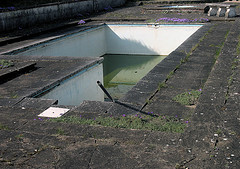 If you’re looking for a way to make some extra income in the coming years, you could always consider turning that swimming pool in your back yard into a miniature subterranean apartment and renting it out to the recently-foreclosed-upon. Mooted as a potential solution to the housing shortage in Sydney, Australia, it strikes me that it might also make great economic sense in other warm countries and regions. [via BLDGBLOG; image by Addictive_Picasso]

 Fruitless Recursion is