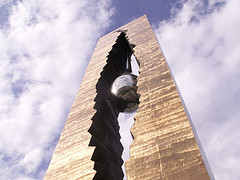
Looking back on 9/11

911-memorialImagine trying to exit a burning building.

Based upon conversations with the WTC survivors, researchers from the Universities of Greenwich, Ulster and Liverpool concluded that more than half of them delayed evacuating because they wanted to gather information about what was happening; those intent on getting more info about the attacks before exiting took between 1.5 and 2.6 times longer to begin evacuating than others; and congestion in stairways was the main cause of delay in getting out, even though the towers were less than one-third occupied that day.

Also: Al-Qaeda HQ has harsh words for AQ in Iraq:

Taken in context, Zawahiri’s latest memos seem to indicate that al-Qaeda’s oft-cited “central front” is a persistent if increasingly difficult management challenge for the movement’s front office.

And some angry leftist observes:

Aside from everything else, 9/11 was the day our mainstream news people promised they’d stop focusing on the trivial.

Oh well.

[Bayonne, NJ 9/11 memorial, Sister72]
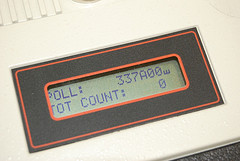
Diebold: Two minutes to vote

opening-countPrivatizing the elections was a great idea, as Black Box Voting reminds us:

Diebold/Premier says [it’s] too late to fix a new voting machine 2-minute warning and “time-out” feature which can kick voters off the machine, forcing them to accept a provisional ballot. “At least 15” voters were booted off the machine in Johnson County, Kansas recently, and Diebold/Premier says this is due to a software “upgrade” which sets a timer on voter inactivity. According to the company, the machines receiving the upgrade are used in 34 states and 1,700 jurisdictions.

The average voter takes 4-9 minutes to cast a ballot, according to studies. [Thanks, Todd]

Meanwhile, in Michigan, members of a certain political party say they will use lists of foreclosed homes to challenge the eligibility of voters.

You have till Oct. 15 to submit your 1,000-word Election Day horror story to Apex.

[Image: Opening Count, hyku]

Very superstitious: why we believe

four_leaved_cloverI’ve always been curious as to why human beings are superstitious, now evolutionary biologists believe it is the result of natural selection. Prof Kevin Foster of Harvard University defines superstition as the tendency to falsely link cause and effect:

…a prehistoric human might associate rustling grass with the approach of a predator and hide. Most of the time, the wind will have caused the sound, but “if a group of lions is coming there’s a huge benefit to not being around,”

So far so plausible:

Foster and Kokko worked with mathematical language and a simple definition for superstition that includes animals and even bacteria.

The pair modelled the situations in which superstition is adaptive. As long as the cost of believing a superstition is less than the cost of missing a real association, superstitious beliefs will be favoured.

I’ve always felt that, even though I agree with a lot of what A C Grayling, Christopher Hitchens and Richard Dawkins say vis a vis belief and superstition they need to give more thought to the possibility that superstitious beliefs are part of the human condition.

[story via Slashdot][image from Greencolander on flickr]

Why near-future science fiction is difficult

Here at Futurismic, our fiction guidelines state that we’re looking for near-future science fiction only. There’s no elitism involved – we just like to have a niche to focus on, one that (we hope) fits with our readers as well as it does with the editorial team.

But there is an argument to the effect that, in some ways, near-future science fiction is more challenging to write well than the out-and-out fabrication of, say, space opera. Few would know that better than Jetse de Vries, who has just finished a four and a half year stint as fiction co-editor for Interzone magazine. De Vries has been doing some thinking-out-loud about the problems of near-future sf from the writer’s perspective:

It’s what makes writing near-future SF such a daunting task, and a kind of catch-22 exercise: if it looks too believable it (most probably) won’t happen; if it looks too implausible it might very well happen.

So if you dive into the world of tomorrow, you need to find a balance between not being too conservative in your predicitions, but also not too ‘off-the-wall’, either. For example, back in 1997 the movie “Wag the Dog” satirised the Clinton/Lewinsky affair by fabricating a war to cover up a presidential sex scandal. Nowadays, one would not only wish it was only a sex scandal they were covering up, but — much more importantly — that the war was ‘fabricated’ instead of real.

[snip]

So what’s a poor SF writer to do? Well, dare to make mistakes, try to ride the fine line between extrapolating too straightforwardly or too crazily, and face complexity.

I hear that: the older I get, the more relevant the old aphorism seems to become – the truth really is stranger than fiction.

How do the writers among you approach plausibility in your near-future science fiction stories?

Presenting the fact and fiction of tomorrow since 2001