If you’re looking for an intelligent contemporary science fiction novel that keeps focused on the near-future, you could do far worse than grab a copy of The Night Sessions, the new book from Ken MacLeod.
There’ll be a review here at Futurismic fairly soon, but in the meantime MacLeod‘s publishers Orbit have a brief blog post where he delivers the “elevator pitch” for The Night Sessions:
The Night Sessions is a crime novel set in 2037. It’s also an SF novel that asks the question: what if we finally got fed up with the influence of religion on politics, education, and law, and decided to drive it out of these areas for good?
Applications for a metamaterial entail altering how light normally behaves. In the case of invisibility cloaks or shields, the material would need to curve light waves completely around the object like a river flowing around a rock. For optical microscopes to discern individual, living viruses or DNA molecules, the resolution of the microscope must be smaller than the wavelength of light
The theory behind negative refraction seems fairly complex – but it’s interesting to imagine what can be done by “altering how light normally behaves” and the possibility of viewing live viruses is also interesting.
BEST SHORT STORY: “Tideline” by Elizabeth Bear (Asimov’s June 2007)
BEST RELATED BOOK: Brave New Words: The Oxford Dictionary of Science Fiction by Jeff Prucher (Oxford University Press)
BEST DRAMATIC PRESENTATION, LONG FORM: Stardust Written by Jane Goldman & Matthew Vaughn; based on the novel by Neil Gaiman; directed by Matthew Vaughn (Paramount Pictures)
BEST DRAMATIC PRESENTATION, SHORT FORM: Doctor Who “Blink”; written by Stephen Moffat; directed by Hettie Macdonald (BBC)
BEST PROFESSIONAL EDITOR, SHORT FORM: Gordon Van Gelder
BEST PROFESSIONAL EDITOR, LONG FORM: David G. Hartwell
BEST PROFESSIONAL ARTIST: Stephan Martiniere
BEST SEMIPROZINE: Locus
BEST FANZINE: File 770 edited by Mike Glyer
BEST FAN WRITER: John Scalzi
BEST FAN ARTIST: Brad Foster
JOHN W. CAMPBELL AWARD FOR BEST NEW WRITER: Mary Robinette Kowal
Very few surprises there, I think it’s safe to say. Ted Chiang’s victory was a given long before the nominations were announced, for example; Van Gelder is a shoo-in based on subscriber figures alone, and likewise Scalzi.
The only vague surprise is Chabon taking the Best Novel – not because it’s an undeserving book, as I’m assured it’s excellent, but because its definition as sf has been such a controversial issue elsewhere.
How would you rewrite this list if you had control of sf fandom for the day?
Presenting the fact and fiction of tomorrow since 2001
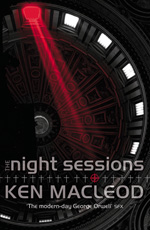 If you’re looking for an intelligent contemporary science fiction novel that keeps focused on the near-future, you could do far worse than grab a copy of The Night Sessions, the new book from Ken MacLeod.
 Via
Via 