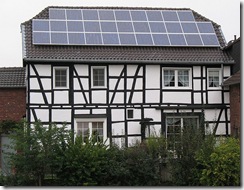
 MIT scientists are touting a “major discovery” that will transfer solar power from a “limited, far-off solution” to “unlimited and soon.” (Via EurekAlert.)
Daniel Nocera, the Henry Dreyfus Professor of Energy at MIT and senior author of a paper describing the work that’s in the July 31 issue of Science, and Matthew Kanan, a postdoctoral fellow his lab, have created a new catalyst that produces oxygen gas from water. When combined with another catalyst that produces hydrogen, their system can duplicate the water-splitting reaction that occurs during photosynthesis. Hydrogen and oxygen produced during the day while the sun is shining can be combined in a fuel cell at night when it’s not, solving the biggest problem with solar power–it doesn’t work when the sun doesn’t shine. Current methods of storing that energy are both too expensive and very inefficient.
Best of all, the new catalyst is made from abundant, non-toxic natural materials: it consists of cobalt metal, phosphate and an electrode, placed in water. When electricity runs through the electrode, the cobalt and phosphate form a thin film on it, and oxygen gas is produced. The catalyst works at room temperature and in neutral pH water, and is easy to set up.
Superlatives are being implemented to describe the discovery:
James Barber, a leader in the study of photosynthesis who was not involved in this research, called the discovery by Nocera and Kanan a “giant leap” toward generating clean, carbon-free energy on a massive scale.
“This is a major discovery with enormous implications for the future prosperity of humankind,” said Barber, the Ernst Chain Professor of Biochemistry at Imperial College London. “The importance of their discovery cannot be overstated since it opens up the door for developing new technologies for energy production thus reducing our dependence for fossil fuels and addressing the global climate change problem.”
Nocera hopes that within 10 years the system will be available to homeowners, allowing them to power their homes during the day with photovoltaic cells and use hydrogen and oxygen produced with the day’s excess energy to power their homes at night.
The net result?
Electricity-by-wire from a central source could be a thing of the past.
(Photo by T
 Straight out of the Greatest Kid’s Franchise of the Century So Far (please enlighten me if there is one greater) we have a transhumanist/human-augmentation project from IBM:
 It’s long been assumed that the complex and mysterious