Bruce Sterling interview: is the shine off steampunk as a literary genre?

Bruce SterlingRegular readers will be aware of my status as a card-carrying fanboy for Commandant Bruce Sterling.

It is in that capacity that I’m very pleased to report that the British Science Fiction Association‘s online media magazine, Matrix, has an interview with Sterling wherein he talks about The Difference Engine, and the steampunk subgenre it arguably spawned:

“My feeling about science fiction is that it ought to expand the scope of things that are possible to think. When Steampunk succeeded it did a little of that. If it’s just costume-drama or a merchandising tag, that’s not the end of the world, but it’s not a pursuit of a lot of use to anybody. Wells

Maybe Neanderthals could speak after all

skullsAnthropologists have long disagreed on the timing of the emergence of language in our hominid ancestors, and the results of recent research may reignite that debate. CT scans of a 530,000-year-old Homo heidelbergensis skull show that its ear canals are sensitive at 2kHz to 4kHz – the same crucial information-rich frequency range that we modern humans are attuned to – suggesting a much earlier emergence of language than commonly accepted. [via SlashDot] [image by Orin Optiglot; no, they’re not Neanderthal skulls]

Of course, like a great deal of anthropological speculation, it’s educated guesswork:

The results don’t necessarily show that the ancient humans could speak, Quam says. “We’re saying that the ear changed for some reason and that those changes facilitated the possibility of language development…”

Researchers have long tried to determine whether Neandertals could speak by reconstructing their vocal tracts, Quam says. But soft tissue makes up most of the voice box, so few traces remain in the fossil record. The ear is a better candidate because the bony structure reveals more about hearing capacity.

Couple this with the recent discovery that Neanderthals also had a gene which governs the development of language and is only found in modern humans, and we start to get a picture of our distant ancestors that differs considerably from the grunting caveman stereotype.

Where to put the carbon…

Aside from nuclear power, one of the most enticing possibilities for solving problems of energy security, peak gas, and global warming is carbon sequestration.
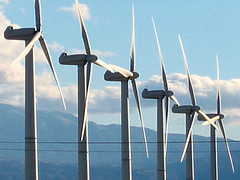
windfarmBy burning cheap and widely available coal but storing the resultant carbon dioxide rather than venting it into the atmosphere means you (theoretically) have a cheap and low-carbon energy source.

The main issue is finding a place to stick all that carbon dioxide. Dave Goldberg of the Lamont-Doherty Earth Observatory claims there is a vast area off the east west coast of Oregon under the Juan de Fuga Fuca tectonic plate which addresses many of the safety issues of carbon sequestration:

“We have insurance upon insurance upon insurance,” he said.

First, the center of the proposed location is about 100 miles off the coast, obviously far away from human settlement. Second, the impermeable sediment cap on the permeable basalt reservoir is hundreds of feet thick, creating an effective seal for the compressed CO2. Third, when CO2 mixes with water inside the basalt, over time it turns into a variety of carbonates, which are, essentially, chalk. Fourth, if there were an unforeseen leak, in deep water, CO2 forms into icy hydrates in the water, preventing it from floating up to the surface.

As to the UK: what about using the recently emptied North Sea oil wells as a carbon sink?

It is becoming clear that if we are to create a genuinely zero-carbon (or even low-carbon) economy we are going to have to embrace nuclear power and carbon sequestration, as suggested in Plan D of David David J. C. Mackay’s excellent (but unfinished) free ebook Substainable Energy – Without the Hot Air. The evidence is mounting that wind power, solar thermal, and photovoltaics don’t work well enough.

[story from Wired][image from Scott Ableman on flickr]

Urban redevelopment: building demolition, Tokyo style

OK, so it’s not quite so dramatic as the old-fashioned controlled explosion method, but it’s infinitely more elegant and high-tech: check out this amazing time-lapse video of the Kajima Corporation’s new method of demolishing obsolete buildings in crowded Tokyo:

According to Pink Tentacle:

Unlike conventional demolition that begins at the top of the building, Kajima

Martian chronicle: Working the interplanetary night shift

MarsThink your schedule is crazy? Spare a thought for the 150 Phoenix Mars lander scientists:

“Living on a Martian day is like traveling two time zones every three days over and over,” said [Laura] Barger, who is an instructor of medicine in Harvard’s Division of Sleep Medicine. “Everyone has a circadian clock. . . . When it isn’t able to synchronize with a Martian day, you get sleep disorders, decreased alertness and decremented performance.”

NASA is experimenting with soft-light boxes and an adjusted sleep schedule to help the Mars explorers stay alert. And it’s funding the two-year, $350,000 Harvard study in the hopes that results might help doctors, police, firefighers, and other earthlings who work skewed shifts.

[Mars image: jasonb42882]

Presenting the fact and fiction of tomorrow since 2001